

A workflow governance framework is essential for enterprises that want to scale automation without losing control, visibility, or compliance. As organizations automate more business processes, governance becomes critical for maintaining consistency and accountability across workflows.
Many organizations focus heavily on building automated workflows but spend far less time defining how those workflows should be governed. Initially, this may not seem like a problem. A few successful automations can improve efficiency and reduce manual work almost immediately. However, as automation expands across departments, the lack of structure often begins to create new operational challenges.
Workflows become inconsistent. Ownership becomes unclear. Approval processes vary between teams. Compliance requirements are overlooked. Leadership struggles to understand which workflows are delivering value and which are creating bottlenecks. This is where a workflow governance framework becomes essential.
What Is Workflow Governance?
Workflow governance is the process of establishing policies, ownership, standards, and oversight mechanisms that ensure automated workflows remain compliant, consistent, and aligned with business objectives.
A strong governance approach typically addresses:
- Workflow ownership
- Design standards
- Change management
- Security controls
- Compliance requirements
- Performance monitoring
- Continuous improvement
In simple terms, governance answers an important question:
How can organizations scale automation while maintaining consistency, accountability, and control?
Without governance, automation efforts often become fragmented as different teams build workflows independently using different standards and practices.
What Happens When Automation Scales Without Governance?
Automation can solve many operational challenges, but scaling it without proper oversight often creates new problems.
Most enterprises start small. One department automates an approval process. Another digitizes a request workflow. A third team introduces automation to streamline compliance activities.
Each initiative delivers value individually.
The challenge begins when these isolated efforts expand across the organization.
Without a clear workflow governance strategy, organizations often experience:
Process Inconsistency
Teams may create workflows using different naming conventions, approval structures, and business rules.
This inconsistency makes workflows harder to manage and understand.
Duplicate Automation Efforts
Multiple departments may unknowingly automate the same process in different ways.
This creates unnecessary complexity and wastes resources.
Limited Visibility
Leadership teams may struggle to answer questions such as:
- Which workflows exist?
- Who owns them?
- How are they performing?
- Where are bottlenecks occurring?
Compliance Risks
As workflows handle more sensitive information, governance gaps can expose organizations to regulatory and security risks.
Change Management Challenges
Workflow changes made without proper oversight can disrupt operations and create unexpected downstream effects.
These challenges demonstrate why governance should be viewed as a business necessity rather than an administrative exercise.
5 Warning Signs Your Automation Program Needs Better Oversight
Many organizations don’t realize governance is missing until problems become visible.
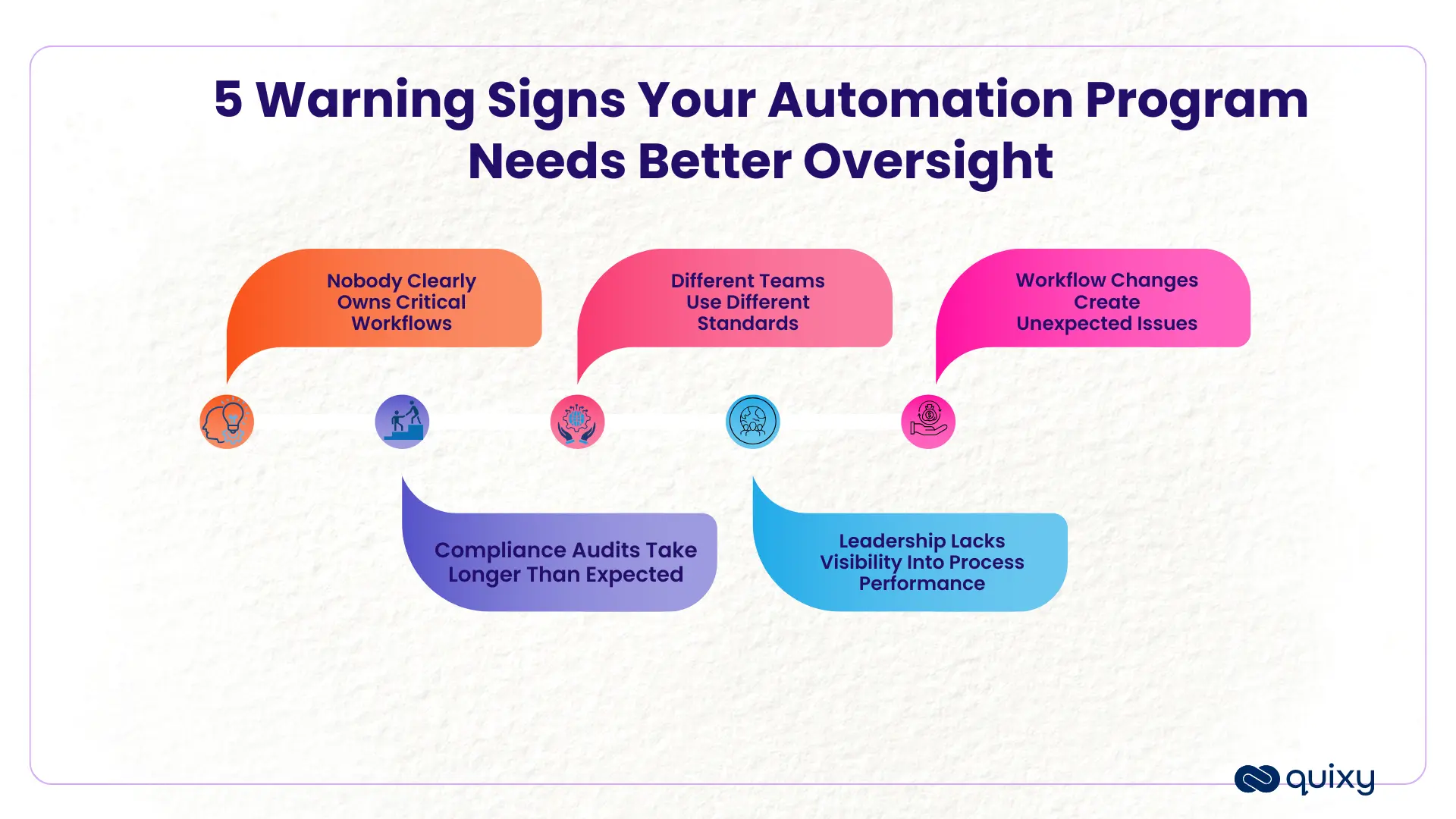
Here are five common warning signs.
1. Nobody Clearly Owns Critical Workflows
When ownership is unclear, workflows often become outdated or misaligned with business needs.
Every workflow should have a designated owner responsible for maintenance, performance, and continuous improvement.
2. Different Teams Use Different Standards
If similar processes operate differently across departments, governance gaps likely exist.
Standardization improves consistency and reduces confusion.
3. Workflow Changes Create Unexpected Issues
Organizations without formal change management processes often experience disruptions when workflows are modified.
4. Compliance Audits Take Longer Than Expected
Difficulty locating documentation, approvals, or audit trails often signals weak governance practices.
5. Leadership Lacks Visibility Into Process Performance
If decision-makers cannot easily identify workflow performance metrics, governance improvements may be necessary.
Core Elements of an Effective Automation Governance Model
An effective automation governance framework consists of several interconnected components.
Governance Structure
Governance starts with accountability.
Organizations should clearly define roles and responsibilities for:
- Workflow owners
- Business stakeholders
- Compliance teams
- IT teams
- Governance committees
Clear accountability reduces confusion and improves decision-making.
Workflow Standards
Standardization creates consistency across teams.
Organizations should establish standards related to:
- Workflow design
- Naming conventions
- Documentation requirements
- Approval structures
- User permissions
These standards make workflows easier to manage and maintain.
Change Management
Business requirements evolve continuously.
A structured process should exist for:
- Requesting changes
- Reviewing impact
- Testing updates
- Approving modifications
- Deploying changes
Effective change management reduces risk while supporting innovation.
Security and Compliance Controls
A mature process governance framework integrates compliance into workflow design rather than treating it as an afterthought.
Controls may include:
- Audit trails
- Access permissions
- Data protection policies
- Regulatory requirements
- Risk management procedures
Performance Monitoring
Organizations cannot improve what they do not measure.
Governance should include metrics that evaluate:
- Process completion times
- Approval turnaround times
- Workflow adoption
- Error rates
- Compliance performance
These insights support data-driven improvement efforts.
Tracking adoption, efficiency, and outcomes is a key component of building a successful workflow automation system.https://quixy.com/blog/benefits-of-workflow-automation-system/
Workflow Governance vs Workflow Management
Although these concepts are related, they serve different purposes.
| Workflow Governance | Workflow Management |
| Establishes standards and policies | Executes workflows |
| Defines accountability | Manages day-to-day activities |
| Focuses on oversight | Focuses on execution |
| Supports compliance and risk management | Supports operational efficiency |
| Enables scalability | Enables productivity |
Governance determines how workflows should operate. Management ensures those workflows run effectively.
Organizations need both to achieve sustainable automation success.
How to Establish Governance Across Enterprise Workflows
Many leaders understand the importance of governance but struggle with implementation.
If you’re wondering how to establish workflow governance, a phased approach is often the most effective.
Assess Existing Workflows
Begin by identifying:
- Current workflows
- Workflow owners
- Existing standards
- Governance gaps
This assessment creates a baseline for improvement.
Define Governance Objectives
Establish clear goals.
Common objectives include:
- Improving consistency
- Strengthening compliance
- Increasing visibility
- Supporting scalability
- Reducing operational risk
Develop Governance Policies
Policies should address:
- Workflow design requirements
- Security standards
- Documentation expectations
- Approval controls
- Performance measurement
Assign Ownership
Every workflow should have a designated owner responsible for governance and performance.
Implement Review Processes
Regular reviews help ensure workflows remain aligned with business objectives.
Continuously Improve
Governance should evolve alongside business needs.
Organizations that review governance regularly are better positioned to support long-term growth.
Workflow Governance Best Practices for Enterprises
Successful organizations share several common governance practices.
Start With High-Impact Processes
Focus governance efforts on business-critical workflows before expanding coverage.
Balance Control and Flexibility
Governance should provide guidance without slowing innovation.
The goal is to create guardrails, not bureaucracy.
Encourage Cross-Functional Collaboration
Effective governance requires input from operations, IT, compliance, and business teams.
Create Reusable Standards
Templates and best practices improve consistency while reducing implementation effort.
Measure Outcomes
Governance should be evaluated using measurable outcomes rather than assumptions.
These are among the most effective workflow governance best practices for enterprises.
Managing Compliance, Risk, and Accountability
As automation expands, compliance and risk management become increasingly important.
A mature governance approach helps organizations:
- Maintain audit readiness
- Enforce policy compliance
- Improve accountability
- Reduce operational risk
- Strengthen data security
This is particularly important in highly regulated industries where governance failures can have significant consequences.
Strong enterprise automation governance helps organizations balance operational efficiency with compliance obligations.
How Large Enterprises Maintain Visibility Across Automated Processes
Visibility is one of the most valuable outcomes of governance.
Organizations with strong governance practices typically have a clear understanding of:
- Workflow performance
- Process ownership
- Operational bottlenecks
- Compliance status
- Improvement opportunities
Effective workflow governance in large organizations often relies on centralized reporting, standardized policies, and continuous monitoring.
This visibility enables leadership teams to make better decisions and identify opportunities for optimization.
Conclusion
As organizations continue to automate more business processes, maintaining control becomes just as important as driving efficiency. Without clear oversight, automation initiatives can create inconsistency, complexity, and risk that ultimately undermine their value.
A well-designed workflow governance system provides the structure needed to scale automation responsibly. By establishing ownership, standardizing processes, implementing controls, and monitoring performance, organizations can build a sustainable foundation for long-term automation success.
As emerging AI workflow automation capabilities become more common, governance frameworks will play an even greater role in ensuring automation remains secure, compliant, and aligned with business goals.
The most successful enterprises understand that governance is not about limiting innovation. Instead, it creates the clarity, accountability, and visibility needed to ensure automation continues delivering value as the organization grows.
Frequently Asked Questions
What is a workflow governance framework?
A workflow governance framework is a structured approach that defines standards, policies, ownership, and controls for managing workflows across an organization.
Why is workflow governance important?
Workflow governance helps organizations maintain consistency, accountability, compliance, and visibility as automation initiatives scale.
What are the benefits of workflow governance?
Benefits include improved process consistency, stronger compliance, better visibility, reduced risk, and greater scalability.
How does governance support automation initiatives?
Governance provides the oversight needed to ensure automation remains aligned with business objectives while minimizing operational risks.
What is enterprise automation governance?
Enterprise automation governance refers to the policies, controls, and accountability structures used to manage automation initiatives across an organization.


Recent Posts




- Download the App