

No-code tools for marketing teams are platforms that let marketers build campaigns, automate workflows, manage leads, and publish content without writing code or waiting for developer support. In 2026, the best marketing teams run on a stack of no-code tools covering CRM, email automation, content creation, landing pages, analytics, and internal workflow management. This guide covers the complete no-code martech stack organised by function, with specific recommendations for each category and a featured section on using Quixy to automate the internal marketing workflows that keep campaigns stuck in approval queues.
Easy-to-use marketing tools without coding complexities have made complicated tasks simpler. All marketing efforts can be streamlined and aligned with the organisation’s goals. There are plenty of excellent tools in the market and researching the one that fits your requirements is the key challenge. Start with current solution analysis and requirements.
Marketing allows you to share your products and services with your target audience strategically. As a strategy, it is important for your business to generate more leads, boost sales, build revenue, make decisions, and build a reputation for your brand. Many companies employ digital tools including no-code marketing tools to enable workflow automation and drive digital transformation.
Useful marketing apps that you must have in you Martech stack!
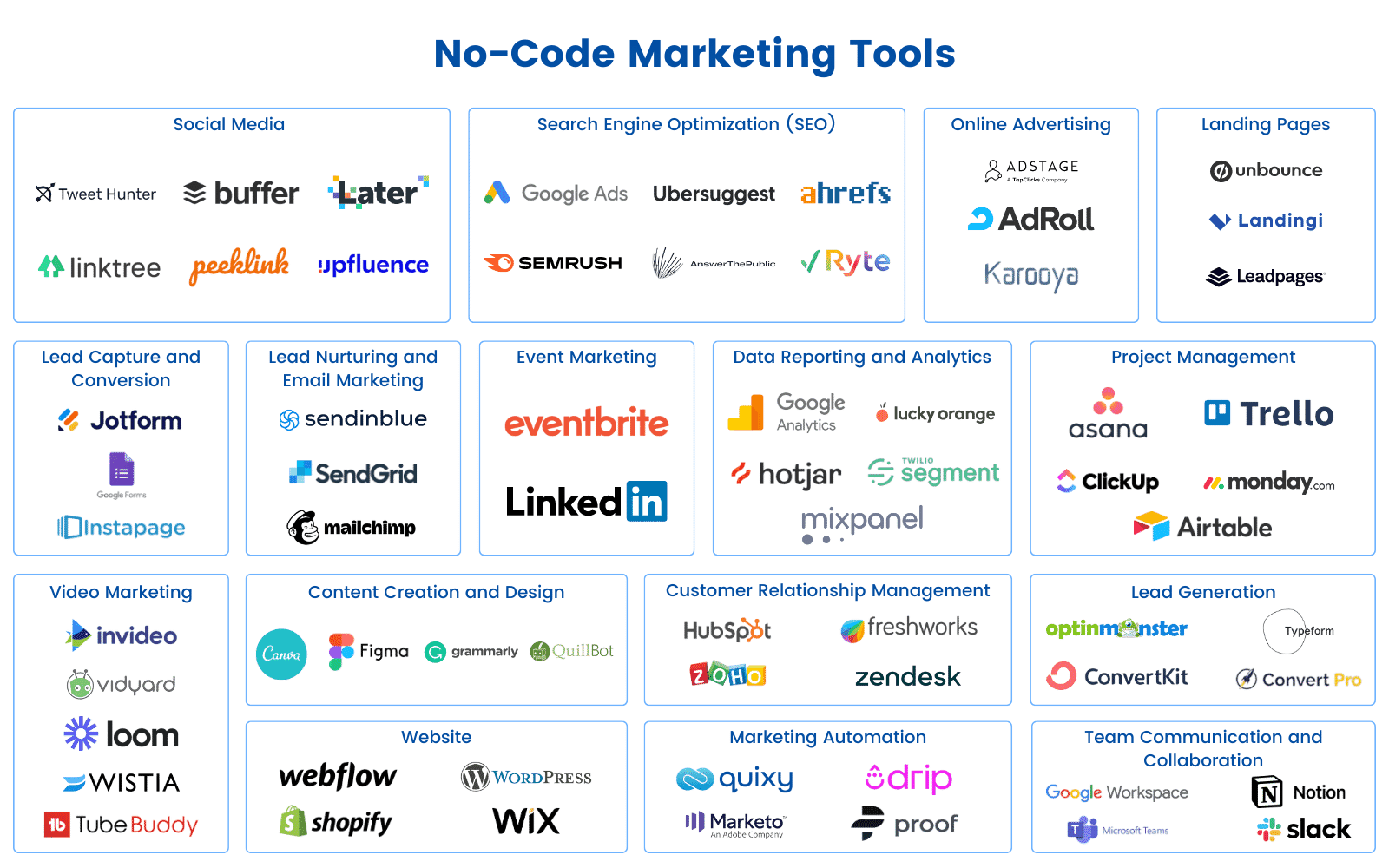
You take care of requirements analysis and we will help find what you need. Here’s a list of tools, divided into essential marketing categories, including various marketing apps that do not require you to code to achieve your goal.
Customer Relationship Management (CRM)
CRM is a mechanism used by businesses to analyze customer interactions and nurture their relationships with customers.
Hubspot
This inbound marketing, sales, service as well as website building (HubSpot CMS) software gives marketers all they require to convert leads, increase website traffic and put all marketing support tools, that share data, in one place.
Freshworks
Freshworks is a unifying software in our stack that aligns the marketing team with the sales team. It provides the combined power of CRM and automation to ascertain customer needs and make marketing interactions better.
Zoho
Zoho offers a list of apps that are designed to effectively cover all areas of businesses. Zoho Creator enables you to build no-code marketing apps as well as other essential apps. It helps you convert leads and manages all your marketing-related activities in one place across numerous channels.
Zendesk
Zendesk is an excellent service tool that enables you to provide a superior customer experience. Its dedicated and highly intuitive service and sales platform enable you to close deals faster.
Also Read: Top 47 No-Code and other Sales Tools to boost Productivity, Efficiency, and Revenue
Online Advertising
Online advertising involves the use of the internet for the promotion of products and services through marketing messages.
AdStage
AdStage is a cloud-based solution that automates across networks and enables marketers to analyze, optimize and report the performance of ads, by bringing all advertising data under one umbrella.
AdRoll
AdRoll is a performance marketing platform that helps marketers reach their audience across the web and convert them into customers.
Karooya
Karooya, is a no-code marketing tool that enables you to optimize your PPC. It enables you to create your expanded ad copy for Google ads and Bing ads and check the preview for the same.
Social Media
Social media is an online form of communication that can be used to build a network and reach a larger audience through strategic planning.
Tweethunter
It is a Twitter growth tool that requires no coding to grow your audience 10x faster by writing better tweets, scheduling, automating, and engaging with people.
Buffer
This software is a multi-purpose social media marketing app that is used to draft posts and schedule them to share across social networks.
Later
Schedule posts across social media platforms and streamline your social media marketing strategy with this social media management platform.
Linktree
Optimize social media traffic by clubbing links to various platforms in a single link with this free tool.
Peeklink
Another free tool that creates “cards” which are essentially links on social media that expand into previews for any site.
Upfluence
This influencer marketing platform gives you tools to build and maintain meaningful partnerships with creators who influence customers’ purchase decisions and therefore, drive revenue.
Search Engine Optimization (SEO)
SEO involves increasing the quantity and improving the quality of website traffic to a web page on search engines. It aids marketing by ascertaining target audiences based on frequently used or similar keywords.
Google Keyword Planner
A free marketing tool that enables keyword research for your search campaigns so that intelligent and targeted marketing can be carried out by your business.
Ubersuggest
Generate ideas for keywords, keep improving and expanding your marketing strategy with this free online tool.
Ahrefs
Make decisions based on strategy with access to in-depth and thorough data and marketing opportunities with this SEO tool.
Semrush
Discover marketing-related insights and improve visibility online with this tool suite that includes services like keyword research, PR, campaign management, SMM, PPC, SEO, PR, content marketing.
AnswerThePublic
This keyword tool is extremely useful in creating relevant and fresh content by gauging search questions and autocomplete data from search engines and mapping out all the useful and key questions related to your keyword.
Ryte
Ryte is an ideal tool for marketers to ensure that their SEO efforts are actually making an impact. They can check and track which keyword to rank for and plan a strategy that meets its goal.
Also Read: No-code for Business Marketing Solutions
Content Creation and Design
Content creation and design are creations that audiences consume in a visual, written, or audio format, that aid in building roadmaps for your marketing activities.
Canva
Canva is a design platform that enables the creation of a variety of graphics for your business. It includes templates for social media images, web banners, marketing brochures, business cards, presentations, and more.
Figma
A powerful design tool that marketers can use for rapid prototyping, design iterations, revision cycles, building a visual identity for the brand, a brand story, or even simply collaborating and brainstorming.
Grammarly
Content marketers use Grammarly, a cloud-based AI using writing assistant, to ensure their writings are of high quality and polished in such a way so as to reflect favorably on their business.
Quillbot
Marketers can use, this tool for paraphrasing and summarizing to rewrite any sentence, and hence, repurpose marketing content.

Video Marketing
Video marketing involves the usage of videos for promoting products or services. It helps marketing through building engagement on digital and social channels.
InVideo
A powerful video editor that marketers can use to converts articles into marketing videos that are informative and engaging.
Vidyard
An easy-to-use video creation tool used for virtual selling and video marketing.
Loom
Loom is a video messaging tool that impacts the customer’s journey with informative marketing videos about products and their features.
Wistia
A video hosting platform for B2B marketers that uses video on their websites to serve companies in their marketing, sales, and support.
Tubebuddy
A Chrome extension that streamlines video marketing offers enhanced analytics, and aids video SEO.
Landing Pages
In digital marketing, a landing page is essentially the single web page that shows up when you click on a website that encourages taking actions such as buying decisions.
Unbounce
This drag-and-drop builder allows the easy and quick creation and publishing of landing pages.
Landingi
A drag-and-drop builder that easily and quickly simplifies complicated landing page software and development, by letting you create and launch unlimited campaigns.
Leadpages
Collect email subscribers and grow your email list by getting access to templates you can use for webinars, lead magnets, and landing pages with the help of this online tool.
Event Marketing
Event marketing involves product, service, or brand promotion by participating in, organizing, or attending events.
Eventbrite
Lock down your social media strategy and engage in email marketing with this platform for selling event tickets online.
LinkedIn Events
Host virtual events and invite your connections with this feature on LinkedIn.
Lead Capture and Conversion
Lead capture and conversion is that part of your business’ inbound marketing strategy that refers to when visitors are converted into leads on your website.
Jotform
Jotform uses a drag-and-drop builder to allow the creation of custom online forms. Its free marketing app integrations enable the automatic addition of contacts and subscribers to your email lists.
Google Forms
Marketers use this app that needs no-coding to obtain insights of customers, which is important to implement customer feedback and consequently grow and develop your business.
Instapage
This service allows the building of landing pages for easy promotion of campaigns and online marketing.
Lead Generation
Lead generation in digital marketing is the process of identifying and transforming online users into prospective customers for the business.
OptinMonster
This lead generation software is used by online marketers to convert website visitors and traffic into subscribers, grow email lists and increase sales.
Typeform
Typeform allows the smooth creation of user-friendly forms for lead collection, feedback, surveys for customer satisfaction, and more.
Convertkit
This creator marketing platform collects subscribers and promotes projects with sign-up forms, landing pages, and link pages.
Convertpro
This is not only a lead generation tool but also one of the marketing apps that need no-coding, which is used by online marketers to increase conversions on their websites.
Website
The promotion of a website is essentially what website marketing entails.
Webflow
This SaaS application and marketing platform need no coding to build responsive marketing websites with visual editing software based on the browser.
WordPress
With content marketing at its core, this content management system is an extremely powerful tool that lets you build and host websites.
Shopify
Create, manage and track your marketing campaigns with the powerful no-code marketing tool provided by this e-commerce platform that hosts your online store.
Wix
This provider of a drag-and-drop HTML5 website builder, with customizable website templates. It markets your product tracks views, clicks, and statistics on email opens, thereby letting you know how your business performs
Lead Nurturing and Email Marketing
Lead nurturing goes hand in hand with email marketing with automated, personalized emails sent to your clientele to reinforce buyer relationships.
SendInBlue
Enable email marketing campaign automation, even if your budget is limited with this email marketing solution for small and medium-sized businesses.
SendGrid
This cloud-based email marketing software aids in creating, delivering, and analyzing email marketing campaigns.
Mailchimp
This all-in-one marketing platform enables better communication with and management of your clients through segmentation and targeted personalized emails to have greater engagement. Build meaningful relationships and increase ROI.
Marketing Automation
Marketing automation refers to the process of automating monotonous or repetitive marketing work.
Drip
Drip uses SMS, email, and third-party integrations to increase business revenue with this marketing automation platform built for e-commerce.
Marketo
One of the leaders in marketing automation as well as efficient marketing tool, this SaaS tool platform aids businesses in assessing and automating their marketing tasks.
Proof
Increase conversions of website visitors by personalizing your website using this tool.
Marketing workflow automation
This is the most underserved category in most marketing team tech stacks. Customer-facing automation like email sequences and lead nurturing is well-handled by HubSpot, Marketo, and similar tools. What is almost never automated is the internal marketing operations layer: the processes that keep campaigns stuck in approval queues.
The key distinction: Marketing automation tools automate what you say to customers. Workflow automation platforms automate how your team operates internally. Both are essential. Almost every marketing team has the first. Very few have automated the second.
Featured tool for internal marketing workflow automation
Quixy
Quixy is a powerful no-code platform for building marketing content management and publishing workflows, and automating operations across your marketing department. Unlike HubSpot or Marketo, which automate customer-facing workflows, Quixy automates internal marketing operations: how your team requests, reviews, approves, and coordinates campaigns from the inside.
Marketing teams using Quixy build applications for their specific processes without involving IT. A campaign brief submitted by a junior marketer automatically routes to the brand manager for creative review, then to legal for compliance sign-off, then to the budget owner for final approval. Everything is tracked, timestamped, and auditable. No email thread. No spreadsheet tracker. No missed approvals.
What marketing teams build in Quixy:
- Campaign request and intake workflow with standardised brief capture and automatic routing based on campaign type, budget, and channel.
- Multi-stage content approval processes, where content moves from draft to brand review to legal check to final sign-off, with SLA tracking and escalation.
- Event management coordination covering pre-event logistics, vendor coordination, attendee registration, and post-event feedback in one application.
- Agency brief and scope management, where all parties see the same status in real time: brief issued, deliverables tracked, feedback documented, approval closed.
- Marketing budget approval from spend request to budget owner approval to finance notification and PO generation, automated end-to-end.
Quixy customers in marketing operations have reported cutting campaign launch time significantly after automating their brief intake and approval process. Teams that previously managed approvals through email threads were live on Quixy within three to five days with no IT involvement.
Data Reporting and Analytics
Data reporting involves presenting information in a concise and digestible manner. Analytics are essential information and data converted into insights.
Google Anlaytics
Marketers use Google Analytics to get an insight into the impact on customers by marketing campaigns and how conversions and retentions impact a site’s user experience.
Lucky Orange
A martech tool that has features for marketers such as heat maps, polls, form analytics, visitor recordings, live chat, and more.
Hotjar
An excellent tool you must add in your martech stack to analyze user behaviour.
Segment
Segment is a tool that unifies customer data in real-time for marketing teams
Mixpanel
Get in-depth, real-time insights into your product interactions and build accurate reports to assist your team with this data-reporting and analytics marketing tool.
Team Communication and Collaboration
Team communication and collaboration is a method of project management that encourages innovative thought, teamwork, and the achievement of unified objectives.
Google Workspace
Google Workspace is a productivity suite of business tools, based on the cloud, that enables work to be done at any place on any device.
Notion
Notion is a digital workspace used for note-taking, management of data, knowledge, task, and projects that are used for marketing and sales as well as other areas.
Teams
This Microsoft product is a collaboration app built for teams to stay organized, informed, and connected in one place.
Slack
This easy-to-use and reliable messaging app is used by businesses to bring people together, communicate, stay informed and organized and work as a team.
Project Management
Project management for marketing involves building a framework within which marketing projects are delivered.
Asana
This dashboard for workplace management helps marketing teams streamline communication, and scale and automate processes across the company.
Trello
This collaboration tool, which has no-code features, allows you to collaborate, assign work, manage deadlines, and visually track progress across marketing initiatives with its Kanban and list views.
Monday.com
An all-in-one place Work Operating System (Work OS) that lets you plan, organize and track your marketing workflows efficiently and enables your marketing team to run projects confidently.
Airtable
This relational database, online collaboration tool, and one of our no-code marketing apps enable marketing teams to drive business growth through the management, organization, and tracking of inventories, event planning, streamlining of content, and campaign workflows.
ClickUp
ClickUp is a marketing project management software that allows the creation of rich-text Docs for your marketing reports, plans, and strategies.
How to automate using no-code marketing tools
The no-code tools in your stack make the marketing team function better with more efficiency since they allow the automation of workflows without involving the tech team or any coding. This removes repetition and human error and saves time, making processes more efficient.
Workflow automation and the use of digital workspaces have become standard in the era of citizen development. For the digital transformation of businesses, it has become essential to engage in Digital Process Automation (DPA), Business Process Automation (BPA), and Business Process Management (BPM).
Automation using no-code marketing tools enables the creation and efficient execution of marketing strategies and campaigns. The highest-impact automation for most marketing teams is internal, not customer-facing. Here is how to build your no-code martech stack in the right order:
Add internal workflow automation. Once the customer-facing stack is operational, audit your internal processes. Campaign requests, content approvals, event logistics, and budget sign-off that still run on email and spreadsheets need Quixy.
Start with a CRM as your data foundation. Every other tool should feed to and from your CRM. Choose CRM first, then evaluate all other tools by how well they integrate with it.
Add email and lead nurturing. If your CRM has strong email built in, you may not need a separate tool. If not, add a dedicated email platform with bidirectional CRM sync.
Add a landing page builder for campaign capture. A dedicated landing page builder lets you launch, test, and optimise campaign pages independently of the main website.
Add content and design tools. Canva for general team asset creation and Figma for brand-level design work.
Add analytics. Google Analytics 4 is the required baseline. Add Hotjar for behavioural insights on landing pages and campaign destinations.
Conclusion
There is no single no-code tool that does everything a marketing team needs. The teams that move fastest in 2026 are not the ones with the most tools. They are the ones with the right tools connected in the right order.
A CRM that captures every lead. An email platform that nurtures them. A landing page builder that converts them. Analytics that tell you what is working. And underneath all of it, a workflow automation platform that keeps your internal operations from becoming the bottleneck.
That last layer is where most marketing teams are still losing time. Campaign briefs stuck waiting for approval. Content held up in email threads. Event logistics scattered across spreadsheets. Budget requests chasing signatures. None of this requires a developer to fix. It requires the right no-code platform and the willingness to automate the internal operations that are slowing campaigns down.
No-code marketing tools have made it possible for any team, regardless of technical background, to build the stack they need and the internal processes to support it. The barrier is no longer technical. It is knowing where to start.
Start with your CRM. Build outward from there. And when you are ready to automate the internal layer that your other tools cannot touch, that is where Quixy fits.
Frequently Asked Questions(FAQs)
Q. What are the best no-code tools for marketing teams in 2026?
The best no-code tools depend on the function. For CRM: HubSpot and Freshworks. For internal marketing workflow automation: Quixy. For content and design: Canva and Figma. For email: Mailchimp and Brevo. For landing pages: Unbounce and Leadpages. For analytics: Google Analytics and Hotjar. For SEO: Semrush and Ahrefs. Most marketing teams need 6 to 8 tools across these categories operating as an integrated stack.
Q. What is the best no-code CRM for marketing teams?
For marketing teams wanting a no-code CRM, HubSpot leads with its visual workflow builder, AI analytics, and free CRM tier. Freshworks is strong for sales-marketing alignment. For teams that want a custom CRM built to their exact process without off-the-shelf limitations, Quixy lets marketing teams build a custom CRM workflow application without coding.
Q. Can marketing teams use no-code tools to automate their workflows?
Yes. Marketing teams use no-code workflow automation platforms like Quixy to automate campaign request intake, content review and approval, event management coordination, agency brief management, and marketing budget approval. These internal process automations free marketing teams from email-based approvals and spreadsheet tracking without any IT involvement.
Q. What is the difference between marketing automation tools and no-code marketing platforms?
Marketing automation tools like HubSpot and Marketo automate customer-facing campaigns such as email sequences, lead nurturing, and ad targeting. No-code platforms like Quixy automate internal marketing operations including campaign request workflows, budget approvals, agency brief management, and content approval chains. Most marketing teams need both: automation tools for customer engagement and a workflow platform for internal operations.
Q. Which no-code tool is best for marketing workflow automation?
For internal marketing workflow automation covering campaign requests, content approvals, event management, and budget sign-off, Quixy is the strongest enterprise choice. It lets marketing teams build custom approval workflows and operational dashboards without coding or IT involvement. For connecting marketing SaaS tools across platforms, Zapier or Make are the standard connector tools.
Q. How do I build a no-code martech stack from scratch?
Build in layers: start with a CRM as your data foundation, add email and lead nurturing, add a landing page builder, add content and design tools, add analytics, and finally add internal workflow automation for marketing operations. Prioritise integration between each layer so data flows automatically. For internal marketing operations where most teams are still running on email and spreadsheets, Quixy is the missing layer.
Related Post



Please login to comment
0 Comments
Oldest
Recent Posts






- Download the App