
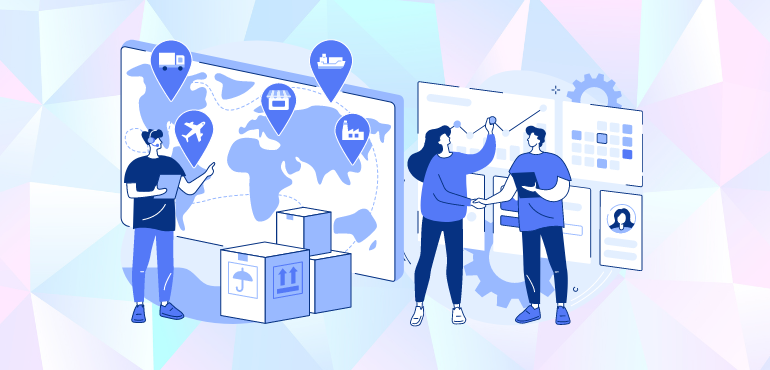
Inventory Management Software System 101 : The Key to Supply Chain Success
Reading Time: 7 minutesRunning a business without the right inventory controls is like driving without a dashboard — you won’t know something’s wrong until it’s already a problem. Stockouts frustrate customers. Overstocking locks up cash. Manual spreadsheets create errors that snowball into bigger issues. That’s where an inventory management software system changes the game. It gives business owners

20 Global Tech Events in 2026 That CIOs, CEOs & CTOs Can’t Miss
Reading Time: 12 minutesSomething feels different the moment you walk into tech events in 2026 Not the format. Not the scale, but the conversations. You do not hear, “This is what’s coming.” You hear the phrase “this is what’s already working.” That shift is small, but it has far-reaching consequences. A few years ago, events were centered on possibility. Big ideas, daring predictions,

Future of Work: 7 Powerful Trends Shaping Your Organization in 2026
Reading Time: 14 minutesWe are not watching the future of work arrive from a distance. It has already moved into the building, set up a desk, and started rewriting the org chart. The question is no longer whether work will change — it already has. The question is whether your organisation will shape that change or be shaped

WFH Meaning: Full Form, Definition & 8 Proven Benefits of Working From Home
Reading Time: 12 minutesWFH is one of the most searched workplace terms across India and globally — and one of the most misunderstood. You’ve seen it in email subject lines, job listings, Slack statuses, and HR policies. But what exactly does WFH mean, and what does it mean for you as an employee or a business leader in

Collaborative Work Management: Strategy, Tools & Framework
Reading Time: 9 minutesKnowledge workers switch between an average of 10 applications per day. Two-thirds switch between different apps every working hour. Companies run an average of 106 SaaS tools simultaneously (McKinsey). The result: work fragments, context gets lost, and the overhead of coordination starts to rival the work itself. Collaborative work management exists to solve this. Not

Employee Management App: 10 Must-Have Features for Better HR Efficiency
Reading Time: 11 minutesManaging employees has always involved a mountain of administrative work: tracking attendance, managing leave requests, running performance cycles, coordinating onboarding, and maintaining compliance documentation. For most organizations, this work happens across a combination of spreadsheets, email, forms, and disconnected systems — which means it happens slowly, inconsistently, and with a high risk of error. An

Remote Workforce Management: Smart Strategies for Scaling Remote Teams Successfully
Reading Time: 12 minutesManaging a remote workforce is not a scaled-up version of managing people in an office. The visual cues are gone. Informal hallway conversations disappear. Assumptions about “who’s working” become unreliable. The managers who thrive in distributed environments don’t replicate the office remotely — they build entirely new operating systems for their teams. This guide gives

Fundamentals of Business Process Optimization 360° : Unlocking Efficiency & Growth
Reading Time: 6 minutesBusiness Process Optimization (BPO) fundamentals begin with understanding how work actually flows inside an organization—not just how it should work. At its core, Business Process Optimization is the discipline of improving how tasks, decisions, and workflows move from start to finish. But before businesses can optimize anything, they need to understand the structure, logic, and

Top 12 Workflow Automation Software for Enterprises (2026 Guide)
Reading Time: 12 minutesDid you know? Over 80% of businesses are planning to boost their spending on automation technologies in the near future. But what is workflow automation software? It’s a tool that automates manual, repetitive tasks and streamlines business processes—eliminating bottlenecks and inefficiencies. That’s why businesses rely on it to boost productivity. But a customized workflow automation

Business Process Optimization (BPO): Definition, Benefits & Proven Techniques
Reading Time: 8 minutesBusiness Process Optimization (BPO) is the practice of analyzing and improving business processes to make them more efficient, cost-effective, and scalable. It helps organizations eliminate inefficiencies, streamline workflows, reduce operational costs, and improve overall performance. Every organization runs on processes whether they are defined or not. From onboarding employees to processing invoices or managing customer
Recent Posts



- Download the App