
Employee training management software (TMS) is a digital platform that manages the complete training lifecycle — from capturing training requirements and scheduling programmes to tracking attendance, collecting feedback, measuring effectiveness, and generating compliance reports — in one centralised system, without manual coordination at each stage.
A Deloitte survey of young professionals found that the “opportunity to learn” was one of an employer’s most desirable benefits — ranking alongside compensation and flexibility for talent retention. Training is no longer a compliance checkbox. It is a competitive advantage and a retention strategy.
But the operational reality of running training programmes at enterprise scale is brutal. Spreadsheets for scheduling. Email chains for nominations. Paper sign-in sheets for attendance. Manual compilation of completion rates before every compliance audit. Separate feedback forms nobody ever reviews. The gap between “we have a training programme” and “every relevant employee actually received it and we can prove it” is wider than most organisations realise — until an auditor asks for evidence.
Employee training management software closes that gap. Not by replacing learning — but by making the infrastructure behind learning reliable, visible, and automatic.
94% of employees say they would stay longer at a company that invests in their learning and development — that investment only pays off when the training infrastructure actually works reliably at scale.
Source: LinkedIn Workplace Learning Report, 2025
218% higher income per employee reported by companies with comprehensive, structured employee training programmes compared to those without formalised training.
Source: Association for Talent Development
75% faster time to produce compliance training evidence when using automated training management — compared to 1–2 weeks required with manual documentation processes.
Source: IBM, 2025
Why Organisations Need Employee Training Management Software
Most organisations that seriously evaluate training management software have already lived through the same story: a compliance audit is announced, and the scramble to produce evidence reveals how fragile the manual process actually was. Completion emails scattered across inboxes. Sign-in sheets filed somewhere no one can find. Spreadsheets last updated by someone who left six months ago.
Beyond compliance, manual training management creates three specific operational problems that software directly solves.
Problem 1 — Inconsistency at Scale
When training coordination is manual, delivery becomes uneven. Some locations receive thorough onboarding with all required programmes. Others receive a folder of PDFs and a manager who did their best. Compliance programmes reach desk-based employees and quietly skip field workers because the logistics are harder. The inconsistency is invisible until something goes wrong — then it is both a compliance problem and an operational one simultaneously.
Problem 2 — Permanent Audit Unreadiness
Manual evidence collection for a training compliance audit typically takes 1–2 weeks. Automated training management reduces that to 1–2 hours. The difference is not just convenience — it is the difference between identifying gaps in time to address them versus discovering them when an auditor is already in the building. (IBM, 2025)
Problem 3 — No Feedback Loop for Programme Quality
Without systematic feedback collection and aggregation, training quality improves only when someone is dissatisfied enough to complain loudly. Low-performing programmes continue consuming budget. High-performing ones are not scaled. Training investment decisions are made on anecdote rather than data. A TMS closes this loop automatically.
Also Read: HR Workflow Automation: The Executive Guide to 10 Core HR Processes | Workflow Automation in Remote Learning: Enterprise L&D Guide
Training Management System (TMS) vs Learning Management System (LMS): What Is the Difference?
This is the most common question HR and L&D leaders ask when evaluating training software — and vendors do not help by marketing their platforms as both simultaneously. The distinction matters because choosing the wrong system means paying for capabilities you do not need while lacking the ones you do.
| Dimension | Training Management System (TMS) | Learning Management System (LMS) |
|---|---|---|
| Primary focus | Operations — the logistics of running training programmes | Learning — delivering and tracking online course content |
| Primary users | HR coordinators, training managers, compliance teams | Learners, L&D specialists, instructional designers |
| What it manages | Scheduling, instructor assignment, attendance, certifications, compliance tracking, feedback, effectiveness measurement | Course creation, content delivery, learning paths, quiz scores, online assessments, module completions |
| The analogy | Backstage crew — makes sure the lights are on, trainers know where to stand, and every attendee has a record that they showed up | The stage itself — where employees interact with content and actually learn |
| Best for | Instructor-led training (ILT), compliance requirements, multi-location delivery, certification tracking | Self-paced online courses, eLearning content, digital learning paths |
| Reporting strength | Completion rates, attendance records, certification status, compliance gaps, effectiveness scores | Module scores, time spent learning, quiz results, course completion |
| Used together? | Yes — TMS and LMS are complementary, not competing. The TMS handles programme logistics; the LMS delivers the content. Quixy’s TMS integrates with existing LMS platforms via API to create a unified training stack. | |
Also Read: Complete Guide to Human Resource Management System (HRMS)
4 Key Feature Categories of a Training Management System
Training your employees shouldn’t feel like wrangling cats. A Training Management System (TMS) is your secret weapon to streamline the process, keep learners engaged, and measure results that matter. Here’s what makes a TMS a game-changer:
1. Content Creation & Management Powerhouse
A TMS provides a centralised repository for all training materials — courses, documents, videos, quizzes, and interactive modules. All training content is stored in one accessible location, eliminating the hunt across shared drives and email threads for the latest version of a training document. Course creation tools allow HR to build diverse learning experiences catering to different learning styles. Version control is managed automatically — when a course is updated, every learner receives the current version without HR manually redistributing materials.
- Build and maintain course structures covering all training types — compliance, onboarding, skills, leadership
- Centralised content library accessible to all authorised trainers and HR coordinators
- Version control — automatic distribution of updated course materials without manual resending
- In-house and outsourced training supported — with links, locations, and trainer details stored centrally
2. Streamlined Administration & Automation
The most time-consuming part of running training programmes is not the training itself — it is the coordination before and after. Scheduling sessions, sending reminders, tracking registrations, following up on incomplete attendance, compiling reports. A TMS automates every one of these administrative steps, freeing HR coordinators and training managers to focus on programme design and learner support rather than logistics.
- Automated workflow routing for training requisitions, approvals, and nominations
- Automated email and in-app notifications for scheduling confirmations, reminders, and post-training feedback
- Scalable administration — the same workflows that manage 100 training participants manage 1,000 without proportional coordination effort
- Configurable business rules for each training type — mandatory vs optional, role-based assignment, location-specific programmes
Also Read: Employee Onboarding Software: Your Guide For Choosing the Perfect Solution!
3. Learner Engagement & On-Demand Access
Training that employees cannot access conveniently does not get completed. Modern TMS platforms provide mobile-first access so employees can register for courses, mark attendance, and complete feedback from any device. Self-service portals give employees visibility into their training schedule, completion status, and upcoming requirements without contacting HR. Personalised learning paths ensure each employee receives the training relevant to their role, location, and development goals rather than a generic programme catalogue.
- Mobile access with offline capability — employees complete training actions without internet connectivity, syncing automatically on reconnection
- Employee self-service portal — view available courses, register, check status, and access training history independently
- Manager self-service — nominate employees, track team completion, and rate training effectiveness from the same platform
- Role-based training assignment — relevant programmes automatically assigned based on employee role and location
Also Read: Employee Management App: The Ultimate Guide to Empower Your Team
4. Data-Driven Insights & Measurable Impact
Training ROI is only demonstrable when training data is systematically captured and reported. A TMS generates real-time dashboards showing completion rates by department, location, and programme — without anyone manually compiling a report. Feedback aggregation identifies low-performing programmes before they run again. Effectiveness tracking connects training completion to manager-assessed performance improvement. Compliance reports are generated on demand — formatted and ready for auditors in minutes, not weeks.
- Real-time completion rate dashboards — updated automatically as training activities are recorded
- Feedback aggregation and programme performance scoring — patterns surfaced without manual analysis
- Effectiveness tracking — manager ratings linked to individual training records for full programme ROI picture
- Compliance reports — certification status across every employee, department, and location, generated on demand
Also Read: The Ultimate Guide to Top-Notch Resource Management Software
Benefits of Employee Training Management Software
| Benefit | What It Means in Practice |
|---|---|
| Eliminated administrative overhead | Scheduling, notifications, attendance, and feedback are all automated — HR coordinators focus on programme design and learner support, not logistics |
| Consistent delivery at every location | Every employee in every department and location receives the same structured training experience — not a version that depends on which coordinator handles their team |
| Permanent compliance readiness | Every assignment, attendance record, and certification logged automatically — compliance reports generated in minutes on demand, not compiled over days before an audit |
| Improved employee engagement | Timely, relevant training delivered consistently with fast feedback loops improves the perception of employer investment in development — directly tied to the 94% LinkedIn retention finding |
| Data-driven programme improvement | Aggregated effectiveness scores and feedback patterns surface what is working and what is not — programme quality decisions driven by data rather than assumption |
| Reduced compliance risk | Automated certification tracking and renewal alerts ensure no employee lapses — gaps identified and resolved before they become audit findings or regulatory violations |
| Scalability without growing the coordination team | The same TMS that manages training for 100 employees manages 1,000 — without adding coordinators to match headcount growth |
| Mobile access for field teams | Employees and managers at field sites, warehouses, and remote locations complete training actions offline — syncing automatically on connectivity restoration |
A Guide to Choosing Your Training Management System
1. Identify Your Needs
- Size Matters: Are you a small startup or a large enterprise? Choose a TMS that scales with your organization’s needs.
- Content & Features: What type of training do you offer? Identify essential features – from course creation tools to mobile learning functionality.
- Budget Considerations: Set a realistic budget and explore TMS options that offer flexible pricing plans.
2. User Experience is King (or Queen)
- Intuitive Interface: Imagine your least tech-savvy employee. Can they navigate the TMS easily? User-friendliness is key for both administrators and learners.
- Mobile-Friendly Access: Does the TMS allow for seamless mobile learning? Today’s workforce demands flexibility!
- Engaging Features: Look for interactive features, gamification options, and diverse content formats to keep learners focused and motivated.
3. Integration & Scalability
- Play Nicely with Others: Does the TMS integrate with your existing HR or LMS software? Seamless integration saves time and avoids data silos.
- Future-Proof Your Training: Choose a TMS that can scale with your growing organization and evolving training needs.
4. Support & Security
- Reliable Support: Ensure the provider offers robust customer support, including training and ongoing assistance.
- Data Security First: Choose a TMS with robust security features to safeguard your sensitive employee data.
5. Test Drive Before You Buy
- Free Trials & Demos: Most TMS providers offer free trials or demos. Take advantage of these to get a feel for the platform and see if it aligns with your needs.
- User Feedback Matters: Read user reviews and case studies to gain valuable insights from other organizations using the TMS.
Remember, the best TMS isn’t a one-size-fits-all solution. By carefully considering your unique needs, prioritizing user experience, and ensuring seamless integration with your existing systems, you’ll find the perfect training management system soulmate to empower your workforce and drive business success!
By having Quixy’s employee training management software in place, you can provide your learners with a richer and more robust learning experience.
Quixy lets you and your business explore any requirements and build easily customizable and flexible software.
Also read: Digital Transformation in HR

How Quixy’s No-Code Training Management Software Works
Quixy’s employee training management solution is built on its no-code aPaaS (Application Platform as a Service) — meaning HR teams configure every aspect of the training management workflow to match their exact processes, without writing code or waiting for IT. Here is the complete training lifecycle as it runs in Quixy.
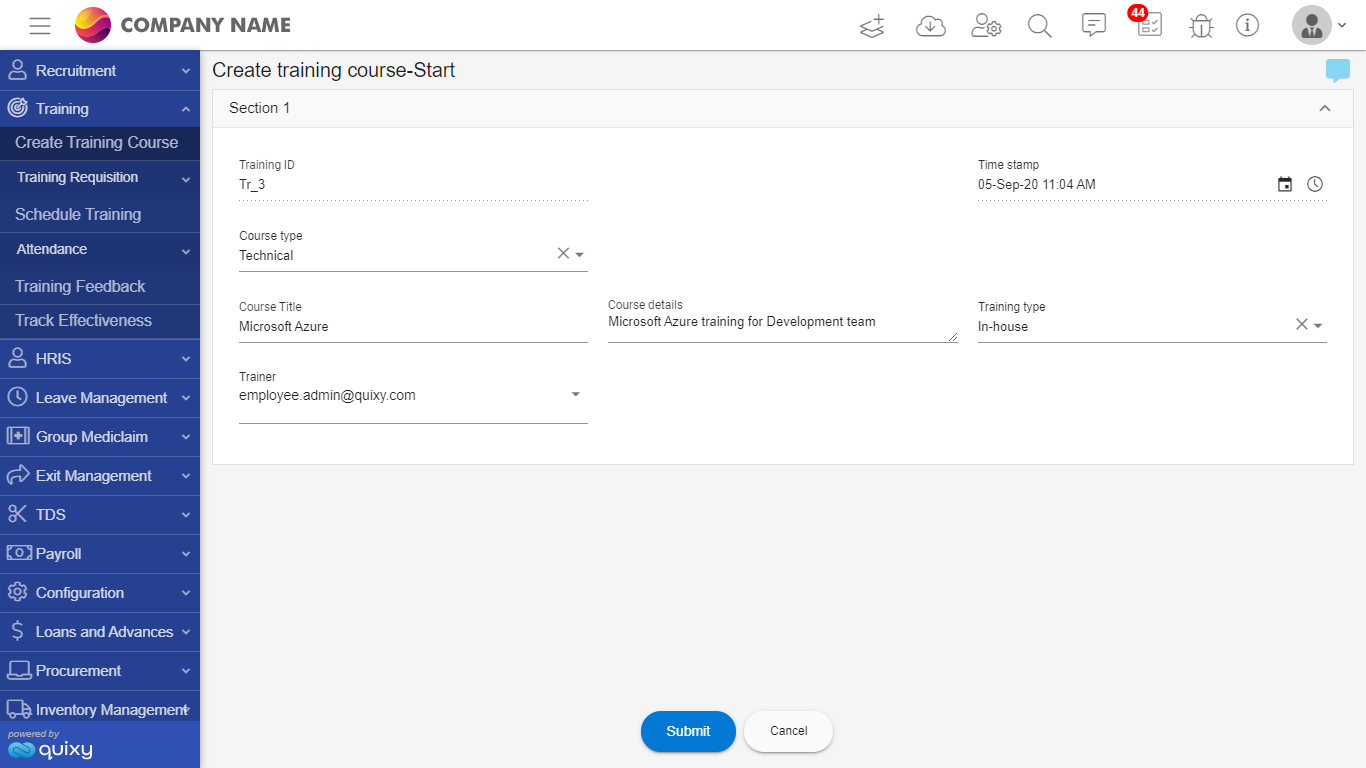
Create a New Training Course
HR creates new training structures and courses based on organisational requirements. Course details, training type (in-house or outsourced), content links, trainer information, venue or virtual meeting details, and target audience are all captured through a configurable digital form.
In-house training or outsourced training can both be added with links, locations, and materials attached. All course data is stored centrally and available for scheduling immediately on submission — no email attachments, no shared drives, no version confusion.
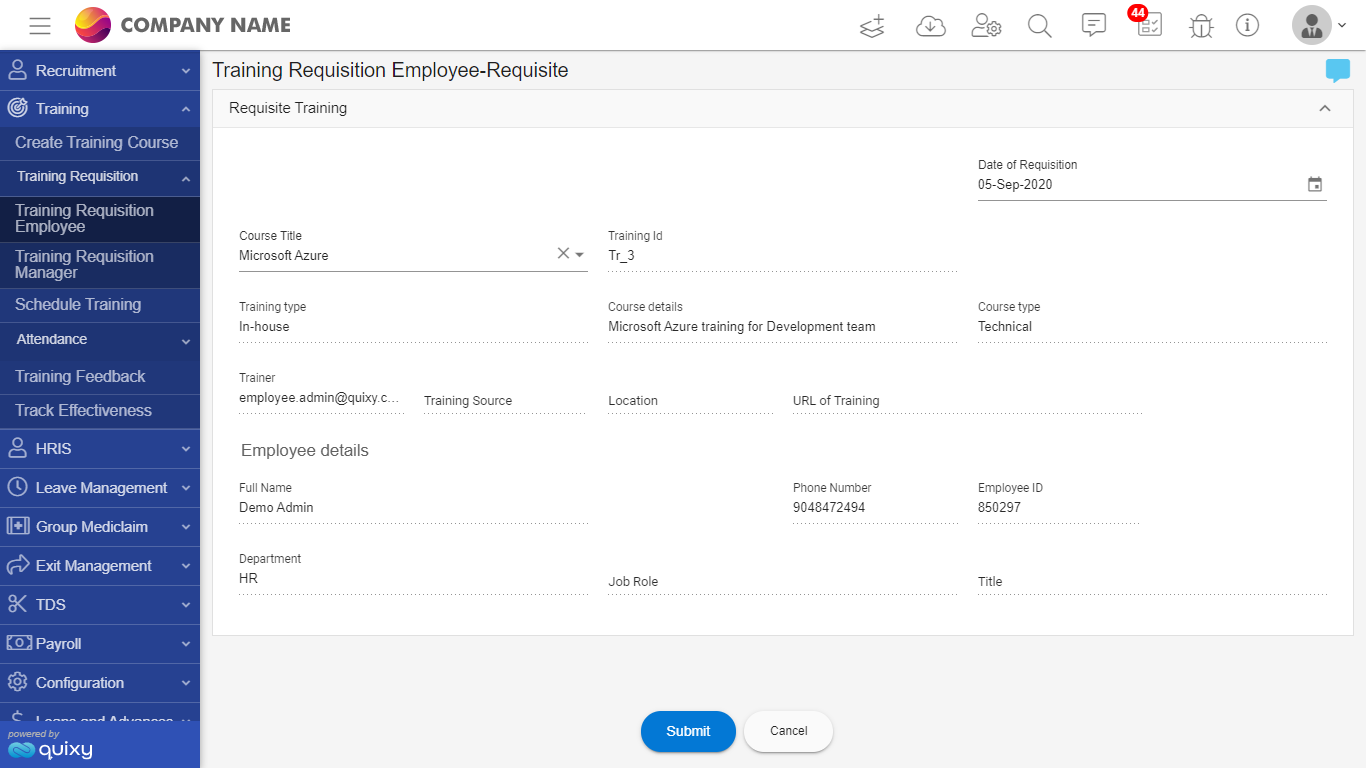
Employee Requisition for Training
Once training courses are published, employees access the course catalogue through their self-service portal and register for relevant programmes directly. The system routes each registration to the correct approver based on configured workflow rules.
Employees receive automatic confirmation on approval with all session details included. No email requests to HR, no manual tracking of who has registered for which programme.
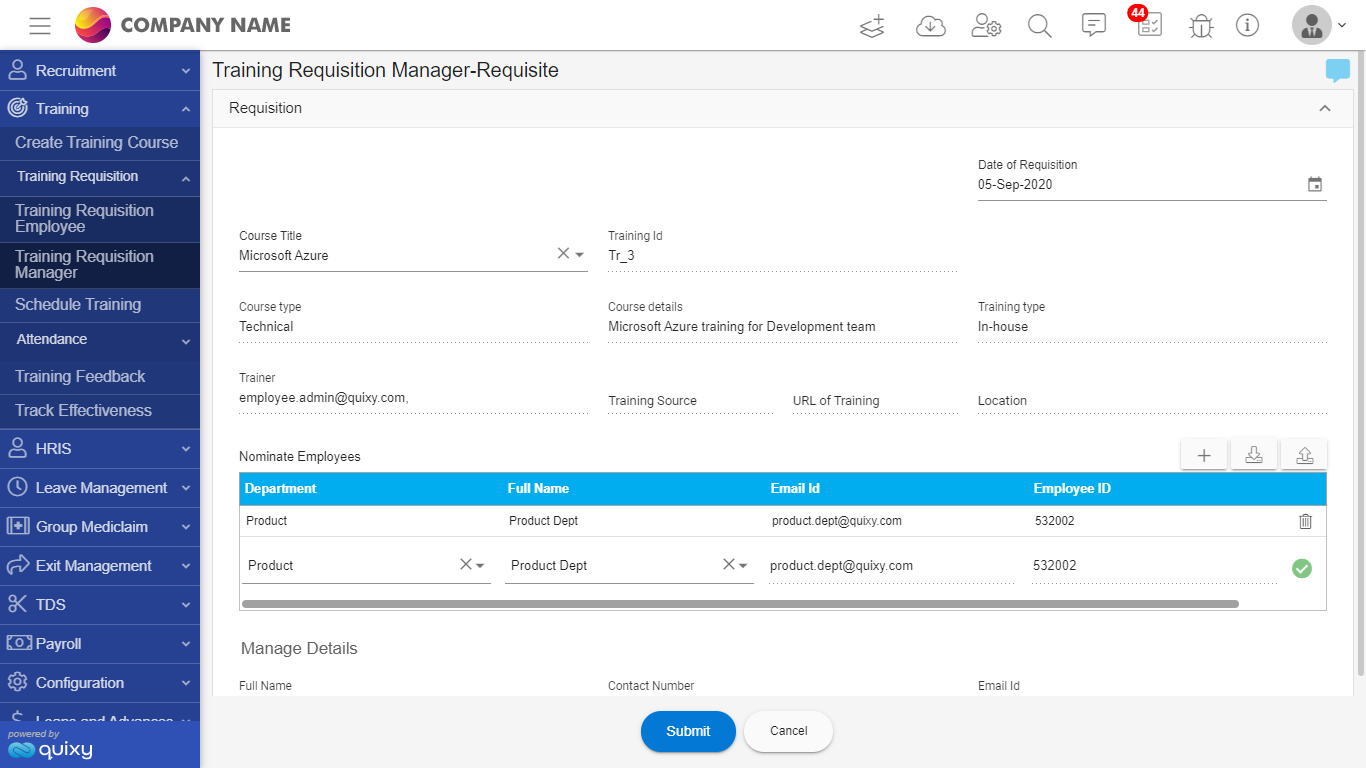
Manager Requisition for Training
Managers access the full course catalogue and nominate specific employees for training programmes — selecting the course, adding nominees, and submitting. Automatic notifications are triggered to all nominated employees immediately on submission, with full session details and registration confirmation included. No email follow-up required from the manager at any subsequent stage.
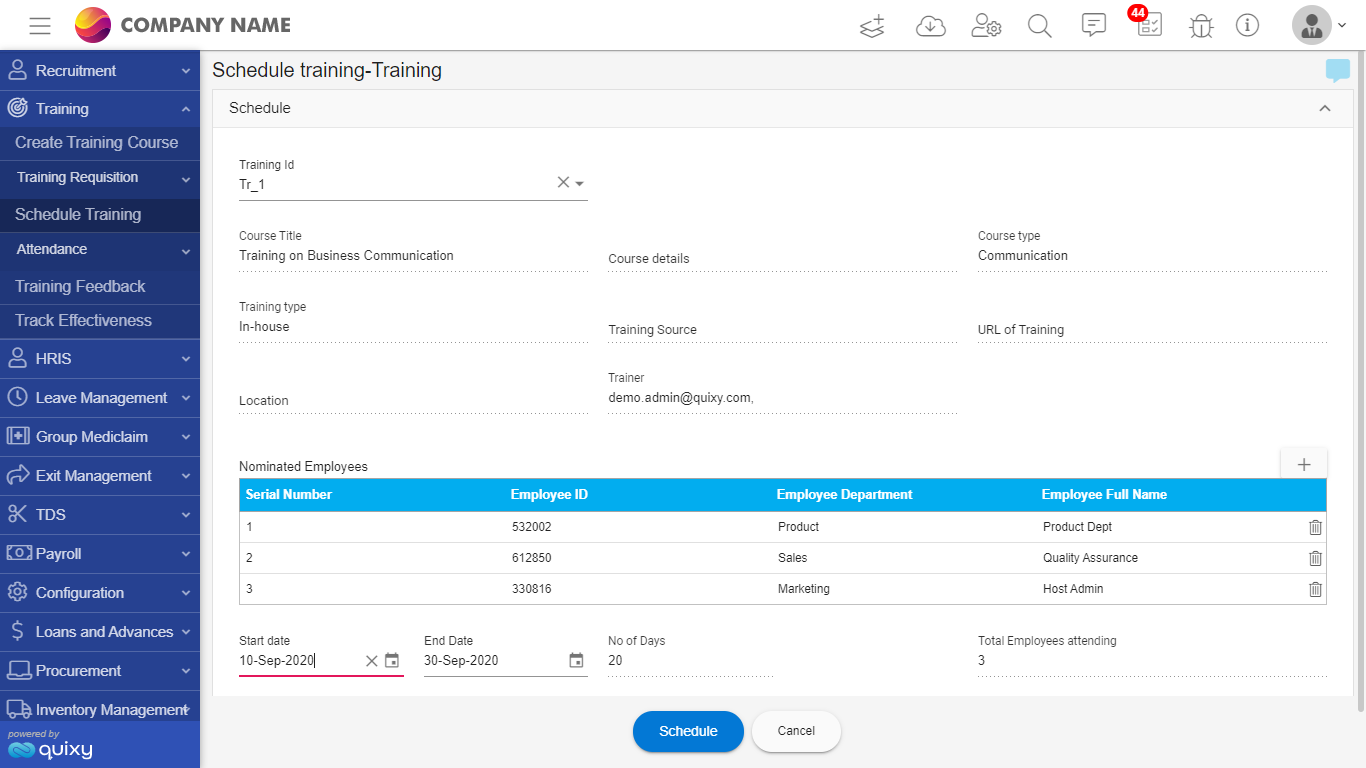
Schedule Training
HR selects a training course from the registered pool, views all registered employees, sets session dates and total training duration, and confirms the schedule.
Automatic email notifications are sent to all registered employees immediately on confirmation — with session details, venue or virtual meeting link, and any pre-training requirements included. The system tracks the training schedule across all active programmes in one consolidated calendar view.
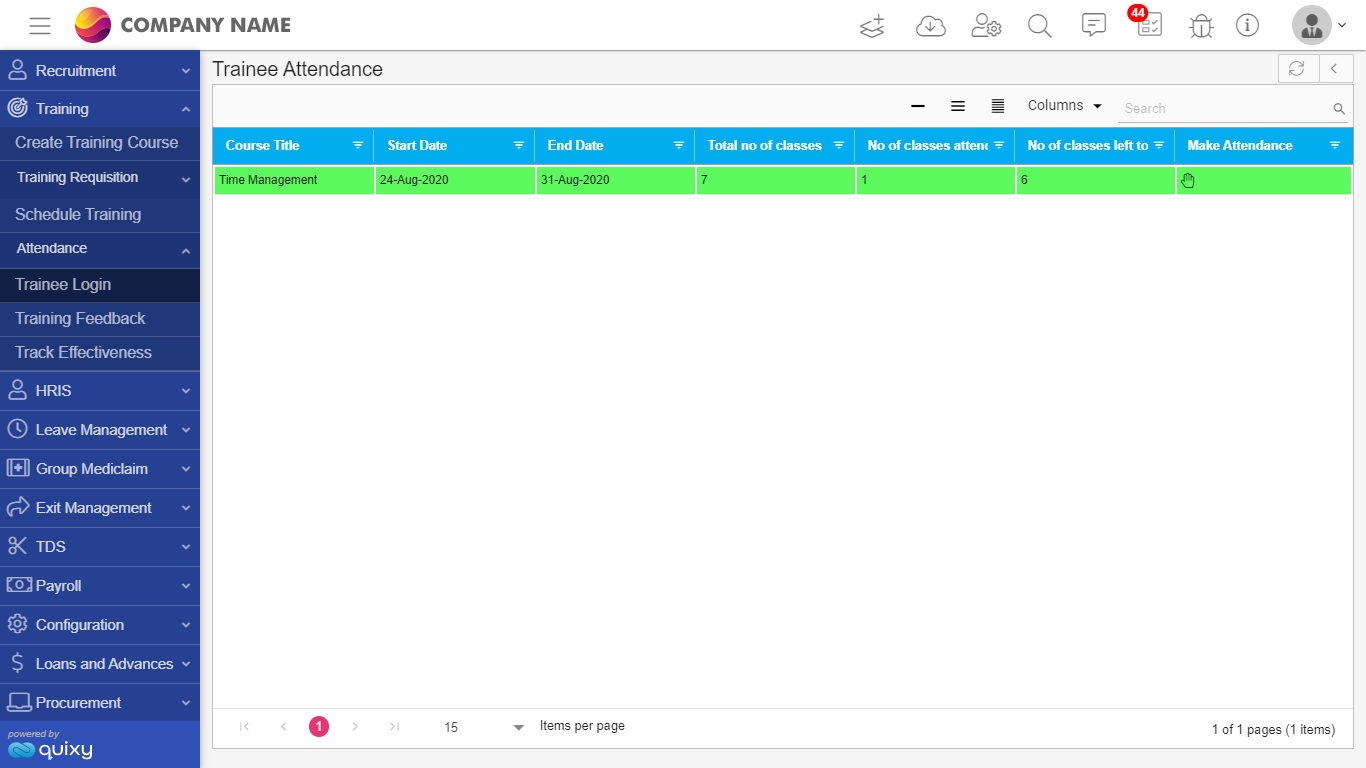
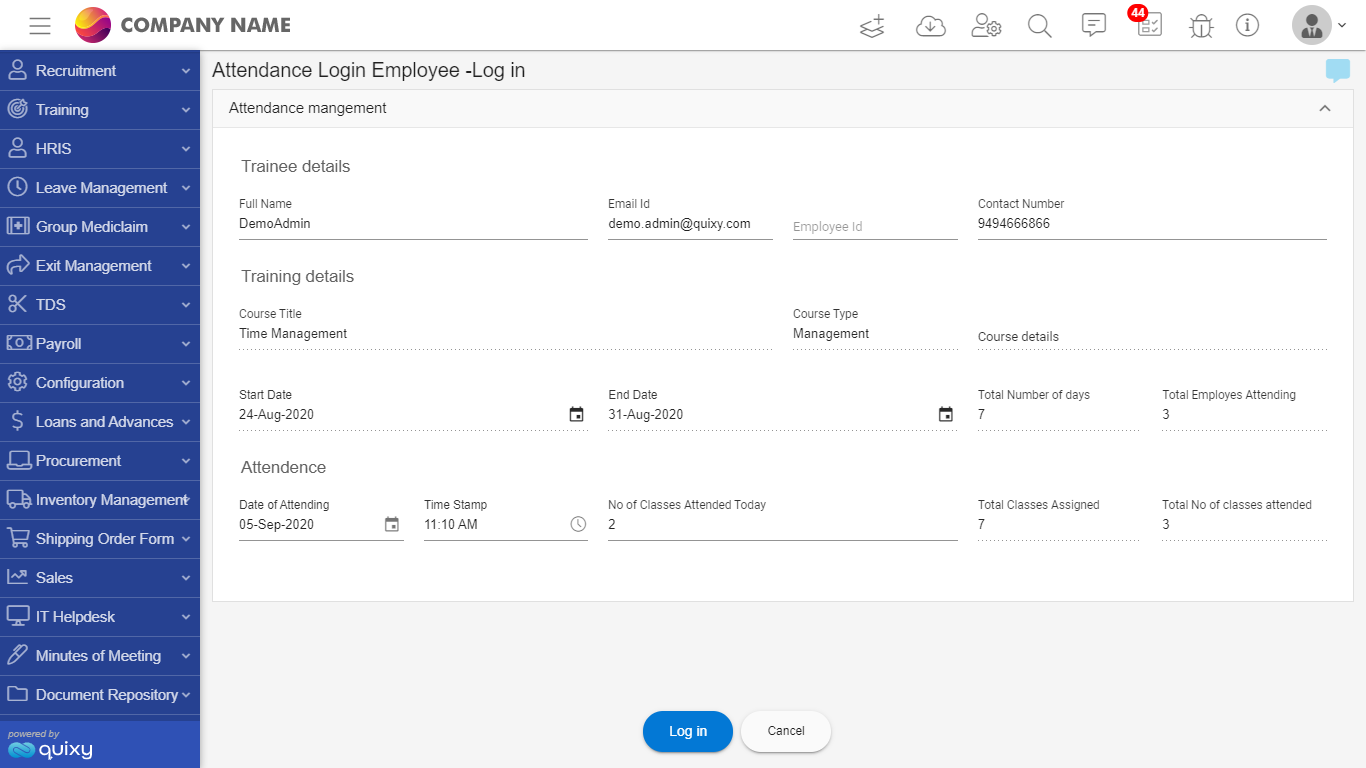
Digital Attendance capture for training
Employees access their registered course list and mark attendance directly in the system with a single action — selecting the course and logging their attendance for the day attended. Attendance is captured digitally, linked to the individual employee record, and aggregated automatically for reporting without any manual transfer to a spreadsheet or separate system.
Quixy’s offline mobile capability means attendance can be marked even at field sites without reliable internet connectivity — data syncs automatically when connectivity is restored. This is specifically how Yum! India manages training compliance across hundreds of restaurant locations.
Training Feedback
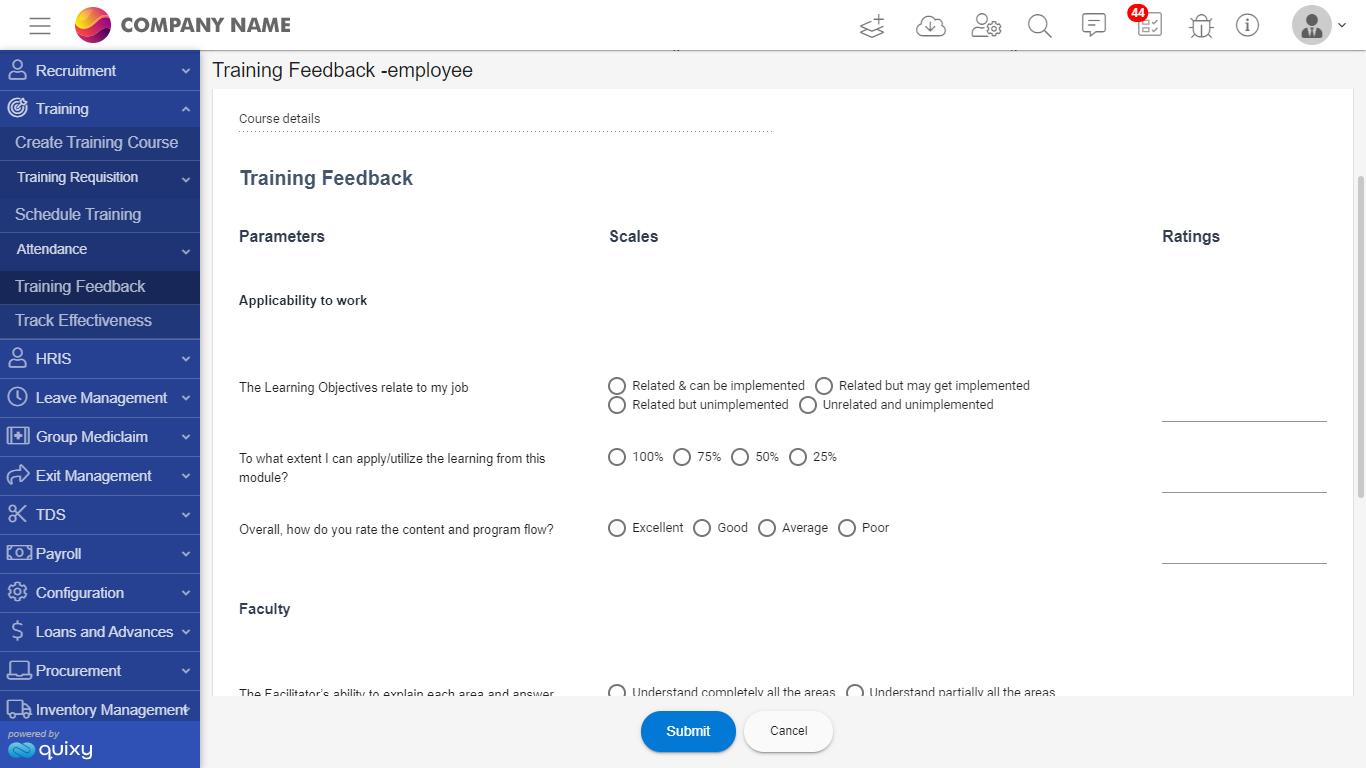
On programme completion, an automated feedback form is sent to all attendees. The form captures structured ratings and open-ended comments against parameters configured specifically for each training type — different programmes can have different feedback criteria. Responses aggregate automatically into programme performance dashboards. No manual compilation, no waiting until someone has time to review paper forms, no delayed insights that arrive after the next cohort has already started.
Tracking Effectiveness
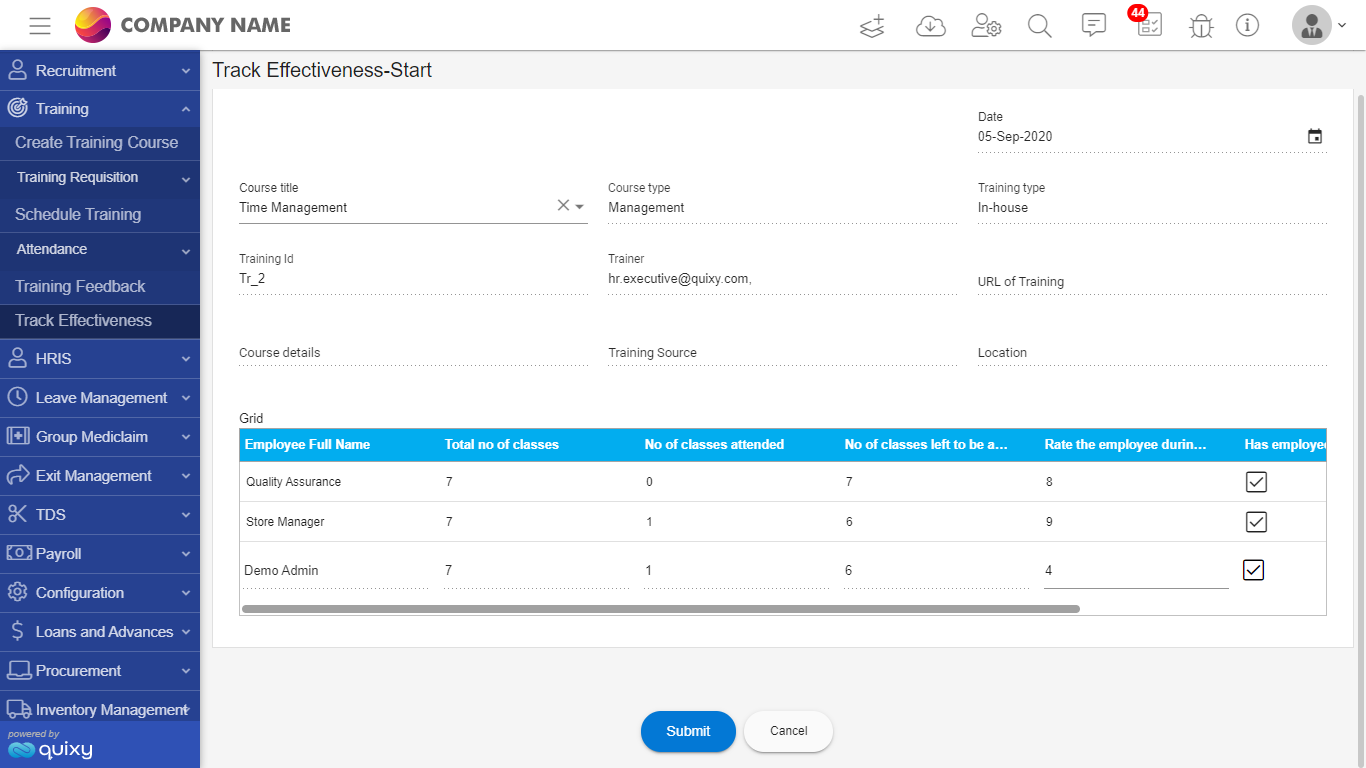
Managers access their employees’ training completion records and rate the effectiveness of completed training against customised performance impact parameters configured by the organisation.
Effectiveness ratings aggregate alongside completion and feedback data in the TMS dashboard — giving L&D leaders the complete picture: who attended, how they rated the experience, and whether their manager observed measurable performance improvement as a result. This connects training investment directly to performance outcomes in a way that manual processes cannot replicate.
Reports and Insights
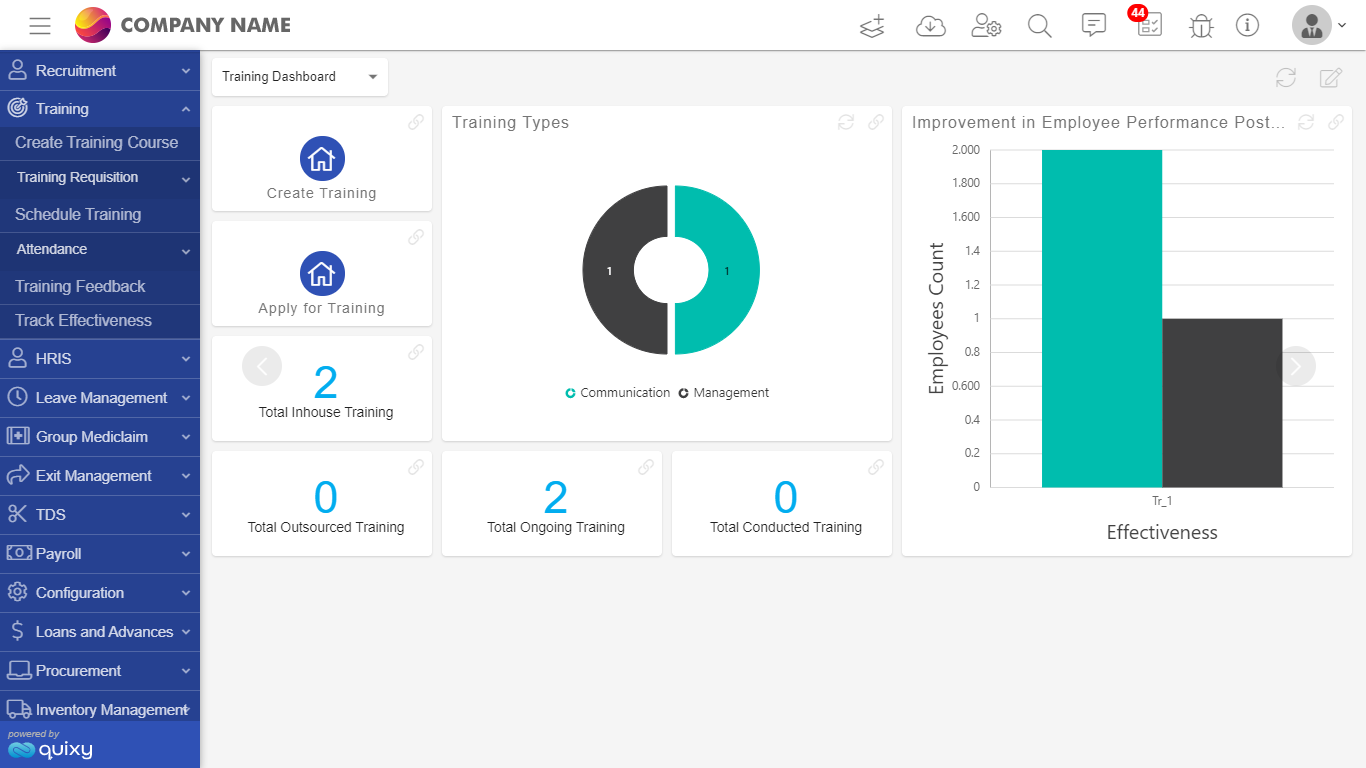
All training data — completions, attendance records, certification status, effectiveness scores, feedback summaries — is displayed on real-time, customisable dashboards. HR coordinators see their programme management view.
L&D leaders see effectiveness analytics. Compliance teams see certification status across all employees and locations. Caddie AI generates on-demand compliance reports in natural language — formatted and ready for auditors without any manual preparation, data export, or spreadsheet compilation.
Also read: Make Your Hiring Process a Breeze With Quixy’s No-Code Recruitment Solution
Yum! India (KFC) — Training Compliance at Scale
Yum! India deployed Quixy’s no-code training management workflows to automate Restaurant Training Score audits and On-the-Job Evaluations across hundreds of locations. Field managers complete digital training assessments on mobile — including offline at sites without internet. Workflows route results automatically. Compliance reports are generated without manual consolidation at any level.
Result: 90% efficiency improvement. Zero manual documentation. Consistent, audit-ready compliance records across every location.
Why Quixy for Employee Training Management
Standard training management software delivers a fixed set of features your HR team adapts to. Quixy’s aPaaS gives your HR team the platform to build a training management system configured precisely to your programmes, your approval hierarchies, your feedback criteria, and your compliance requirements — without writing a single line of code.
| Requirement | Quixy Capability |
|---|---|
| No-code configuration | HR coordinators build and modify training workflows, forms, and dashboards without IT or developer involvement |
| Offline mobile for field teams | Full training management functionality on iOS and Android without internet — auto-syncs on reconnection |
| Automated notifications | Email, SMS, WhatsApp, and in-app alerts configured per training type — nomination, confirmation, reminders, feedback, effectiveness |
| Caddie AI | On-demand compliance reports in natural language — formatted for auditors instantly, no manual compilation |
| HRMS and LMS integration | Native API and 3,000+ Zapier integrations — connects to existing HRMS, LMS, payroll, and attendance systems |
| CMMI Level 3 + ISO 27001 | Enterprise security for sensitive training records, performance assessments, and compliance documentation |
| Customisable effectiveness parameters | Each training programme has its own effectiveness rating criteria — configured by the organisation, not the vendor |
| Sandbox testing environment | Test new training workflows and notification sequences without affecting live training operations |
An ingenious no-code platform, Quixy helps you automate any business process and build simple to complex enterprise-grade applications in hours and days instead of weeks and months, all without writing any code. The process can be customized to your needs and best practices.
Begin your journey towards streamlined operations and tailored apps – all with the simplicity of our platform. Get started today to harness the potential of automation.
Frequently Asked Questions(FAQs)
Q. What is employee training management software?
Employee training management software (TMS) is a platform that manages the complete operational logistics of training programmes — scheduling sessions, tracking attendance, collecting feedback, recording certifications, and generating compliance reports — in one centralised system. It replaces spreadsheets, email chains, and paper sign-in sheets with automated workflows. Unlike an LMS which delivers learning content, a TMS manages everything required to get learners into that experience on time with a verifiable completion record.
Q. What is the difference between a TMS and an LMS?
A Training Management System (TMS) handles the operational side of training — scheduling, instructor assignments, attendance tracking, certification recording, and compliance reporting. An LMS (Learning Management System) focuses on delivering learning content — online courses, assessments, and digital learning paths. The TMS manages the logistics; the LMS manages the learning experience. Most organisations use both together. Quixy’s TMS integrates with existing LMS platforms via API to create a unified training stack.
Q. How does training management software support compliance training?
Training management software tracks every mandatory training assignment, attendance record, and certification with timestamps and individual employee attribution. When a compliance audit requires evidence that all employees completed required training — safety certifications, regulatory programmes, anti-money laundering, data protection — the system generates a complete, formatted report instantly. Automated escalation ensures non-completers are flagged and followed up before certification deadlines pass, so compliance gaps are identified proactively rather than discovered under audit pressure.
Q. Is coding knowledge required to use Quixy’s training management software?
No coding knowledge is required at any stage. Quixy’s no-code platform allows HR teams and training coordinators to create training courses, configure workflows, set up notification sequences, design feedback forms, and build compliance dashboards using a visual drag-and-drop interface. The entire training management system is configured and maintained by HR professionals without IT dependency — changes to workflows, forms, or dashboards happen in hours, not months.
Q. Can training management software integrate with existing HR and LMS systems?
Yes — modern training management platforms connect to existing HR systems, LMS platforms, and payroll tools via API, eliminating manual data re-entry between systems. When a new employee record is created in your HRIS, training assignments trigger automatically. Attendance flows to payroll. Certification records update HRMS compliance fields. Quixy connects via native API, REST webhooks, and 3,000+ Zapier integrations — covering all standard HR and training systems without custom development.
Q. Does the software work for field teams without reliable internet?
Yes — Quixy’s training management workflows include full offline mobile capability. Field managers and employees complete training assessments, mark attendance, and submit feedback from mobile devices without internet connectivity. All data syncs automatically when connectivity is restored. This is how Yum! India manages training compliance across hundreds of restaurant locations — field managers complete digital assessments offline on mobile, workflows route results automatically on sync, and compliance reports are generated without any manual consolidation.
Q. Is training management software adaptable for different industries and team sizes?
Yes — training management challenges exist across every industry and at every scale. Quixy is particularly well-suited for organisations with complex or unique training requirements that do not fit standard TMS templates: multi-location operations with field-based workforces, regulated industries with specific compliance frameworks, fast-growing organisations whose training needs are evolving rapidly, and enterprises managing both in-house and outsourced training programmes simultaneously. The platform scales from small teams to global enterprises without architectural changes.
Q. What does no-code employee training management software offer that standard software cannot?
No-code TMS lets your HR team configure every aspect of training management — approval hierarchies, feedback criteria, notification sequences, compliance report formats — to match your exact processes, without developer involvement. Standard software delivers a fixed template that your team adapts to. No-code software adapts to your team. Practically: workflow changes on a no-code platform take hours. The same changes on standard software take weeks and often carry additional professional services fees.
Related Post


Please login to comment
0 Comments
Oldest
Recent Posts



- Download the App