

Every enterprise depends on approvals to maintain control, manage risk, and ensure accountability across business operations. Whether it involves budget requests, procurement approvals, vendor onboarding, contract reviews, policy exceptions, or resource allocation, approvals play a critical role in keeping business processes organized and compliant.
However, many organizations struggle with slow approvals, unclear ownership, fragmented communication, and inefficient decision-making structures. As enterprises grow, approval chains often become increasingly complex. Requests move through multiple stakeholders, email threads become difficult to track, and employees spend valuable time following up instead of focusing on strategic work.
The result is more than administrative frustration. Delayed approvals can slow project execution, increase operational costs, reduce employee productivity, and create compliance risks that affect overall business performance.
This is where Enterprise Approval Workflow Design becomes essential.
A well-designed decision approval process establishes clear approval paths, predefined decision criteria, escalation mechanisms, and governance controls that help organizations process requests efficiently while maintaining accountability. Instead of relying on manual coordination and inconsistent review processes, enterprises can create repeatable workflows that support faster, more informed decisions.
Modern workflow automation platforms such as Quixy enable organizations to design, automate, and manage approval workflows with greater visibility, governance, and operational efficiency. By combining structured workflow design with automation capabilities, enterprises can reduce bottlenecks and accelerate decision-making while maintaining compliance and accountability.
Key Takeaways
- Enterprise Approval Workflow Design helps organizations accelerate decision-making while maintaining governance and compliance.
- Approval workflow automation reduces manual effort, approval delays, and administrative overhead.
- Effective workflows use role-based approvals, automated routing, escalation rules, and real-time visibility.
- Parallel approvals can significantly reduce approval cycle times.
- Workflow governance improves accountability and audit readiness across departments.
- Tracking approval framework metrics helps organizations continuously optimize performance.
- Scalable approval workflows support organizational growth without increasing operational complexity.
What Is Enterprise Approval Workflow Design?
Enterprise Approval Workflow Design is the process of defining how business requests move through review, validation, and authorization stages within an organization. Organizations often start by establishing a structured approval process and workflow framework that defines approval paths, responsibilities, and governance requirements.It establishes the rules, responsibilities, routing logic, escalation procedures, and approval requirements that ensure requests are evaluated consistently and efficiently.
The objective is not simply to collect approvals. The goal is to create a structured framework that balances operational speed, decision quality, governance, and compliance.
A well-designed approval workflow typically defines:
- Who can submit requests
- Which stakeholders must review requests
- What approval criteria apply
- How requests are routed
- When escalations occur
- How exceptions are handled
- How decisions are documented
Without a structured approval framework, organizations often rely on email chains, spreadsheets, manual reminders, and informal communication channels. These approaches create inconsistencies, reduce visibility, and increase the likelihood of delays.
Modern enterprises increasingly view approval management as a strategic business capability because the speed and quality of approvals directly affect organizational agility, compliance, and operational efficiency.

What Is Approval Workflow Automation?
Approval workflow automation uses software to automatically route, track, escalate, and document business approvals based on predefined business rules and governance requirements.
Instead of manually coordinating requests through emails and spreadsheets, organizations can automate approval routing, notifications, audit trails, and policy enforcement to improve efficiency and consistency.
Why Approval Workflows Impact Enterprise Decision-Making
Approval workflows influence how quickly organizations can execute initiatives, respond to opportunities, manage risk, and allocate resources.
When approval processes are inefficient, delays ripple across departments and affect broader business outcomes.
Slower Project Execution
Projects often require approvals for:
- Budgets
- Resource allocation
- Procurement requests
- Vendor contracts
- Compliance reviews
When approvals are delayed, project timelines become difficult to maintain, resulting in missed deadlines and reduced business agility.
Reduced Operational Efficiency
Employees frequently spend time:
- Tracking approvals
- Sending reminders
- Requesting status updates
- Escalating pending requests
This administrative burden reduces productivity and diverts attention from higher-value work.
Limited Process Visibility
Without centralized tracking, stakeholders often struggle to determine:
- Where requests are located
- Who is responsible for action
- What approval stage remains pending
- Why delays are occurring
Poor visibility creates communication gaps and increases frustration among employees and managers.
Increased Compliance Risks
Inconsistent approval paths make it difficult to enforce policies and maintain governance standards.
Organizations may struggle to demonstrate compliance during audits when approval records are incomplete or difficult to locate.
Poor Employee Experience
Waiting days or weeks for routine approvals can negatively affect employee satisfaction and confidence in internal processes.
Approval delays often create the perception that organizational processes are inefficient and difficult to navigate.
Organizations that improve approval routing process management frequently experience measurable gains in transparency, productivity, and decision-making speed.
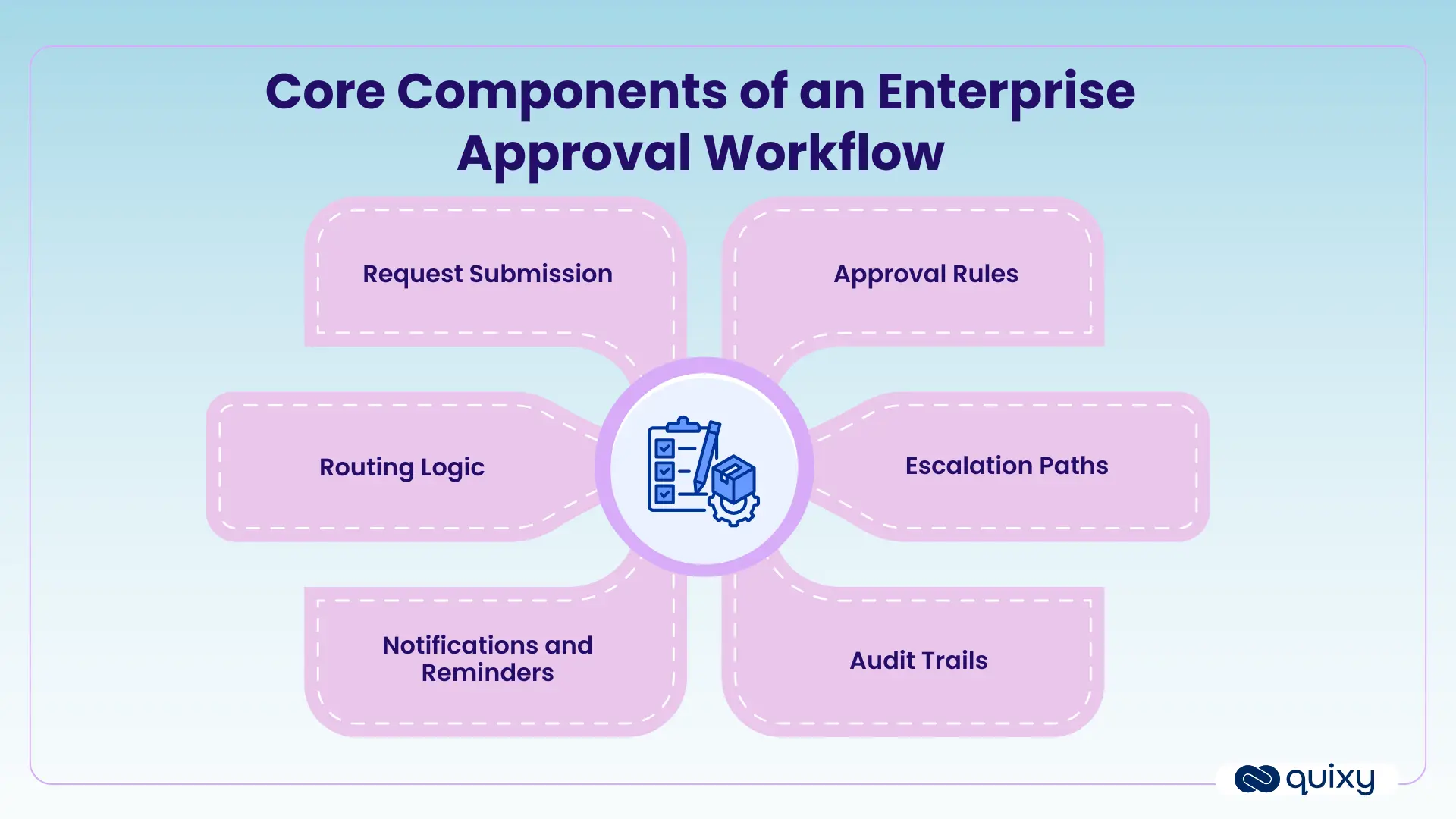
Core Components of an Enterprise Approval Workflow
Successful approval workflows share several foundational components that help ensure consistency, accountability, and operational efficiency.
Request Submission
Every workflow begins with a request.
Examples include:
- Budget approvals
- Purchase requests
- Vendor onboarding applications
- Contract reviews
- Leave requests
- Policy exception requests
Clear submission requirements reduce errors and help ensure requests contain the information necessary for efficient review.
Organizations should standardize request forms to improve data quality and minimize back-and-forth communication.
Approval Rules
Approval rules determine how requests are evaluated and routed.
Common approval criteria include:
- Financial thresholds
- Department ownership
- Business unit
- Risk classification
- Project value
- Request category
Clearly defined rules reduce ambiguity and improve decision consistency across the organization.
Routing Logic
Routing logic determines how requests move through approval stages.
Effective routing ensures requests automatically reach the correct stakeholders based on predefined conditions rather than manual intervention.
For example:
- Procurement requests above a specific value may require finance approval.
- Vendor onboarding requests may require legal and compliance reviews.
- HR requests may route directly to department managers.
Proper routing helps reduce delays and eliminates unnecessary administrative work.
Escalation Paths
Approvers may be unavailable due to leave, travel, workload constraints, or competing priorities.
Escalation mechanisms ensure requests continue progressing when response times exceed predefined limits.
For example:
- Escalate after 48 hours for standard requests.
- Escalate after 24 hours for high-priority requests.
- Automatically notify supervisors when deadlines are missed.
Escalation workflows help maintain momentum and improve accountability.
Notifications and Reminders
Automated notifications keep stakeholders informed about:
- Pending approvals
- Upcoming deadlines
- Escalations
- Workflow updates
Timely reminders reduce the need for manual follow-ups and help prevent requests from becoming stalled.
Audit Trails
Audit logs provide a complete history of workflow activity.
This includes:
- Submission timestamps
- Approval actions
- Rejections
- Comments
- Modifications
- Escalations
Comprehensive audit trails support governance, compliance, reporting, and regulatory requirements.
They also provide valuable insights into workflow performance and bottlenecks.
What Is an Approval Matrix?
An approval matrix is a governance framework that defines who can approve requests based on factors such as financial value, business risk, department ownership, and organizational authority levels.
Approval matrices help organizations standardize decision-making, improve accountability, and eliminate confusion regarding approval responsibilities.
Example Approval Matrix
| Request Value | Required Approver |
| Up to $5,000 | Department Manager |
| $5,001–$25,000 | Finance Director |
| $25,001–$100,000 | Vice President |
| Above $100,000 | Executive Leadership |
Organizations often use approval matrices to support procurement approvals, budget approvals, vendor onboarding decisions, contract approvals, and capital expenditure requests.
By defining approval authority levels upfront, enterprises can reduce approval delays and improve governance consistency.
5 Signs Your Approval Process Is Slowing Business Decisions
Many organizations assume delays are caused by increasing workloads when the real issue is ineffective workflow design.
Recognizing warning signs early can help organizations identify opportunities for improvement.
1. Requests Frequently Miss Expected Timelines
If approvals consistently exceed target turnaround times, workflow inefficiencies likely exist.
Long approval cycles often indicate:
- Excessive review stages
- Unclear ownership
- Poor routing logic
- Resource constraints
Monitoring approval cycle times can help identify where delays occur.
2. Employees Constantly Chase Approvals
Employees should not spend significant portions of their workday requesting status updates or reminding stakeholders to review requests.
Frequent follow-ups usually indicate:
- Poor visibility
- Lack of accountability
- Inadequate notifications
An efficient workflow minimizes the need for manual intervention.
3. Similar Requests Follow Different Paths
Inconsistent routing creates confusion and makes governance difficult to maintain.
For example, two similar procurement requests should not require completely different approval processes simply because they originated from different departments.
Standardization improves consistency and fairness.
4. Approval Bottlenecks Occur Repeatedly
Certain stakeholders or departments often become recurring points of delay.
These bottlenecks may result from:
- Overloaded approvers
- Poor process design
- Lack of delegation
- Insufficient escalation procedures
Identifying recurring bottlenecks is essential for workflow optimization.
5. Stakeholders Lack Visibility
Decision-makers should be able to view request status, pending actions, and approval history without searching through emails or messaging platforms.
Limited visibility often leads to:
- Missed deadlines
- Duplicate work
- Communication breakdowns
- Reduced accountability
Organizations experiencing these challenges often benefit from implementing a more structured approval workflow strategy.
Why Approval Workflow Optimization Matters
Approval efficiency has a direct impact on business performance. Many organizations achieve these improvements through business process automation, which helps standardize approvals, eliminate manual tasks, and accelerate operational execution.
Even small delays can accumulate across hundreds or thousands of requests, creating significant operational friction.
Benefits of approval workflow optimization include:
- Faster decision-making
- Improved employee productivity
- Better compliance management
- Reduced administrative effort
- Increased process transparency
- Greater stakeholder satisfaction
- Stronger governance controls
More importantly, optimization helps organizations create predictable and scalable approval experiences that support long-term growth.
As enterprises expand across regions, departments, and business units, structured approval management becomes increasingly important for maintaining consistency and operational control.
Enterprise Approval Workflow Design Framework
Organizations often ask how to build approval workflows that remain efficient as business complexity increases.
A structured framework provides a practical roadmap for designing workflows that balance speed, governance, and scalability.
Phase 1: Process Discovery
Before redesigning workflows, organizations must understand how approvals currently operate.
This includes documenting:
- Existing approval stages
- Stakeholders involved
- Approval timelines
- Escalation practices
- Common bottlenecks
- Exception scenarios
Process discovery helps uncover inefficiencies that may otherwise remain hidden.
Phase 2: Workflow Design
Once current-state processes are understood, organizations can design improved workflows.
Key activities include:
- Defining approval authority levels
- Establishing routing rules
- Creating escalation procedures
- Standardizing decision criteria
- Documenting exception handling processes
The objective is to eliminate unnecessary complexity while maintaining appropriate governance.
Phase 3: Workflow Automation
After workflows are designed, automation can improve efficiency and consistency.
Approval workflow automation capabilities typically include:
- Automated routing
- Notifications and reminders
- Escalation triggers
- Audit logging
- Policy enforcement
Automation reduces manual coordination and allows stakeholders to focus on decision-making rather than administrative tasks.
Phase 4: Continuous Optimization
Workflow design is not a one-time initiative.
Organizations should continuously evaluate performance using metrics such as:
- Approval cycle time
- Escalation frequency
- Approval completion rates
- SLA compliance
- Request backlog volume
Continuous optimization helps ensure workflows remain aligned with evolving business requirements.
How to Design an Enterprise Approval Workflow
Many organizations invest in workflow automation technology before addressing process design challenges. However, technology alone cannot fix inefficient approval structures.
A successful approval workflow begins with understanding existing bottlenecks and creating a framework that balances governance with operational agility.
Step 1: Map Existing Processes
The first step is documenting the current approval journey from request submission to final decision.
Organizations should identify:
- Stakeholders involved
- Approval stages
- Existing review requirements
- Approval timelines
- Escalation practices
- Common delays
Process mapping provides visibility into inefficiencies and helps teams understand where improvements are needed.
It is important to involve employees, managers, compliance teams, and process owners during this stage to ensure workflows accurately reflect operational requirements.
Step 2: Categorize Approval Types
Not all requests require the same level of review.
Examples include:
- Procurement approvals
- Vendor onboarding requests
- Budget approvals
- Contract reviews
- HR approvals
- Policy exception requests
Separating approval workflows based on business requirements prevents unnecessary reviews and helps improve efficiency.
A low-risk request should not follow the same approval path as a high-risk business decision.
Step 3: Define Decision Criteria
Approvers should evaluate requests using predefined criteria rather than personal judgment alone.
Examples include:
- Financial thresholds
- Risk classifications
- Department ownership
- Regulatory requirements
- Business impact
Standardized decision criteria improve consistency and help organizations maintain governance standards.
Step 4: Establish Approval Authority Levels
Clearly define who can approve requests and under what circumstances.
For example:
- Department managers may approve requests up to a certain value.
- Finance leaders may approve larger expenditures.
- Executive approval may be required for strategic initiatives.
Approval authority matrices help eliminate confusion and improve accountability.
Step 5: Create Escalation Procedures
Delays are inevitable when stakeholders become unavailable or workloads increase.
Organizations should define:
- Escalation triggers
- Escalation timelines
- Secondary approvers
- Notification procedures
Escalation paths help ensure requests continue moving without unnecessary interruptions.
Approval Workflow Design Principles That Improve Decision Speed
The most effective approval workflows are designed around simplicity, accountability, transparency, and scalability.
Organizations that follow these principles often reduce delays while improving governance outcomes.
Minimize Unnecessary Approval Layers
Every additional approval stage increases cycle time.
Organizations should regularly review workflows and remove approval steps that no longer provide meaningful business value.
Questions to ask include:
- Does this approval reduce risk?
- Is this review required by policy?
- Does this stakeholder contribute meaningful input?
Removing unnecessary approvals helps accelerate decision-making without compromising oversight.
Establish Clear Ownership
Each workflow stage should have a designated approver responsible for making timely decisions.
Clear ownership helps prevent requests from becoming stalled due to uncertainty regarding responsibilities.
Employees should never wonder who is expected to take action next.
Standardize Approval Criteria
Approvers should evaluate requests using consistent business rules.
Standardization improves:
- Fairness
- Governance
- Compliance
- Decision quality
It also reduces variability across departments and business units.
Improve Process Visibility
Stakeholders should be able to view:
- Request status
- Pending actions
- Approval history
- Escalation events
Real-time visibility reduces communication gaps and improves accountability throughout the workflow.
Design for Scalability
Approval structures should support future business growth.
As organizations expand, workflows must accommodate:
- Additional departments
- New business units
- Increased request volumes
- Changing regulatory requirements
Scalable workflows reduce the need for frequent redesign efforts.
Enterprise Approval Workflow Best Practices for Faster Approvals
Organizations looking to improve approval efficiency can apply several proven best practices.
Use Role-Based Approvals
Assign approval responsibilities to roles rather than individual employees.
Examples include:
- Procurement Manager
- Finance Director
- Legal Reviewer
- Department Head
Role-based approvals reduce maintenance efforts and ensure workflow continuity when personnel changes occur.
Enable Parallel Reviews
Many workflows require input from multiple stakeholders.
Rather than routing approvals sequentially, organizations can enable parallel reviews where appropriate.
For example:
- Finance and legal teams can review contracts simultaneously.
- Compliance and procurement teams can evaluate vendor requests in parallel.
Parallel approvals significantly reduce overall cycle times.
Define Response Time Expectations
Establish service-level expectations for different request categories.
| Request Type | Target Response Time |
| Standard Requests | 48 Hours |
| High-Priority Requests | 24 Hours |
| Critical Requests | 8 Hours |
Clear expectations improve responsiveness and accountability.
Implement Escalation Rules
Escalation procedures ensure requests continue progressing when deadlines are missed.
Common escalation strategies include:
- Manager notifications
- Secondary approver assignment
- Escalation to department leaders
Automated escalations reduce the likelihood of stalled requests.
Conduct Regular Workflow Audits
Business requirements evolve over time.
Organizations should periodically review approval workflows to identify:
- Outdated approval requirements
- Process bottlenecks
- Compliance gaps
- Automation opportunities
Regular audits help maintain workflow effectiveness and operational alignment.
Manual vs Automated Approval Workflows
As organizations grow, manual approval processes often become difficult to manage. Increasing request volumes, complex approval chains, and growing compliance requirements can quickly overwhelm traditional approval methods.
Approval workflow automation helps eliminate repetitive administrative tasks while maintaining governance, visibility, and compliance.
Manual Approval Workflows vs Automated Approval Workflows
| Factor | Manual Approval Workflow | Automated Approval Workflow |
| Approval Speed | Slow | Fast |
| Routing | Manual forwarding | Automatic routing |
| Visibility | Limited | Real-time visibility |
| Compliance Tracking | Difficult | Standardized and automated |
| Audit Readiness | Manual documentation | Built-in audit trails |
| Scalability | Low | High |
| Administrative Effort | High | Low |
| Reporting | Manual reporting | Automated dashboards |
| Governance | Inconsistent | Policy-driven |
| Escalations | Manual follow-up | Automated escalation rules |
| User Experience | Fragmented | Streamlined |
| Decision Consistency | Variable | Standardized |
Organizations that implement automated approval workflows often experience:
- Faster approval cycle times
- Reduced administrative overhead
- Improved governance controls
- Better compliance management
- Increased process transparency
- Enhanced stakeholder accountability
As approval volumes increase, automation becomes essential for maintaining operational efficiency without sacrificing governance.
How Modern Approval Workflow Platforms Support Enterprise Decision-Making
Many organizations initially manage approvals through emails, spreadsheets, and manual coordination. While these approaches may work for smaller teams, they often become difficult to manage as business complexity grows.
Modern approval workflow platforms are a key component of broader digital process automation initiatives that improve efficiency across enterprise operations.
Key Capabilities of Modern Approval Workflow Platforms
Automated Workflow Routing
Requests are automatically routed to the appropriate stakeholders based on predefined business rules.
Examples include:
- Budget thresholds
- Risk classifications
- Department ownership
- Project categories
- Regulatory requirements
Automated routing reduces delays caused by manual coordination and helps ensure requests reach the right approvers quickly.
Centralized Approval Tracking
Decision-makers can monitor approval progress through centralized dashboards.
This visibility helps stakeholders understand:
- Current request status
- Pending actions
- Approval history
- Escalation events
- Workflow bottlenecks
Centralized tracking improves accountability and reduces the need for status update requests.
Role-Based Access Controls
Role-based permissions help organizations maintain security and governance standards.
Examples include:
- Department managers
- Finance leaders
- Procurement reviewers
- Compliance officers
- Executive approvers
Role-based controls ensure stakeholders can only access information relevant to their responsibilities.
Workflow Analytics and Reporting
Advanced workflow analytics help organizations measure performance and identify improvement opportunities.
Common reporting capabilities include:
- Approval cycle time analysis
- SLA compliance tracking
- Escalation monitoring
- Approval completion rates
- Request backlog analysis
Data-driven insights support continuous workflow optimization.
Integration Capabilities
Enterprise approval workflows often connect with existing business systems.
Examples include:
- ERP platforms
- HR systems
- Procurement solutions
- CRM platforms
- Financial applications
Integration eliminates duplicate data entry and improves process efficiency across departments.
How Intelligent Approval Workflows Accelerate Enterprise Decision-Making
Traditional approval workflows often require significant manual coordination.
Intelligent approval workflows use automation and process management capabilities to reduce administrative effort and accelerate business decisions.
What Is an Intelligent Approval Workflow?
An intelligent approval workflow combines automation, predefined business rules, governance controls, and real-time visibility to streamline approval management.
Instead of manually tracking requests, organizations can automate key workflow activities while maintaining oversight and compliance.
Capabilities of Intelligent Approval Workflows
Intelligent workflows can:
- Route requests automatically
- Trigger notifications and reminders
- Enforce approval policies
- Maintain audit records
- Monitor approval timelines
- Support escalation procedures
- Track workflow performance
These capabilities allow decision-makers to focus on evaluating requests rather than managing workflow logistics.
Benefits of Intelligent Approval Workflows
Organizations that implement intelligent approval workflows often experience:
- Faster approval cycles
- Reduced administrative effort
- Better compliance management
- Improved process consistency
- Increased stakeholder satisfaction
- Stronger governance controls
As enterprises scale, intelligent workflows become critical for maintaining operational agility and decision-making efficiency.
Key Metrics for Measuring Approval Workflow Performance
Organizations cannot improve what they do not measure.
Tracking workflow performance metrics helps identify inefficiencies, uncover bottlenecks, and prioritize optimization initiatives.
Approval Cycle Time
Approval cycle time measures how long requests take from submission to final approval.
Long approval cycle times often indicate:
- Excessive approval layers
- Routing inefficiencies
- Resource constraints
- Process bottlenecks
Reducing cycle time is one of the most common goals of approval workflow optimization.
Approval Completion Rate
Approval completion rate tracks the percentage of requests successfully completed.
Low completion rates may indicate:
- Process complexity
- Poor user adoption
- Workflow design issues
- Insufficient training
Monitoring completion rates helps organizations identify process improvement opportunities.
Escalation Frequency
Escalation frequency measures how often requests exceed expected response times.
High escalation rates often suggest:
- Overloaded approvers
- Poor workflow design
- Resource limitations
- Inadequate delegation practices
Escalation analysis can help uncover recurring bottlenecks.
SLA Compliance Rate
Service-level agreement (SLA) compliance measures whether approvals meet predefined response targets.
Monitoring SLA compliance helps organizations maintain:
- Accountability
- Responsiveness
- Operational consistency
Request Backlog Volume
Backlog volume tracks pending requests awaiting review or approval.
Growing backlogs may indicate:
- Capacity constraints
- Workflow inefficiencies
- Approval bottlenecks
Backlog monitoring provides early warning signs of process issues.
First-Pass Approval Rate
First-pass approval rate measures how often requests are approved without requiring revisions.
Higher first-pass approval rates often indicate:
- Clear submission requirements
- Effective workflow design
- Better employee understanding of approval expectations
Organizations that continuously monitor these metrics are better positioned to optimize workflow performance over time.
Benefits of Approval Workflow Optimization
Approval workflow optimization delivers measurable business value beyond simply reducing approval times. Improved workflow efficiency enables organizations to process requests faster while maintaining governance and compliance standards.
Improved Decision-Making Speed
Requests move through approval stages more efficiently, reducing delays that impact business operations.
Better Employee Productivity
Employees spend less time tracking approvals and more time focusing on strategic initiatives.
Enhanced Compliance
Standardized approval paths help ensure organizational policies are applied consistently.
Greater Transparency
Stakeholders gain visibility into workflow status, ownership, and approval history.
Reduced Operational Costs
Automation minimizes manual effort and reduces administrative overhead.
Stronger Governance
Clearly defined approval structures improve accountability and risk management.
Increased Organizational Agility
Faster approvals allow organizations to respond more quickly to changing business conditions and emerging opportunities.
Organizations that prioritize workflow optimization often achieve measurable improvements across multiple operational performance indicators.
Common Approval Workflow Design Mistakes That Cause Delays
Even well-intentioned workflow initiatives can create inefficiencies when approval structures are not designed properly.
Understanding common mistakes helps organizations avoid unnecessary delays and improve workflow performance.
Overcomplicating the Approval Process
One of the most common mistakes is adding excessive approval layers.
Organizations sometimes assume that more approvals automatically improve control. In reality, unnecessary review stages often create bottlenecks without adding meaningful business value.
Every approval stage should have a clear purpose and contribute to governance, risk management, or decision quality.
Ignoring End-User Experience
Approval workflows should be intuitive and easy to follow.
Complicated request forms, unclear instructions, and confusing approval paths often lead to:
- Submission errors
- Delays
- Increased support requests
- Lower process adoption
A user-friendly workflow improves both compliance and efficiency.
Failing to Plan for Exceptions
Not every request follows a standard approval path.
Organizations that fail to define exception handling procedures often experience delays when unusual situations arise.
Examples include:
- Urgent procurement requests
- Executive approvals
- Regulatory exceptions
- Emergency budget approvals
Exception workflows should be documented and governed appropriately.
Lack of Stakeholder Involvement
Workflow design should involve:
- Business users
- Managers
- Compliance teams
- Process owners
- IT stakeholders
Without stakeholder input, workflows may fail to address real operational challenges.
Neglecting Performance Measurement
Organizations that do not monitor workflow performance often struggle to identify opportunities for improvement.
Regular performance reviews help uncover:
- Approval bottlenecks
- Escalation trends
- SLA violations
- Process inefficiencies
Continuous measurement supports long-term optimization.
Why Enterprise Approval Workflows Commonly Fail
Many approval workflow initiatives fail not because of technology limitations but because organizations focus on automation before addressing process design challenges.
Successful approval workflows require a balance between governance, operational efficiency, and user adoption.
Excessive Approval Layers
Too many approvers increase cycle times and create unnecessary complexity.
Organizations often add approval stages over time without evaluating whether they still provide business value.
The result is slower decision-making and increased process frustration.
Unclear Ownership
When responsibilities are not clearly defined, requests often become stalled.
Employees may not know:
- Who is responsible for approval
- Who should take action next
- Who can resolve workflow issues
Clear ownership is essential for accountability and workflow efficiency.
Manual Email-Based Approvals
Email-based approvals often create visibility and governance challenges.
Common issues include:
- Lost approval requests
- Incomplete audit records
- Delayed responses
- Limited reporting capabilities
As organizations grow, email approvals become increasingly difficult to manage.
Inconsistent Approval Rules
Different departments following different approval standards create governance challenges.
Without standardized rules:
- Decisions become inconsistent
- Compliance risks increase
- Approval timelines vary significantly
Consistency is critical for enterprise-scale approval management.
Limited Process Visibility
Stakeholders need visibility into workflow progress.
Without centralized tracking, organizations struggle to answer questions such as:
- What stage is the request in?
- Who currently owns the request?
- Why is the approval delayed?
- What actions remain outstanding?
Limited visibility often leads to communication breakdowns and missed deadlines.
Poor Escalation Management
Without escalation procedures, requests can remain unresolved for extended periods.
Escalation workflows help maintain momentum when:
- Approvers are unavailable
- Deadlines are missed
- Workloads increase unexpectedly
Lack of Continuous Improvement
Approval workflows should evolve as business requirements change.
Organizations that never review their workflows often experience:
- Growing bottlenecks
- Outdated approval structures
- Increased administrative effort
- Reduced operational efficiency
Regular optimization helps maintain workflow effectiveness over time.
Governance Requirements for Scalable Approval Processes
Automation alone is not enough to ensure workflow success.
Organizations also need governance structures that support accountability, consistency, compliance, and long-term scalability.
Approval Authority Policies
Organizations should clearly define:
- Who can approve requests
- Approval limits
- Delegation procedures
- Escalation authority
Approval authority policies reduce ambiguity and improve decision-making consistency.
Documentation Standards
Maintain documentation for:
- Approval rules
- Routing logic
- Escalation procedures
- Exception handling processes
- Workflow ownership
Comprehensive documentation supports operational consistency and audit readiness.
Performance Monitoring
Organizations should continuously monitor:
- Approval cycle time
- Escalation frequency
- SLA compliance
- Approval completion rates
- Request backlog volume
Monitoring provides visibility into workflow effectiveness and identifies improvement opportunities.
Audit and Compliance Controls
Audit trails help organizations:
- Demonstrate compliance
- Support governance initiatives
- Improve transparency
- Reduce operational risk
Audit readiness should be built into workflow design from the beginning rather than added later.
Continuous Improvement Reviews
Regular workflow reviews help ensure approval processes remain aligned with:
- Business objectives
- Regulatory requirements
- Operational priorities
- Organizational growth
Continuous improvement supports long-term scalability and operational resilience.
Enterprise Process Approval Workflow Examples
Understanding practical use cases helps organizations design workflows that align with real business requirements.
Procurement Approval Workflow
- Employee submits purchase request.
- Department manager reviews request.
- Finance validates budget availability.
- Procurement verifies supplier requirements.
- Final approval is issued.
- Purchase order is generated.
This workflow helps ensure spending aligns with organizational policies and budget controls.
Contract Review Workflow
- Contract request submitted.
- Legal review initiated.
- Risk assessment completed.
- Compliance review conducted.
- Leadership approval obtained.
- Contract finalized.
Structured contract approvals help reduce legal and operational risks.
Budget Approval Workflow
- Budget proposal submitted.
- Department review completed.
- Financial analysis performed.
- Executive review conducted.
- Funding authorization granted.
This workflow helps ensure financial decisions align with organizational priorities and strategic objectives.
Vendor Onboarding Workflow
- Vendor information submitted.
- Procurement review completed.
- Compliance verification conducted.
- Risk assessment performed.
- Approval granted.
- Vendor activated within enterprise systems.
Vendor approval workflows help organizations maintain supplier quality, governance, and compliance standards.
Enterprise Approval Workflow Design Checklist
Before deploying an approval workflow, organizations should verify that key design elements are in place.
Workflow Governance
✓ Defined approval authority matrix
✓ Clear ownership assignments
✓ Documented approval policies
✓ Established escalation procedures
Process Standardization
✓ Standardized approval criteria
✓ Consistent routing rules
✓ Defined exception handling processes
✓ Documented workflow stages
Automation Readiness
✓ Automated routing capabilities
✓ Notification workflows
✓ Escalation triggers
✓ Audit trail tracking
Performance Management
✓ SLA targets established
✓ Workflow KPIs defined
✓ Monitoring dashboards configured
✓ Review schedules established
Organizations that follow a structured checklist are more likely to achieve successful workflow implementation and long-term scalability.
What to Look for in an Approval Workflow System
Technology plays a critical role in workflow efficiency.
Selecting the right approval workflow platform can significantly improve process performance and user experience.
Flexible Workflow Configuration
The system should support multiple approval scenarios without requiring extensive customization.
Organizations should be able to adapt workflows as business requirements evolve.
Role-Based Access Controls
Role-based permissions help maintain:
- Security
- Governance
- Compliance
- Data privacy
Access controls should align with organizational responsibilities.
Real-Time Notifications
Timely notifications improve responsiveness and help reduce approval delays.
Stakeholders should receive alerts for:
- Pending approvals
- Escalations
- Workflow updates
- Missed deadlines
Audit Trail Functionality
Comprehensive audit logs support:
- Compliance reporting
- Governance initiatives
- Internal audits
- Regulatory requirements
Audit trails should capture every workflow action and approval decision.
Mobile Accessibility
Approvers should be able to review and approve requests from any location.
Mobile accessibility improves responsiveness and supports hybrid work environments.
Integration Capabilities
The platform should integrate with existing business systems such as:
- ERP platforms
- HR systems
- Finance applications
- Procurement solutions
- CRM platforms
Integration creates a seamless approval experience and reduces manual data entry.
Reporting and Analytics
Analytics capabilities help organizations monitor workflow performance and identify optimization opportunities.
Advanced reporting supports continuous improvement initiatives and data-driven decision-making.
Enterprise Workflow Design Success Factors
Organizations seeking faster approvals often focus on five critical success factors.
Clear Ownership
Every request should have a designated decision-maker at each stage.
Ownership drives accountability and reduces workflow delays.
Rule-Based Routing
Requests should automatically reach the correct approvers based on predefined business rules.
Automated routing improves efficiency and consistency.
Real-Time Visibility
Stakeholders should be able to track request status without relying on manual updates.
Visibility improves transparency and accountability.
Escalation Management
Missed deadlines should trigger predefined escalation procedures.
Escalation management helps maintain workflow momentum.
Continuous Optimization
Approval workflows should evolve alongside business requirements.
Organizations that continuously optimize workflows are better positioned to maintain efficiency at scale.
Supporting Workflow Adoption Across the Enterprise
Even the most effective approval workflow can fail if employees struggle to follow standardized processes within enterprise applications. Organizations often complement workflow automation initiatives with digital adoption solutions that help users navigate complex systems, complete workflow tasks accurately, and improve process consistency. Effective user enablement can accelerate adoption, reduce workflow-related errors, and improve overall workflow performance.
Conclusion
Effective Enterprise Approval Workflow Design enables organizations to create a structured decision-making environment that balances speed, accountability, governance, and compliance.
By simplifying approval paths, establishing clear ownership, implementing automated routing, improving visibility, and continuously monitoring workflow performance, enterprises can reduce delays while maintaining operational control.
The most successful organizations view approval management as a strategic capability rather than an administrative function. As businesses continue to scale, approval workflows become increasingly important for maintaining consistency, supporting governance, and enabling faster business decisions.
Organizations that invest in approval workflow optimization are better positioned to improve employee productivity, strengthen compliance, accelerate operational execution, and create scalable processes that support long-term growth.
Equally important, workflow success depends not only on process design and automation but also on user adoption. Ensuring employees can easily navigate approval processes and enterprise applications helps organizations maximize the value of their workflow investments and achieve sustainable operational improvements.
As enterprise environments become more complex, organizations that combine intelligent workflow automation, strong governance practices, and effective user enablement will be best equipped to make faster, more informed decisions at scale.
Frequently Asked Questions
What is an enterprise approval workflow?
An enterprise approval workflow is a structured process that defines how business requests move through review and authorization stages to ensure accountability, governance, consistency, and compliance.
Why is approval workflow design important?
Approval workflow design helps organizations reduce delays, improve transparency, strengthen compliance, standardize decision-making, and support operational efficiency.
How can organizations reduce approval bottlenecks?
Organizations can reduce bottlenecks by simplifying approval paths, enabling automation, improving visibility, implementing escalation procedures, and regularly reviewing workflow performance.
What role does automation play in approvals?
Automation helps route requests, trigger notifications, maintain audit trails, enforce approval policies, improve consistency, and reduce administrative effort.
How often should approval workflows be reviewed?
Most organizations benefit from reviewing approval workflows quarterly or semi-annually to identify bottlenecks, improve efficiency, and maintain alignment with business objectives.
What is an approval routing workflow?
An approval routing workflow automatically directs requests to the appropriate reviewers based on predefined business rules, approval criteria, and organizational policies.
What are approval workflow bottlenecks?
Approval workflow bottlenecks occur when requests become delayed because of overloaded approvers, inefficient routing, unclear ownership, limited visibility, or inadequate escalation procedures.
How does approval workflow automation improve compliance?
Automation standardizes approval paths, enforces organizational policies, maintains audit trails, reduces human error, and helps organizations demonstrate compliance during audits.
What metrics should organizations track in approval workflows?
Organizations should monitor approval cycle time, approval completion rate, escalation frequency, SLA compliance, request backlog volume, and first-pass approval rate.
What is the difference between approval workflow design and workflow automation?
Approval workflow design defines the structure, rules, responsibilities, and approval paths, while workflow automation uses technology to execute and manage those workflows efficiently.
How can enterprises shorten approval cycle times?
Enterprises can shorten approval cycle times by removing unnecessary approval layers, enabling parallel reviews, improving routing logic, automating repetitive tasks, and implementing escalation procedures.



Recent Posts





- Download the App