
The biggest HR challenges in the retail industry are high employee turnover, high-volume and seasonal hiring, multi-location workforce and data management, labour-law compliance, shift scheduling, engagement, and low HR-tech adoption. Retailers increasingly solve them with low-code/no-code platforms that let HR build custom hiring, onboarding, scheduling, and compliance apps in days — without waiting on IT.
The retail industry is a vast, often unorganised ecosystem that demands seamless coordination across departments — from supply chain and logistics to staffing. In this dynamic environment, even the slightest disruption can cause ripple effects across operations. While small retail businesses may catch issues quickly, large enterprises face far greater complexity.
With thousands of moving parts — people, logistics, and workflows — the human resource management system plays a crucial role in keeping everything aligned. From managing human capital to ensuring smooth operational processes, these responsibilities expose retail HR teams to unique operational pressures.
As businesses scale, so do the HR challenges in the retail industry, making it crucial to understand and address them strategically. Let’s explore them in detail — and find effortless, customised solutions using low-code, no-code technology.
The Role of Human Resources in the Retail Sector
In the retail industry, the HR department serves as the strategic backbone, holding the entire ecosystem together. This role is not only to enhance the customer experience in retail but also to manage people, processes, performance, and compliance across the retail and wholesale industries.
In short, HR in retail isn’t limited to hiring or improving service — it’s about building a workforce that can scale, adapt, and lead in a fast-moving business landscape. And the pressure is real: retail and hospitality see some of the highest employee attrition of any sector, which makes retention a defining HR challenge.
Also read: Build an Application with LCNC for Retail & Wholesale Processes
Importance of the HR Department in Retail Industry
The importance of HR in retail can’t be overstated. In this complex industry, HR drives retail performance by hiring the right talent, managing workforce dynamics, and maintaining operational consistency. Without strong HR technology or a modern strategy, businesses risk high turnover, low morale, and disrupted customer experiences.
To structure their HR efforts, many retailers use frameworks such as the Ulrich HR Model, which categorises HR’s roles as Strategic Partner, Change Agent, Administrative Expert, and Employee Champion — alongside the 3C’s Framework (Capability, Commitment, and Culture), which guides the development of skills, engagement, and a positive environment.
Modern technology solutions, such as no-code tools for the HR department, amplify these frameworks — automating routine tasks and providing data insights. This enables HR to be more strategic and to bring agile workflows and impactful processes to the business, creating a substantial retail HR impact that fuels growth and resilience.
Key Responsibilities of HR in Retail Industry
HR in the retail sector plays a crucial role in driving retail digital transformation, and it carries a wide set of responsibilities to keep operations smooth, reduce turnover, and support business success. Below are the key retail HR functions every HR team must master:
Talent Acquisition & Onboarding
Retail HR must handle high-volume hiring with precision — efficient screening, interviewing, and onboarding of new employees — to meet dynamic staffing needs during peak seasons or store expansions.
Also read: Employee Management App to Empower Your Team
Operational Workforce Management
From scheduling shifts and forecasting labour requirements to tracking attendance with tools like a date range picker and ensuring proper staff allocation, HR keeps retail locations from being under- or over-staffed while maintaining labour-law compliance.
Multi-location Employee Data Management
Retailers operate across regions, so HR is responsible for maintaining centralised, secure data management systems that are accessible and compliant with varying state and international regulations.
Legal & Regulatory Compliance
A key HR task is staying up to date with wage laws, occupational safety standards, anti-discrimination regulations, and harassment policies that protect both employees and the business from legal pitfalls.
Performance Management & Evaluation
Monitoring KPIs, setting benchmarks, running performance appraisals, and managing promotions or disciplinary actions are essential to maintaining a productive, accountable retail workforce.
Also read: Ensuring Rock-Solid Governance and Security with LCNC
Training & Capability Building
HR leads not only onboarding but also continuous skill development across store operations, inventory management apps, POS technology, and logistics coordination — ensuring employees adapt to evolving retail demands.
Employee Relations & Workplace Culture
Retail HR fosters healthy communication, handles grievances effectively, prevents burnout, and promotes productivity in the workplace — creating a positive environment that improves employee retention and productivity.
Top 10 HR Challenges in the Retail Industry
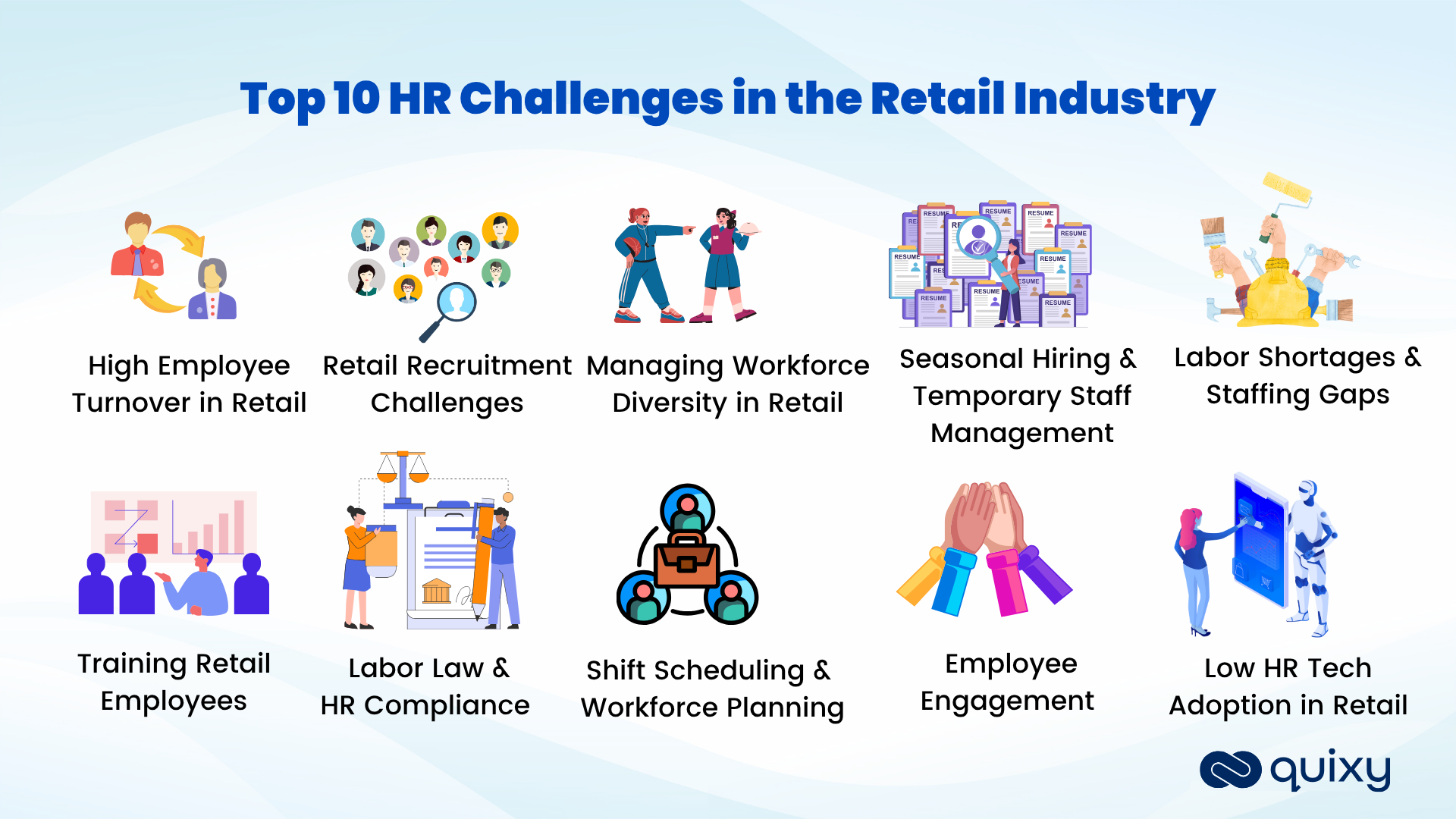
1. High Employee Turnover in Retail
High attrition is one of the main challenges in retail. Many employees view roles as stepping stones rather than long-term careers, and frequent exits disrupt store operations, lower morale, and drive up hiring costs. How to solve it: focused employee retention strategies, career mapping, engagement programmes, and clear incentives.
2. Retail Recruitment Challenges
Hiring at scale with speed and accuracy is a persistent struggle. Last-minute hiring, tight labour markets, and limited skilled candidates make retail recruitment a race against time. How to solve it: modern sourcing strategies and automated hiring workflows that keep the process moving even under pressure.
3. Managing a Diversified Workforce in Retail
Retail stores bring together diverse backgrounds, cultures, and skill sets. Diversity adds value, but it can also create challenges in communication, team dynamics, and inclusion. How to solve it: actively update policies to promote cultural sensitivity and provide unbiased opportunities that foster a unified workplace.
4. Seasonal Hiring & Temporary Staff Management
Seasonal sales spikes demand quick onboarding of gig workers, temps, and part-timers — without compromising compliance or quality. How to solve it: efficient, repeatable systems for training, tracking, and communication that spin up fast during peak periods.
5. Training Retail Employees Effectively
Upskilling is non-negotiable in retail — product knowledge, compliance, and service standards all matter. But training part-time or temporary staff in fast-paced environments often leads to inconsistent outcomes. How to solve it: design modular, accessible learning programmes that are scalable yet consistent.
6. Labor Shortages and Staffing Gaps
Retailers increasingly face staff shortages due to burnout, changing job expectations, and competition from gig-based work — leading to overworked teams, reduced service quality, and revenue loss. How to solve it: proactive workforce planning and stronger value propositions for employees.
7. Labor Law and HR Compliance Complexities
Managing compliance across multiple locations, shifts, and worker types is complex — and even minor lapses in wage or health-and-safety laws can attract penalties and brand damage. How to solve it: automated compliance checks and rule-based workflows that keep pace with evolving labour regulations.
8. Shift Scheduling and Workforce Planning
Coordinating multiple shifts and ensuring adequate store coverage is a constant juggling act, and poor scheduling leads to fatigue, dissatisfaction, or missed business. How to solve it: scheduling tools that align business needs with employee preferences and legal constraints.
9. Employee Engagement and Motivation
Monotonous tasks and customer pressure often lead to burnout and disengagement in retail roles. How to solve it: programmes that instil purpose, recognise achievements, and promote personal growth — meaningful engagement improves retention, especially in customer-facing and frontline roles.
10. Low HR Tech Adoption in Retail
Many retailers still run on outdated, manual workflows that slow down hiring, onboarding, and performance tracking. Modern HR tech — like next-gen ERP — enables data-driven decisions, automation, and scalable HR operations, but budget constraints and tech aversion often delay adoption. How to solve it: start small with low-cost, no-code apps that prove value quickly before scaling.
How Low-Code No-Code Platforms Help Overcome Retail HR Challenges
Speeding Up Seasonal Hiring
Retail HR teams can build LCNC recruitment solutions in days, not weeks — meaning faster application processing, quicker training, and better preparedness during peak sales periods with efficient HR platforms.
Smarter Workforce Scheduling
With customised scheduling tools, HR can automate shift planning, handle last-minute changes, and ensure fair distribution of hours — all while staying compliant with labour laws.
Smoother Onboarding & Training
Custom employee onboarding software, tailored to organisational needs, ensures part-time, full-time, and temporary workers receive consistent training. Interactive checklists and learning modules increase job readiness and reduce early dropouts.
Centralized Employee Data Management
All employee information — from attendance to performance — is stored securely in centralised, cloud-integrated data management systems for retail HR. Teams can access real-time updates across stores and regions without juggling spreadsheets.
Real-Time Compliance Monitoring
Automated custom notifications and digital logs help HR stay ahead of regulations. Whether it’s tracking break times or wage compliance, rule-based workflows reduce the risk of penalties.
Boosting Engagement & Recognition
Customisable, mobile-friendly feedback forms and digital recognition boards encourage real-time input and motivation. Engaged employees stay longer and deliver better customer service.
Quick Grievance Redressal
Mobile-friendly apps make it easy for employees to report issues or raise requests. HR gains a clear view of pending actions, resolving concerns faster and building employee trust.
Better Workforce Planning with Data
Tailored dashboards give a detailed view of labour trends, productivity, retention, 360-degree performance, and turnover. HR can adjust hiring and retention strategies proactively based on live data, not assumptions.
Additionally, according to Forrester’s Priorities Survey, 15% of businesses in the retail and wholesale sectors have implemented several generative AI solutions across their organisations.
How Quixy’s Custom LCNC Solutions Empower Retail HR Teams
Speed Up Recruitment with AI-Powered Suggestions
Quixy’s AI, Caddie, makes retail hiring faster and smarter — recommending app icons, building reports easily, and assisting with form automation. This helps HR teams quickly design recruitment apps without worrying about what to include, so no key detail is missed.
Manage High-Volume Hiring with Confidence
Quixy’s automation helps retail HR teams tackle bulk hiring with ease — create custom forms, set automated screening business rules, and manage candidate pipelines in record time.
Streamline Onboarding Across Store Locations
From sending welcome kits to assigning training, onboarding becomes effortless. Quixy lets you create fully customisable employee onboarding apps for part-time, gig, or full-time staff, ensuring consistency across all retail branches.
Ensure Compliance with a Single Dashboard
Quixy enables real-time tracking of wage laws, shift limits, and labour policies. Set compliance checkpoints into your workflows and avoid surprises during audits — especially useful when laws vary by region.
Innovate Safely with Sandbox Testing
Test new HR workflows — like new onboarding journeys or engagement surveys — in a secure sandbox before rolling them out company-wide. No disruption to your existing system: high confidence, zero risk.
Automate Performance & Feedback Loops
Design apps to manage evaluations, 360° feedback, or daily check-ins. Quixy keeps frontline staff aligned with retail goals and gives HR teams actionable insights — without requiring additional software.
Keep Staff Engaged, Even in High-Turnover Roles
With tools like survey software, appreciation boards, and the in-app conversations feature, HR can build a connected culture even among temp and gig staff — boosting morale, improving retention, and lifting the customer-facing experience.
Also read: How to Build an App: The Ultimate Guide for Non-Techies
Conclusion
Retail HR is one of the toughest environments in the business — high volume, high churn, and constant compliance pressure across every location. But almost every challenge on this list traces back to manual, disconnected processes, which is exactly what modern low-code/no-code platforms are built to fix.
Ready to transform your retail HR operations? Quixy is an AI-powered low-code/no-code platform built for rapid application development — so you can deploy a custom, powerful enterprise application for retail, designed for your exact needs, in as little as a week. Schedule a demo call with our experts today — we’ll understand your challenges and craft a tailored solution for every retail hurdle you face.
Frequently Asked Questions (FAQ)
1. Can LCNC applications help reduce employee turnover in retail?
Yes. Low-code/no-code apps streamline onboarding, training, and feedback, creating a better employee experience that boosts retention. Quixy helps retail HR build these tailored apps quickly, fostering loyalty and reducing costly turnover.
2. How can low-code, no-code platforms improve HR processes in retail?
Low-code and no-code platforms simplify HR workflows by enabling the quick creation of apps without coding — speeding up recruitment, scheduling, and compliance tasks. Quixy empowers retail HR teams to automate these processes and drive operational efficiency and growth.
3. How fast can HR apps be built and deployed with low-code, no-code platforms?
Low-code/no-code platforms like Quixy let HR teams build and launch custom applications within days, not months. That speed lets retailers respond to staffing challenges quickly and support continuous growth.
4. What are the benefits of using LCNC tools for retail HR management?
LCNC tools reduce dependency on IT, enable rapid customisation, and improve data accuracy in retail HR management. With Quixy, HR teams can tailor solutions fast — enhancing engagement and scaling business performance seamlessly.
Related Post


Please login to comment
0 Comments
Oldest
Recent Posts





- Download the App