

Digital transformation looks different in every organization — but the most successful initiatives all have one thing in common: they solve real business problems using digital capabilities.
While many digital transformation efforts struggle to scale, companies that focus on outcomes not tools see measurable gains in efficiency, customer experience, and agility.
In this article, you’ll explore 20+ real-world digital transformation examples across industries like retail, finance, healthcare, manufacturing, and more, showing how organizations transformed operations, customer experiences, and costs in practice.
According to a majority of business leaders, 81% view investing in digital transformation as crucial or indispensable for driving business success.
What is Digital Transformation?
Before diving into examples of digital transformation, here’s a quick context.
Digital transformation isn’t just about adopting new tools — it’s about rethinking how businesses operate, serve customers, and scale using digital capabilities.
It often involves modernizing processes, improving customer experiences, and enabling faster decision-making through data, automation, and connected systems.
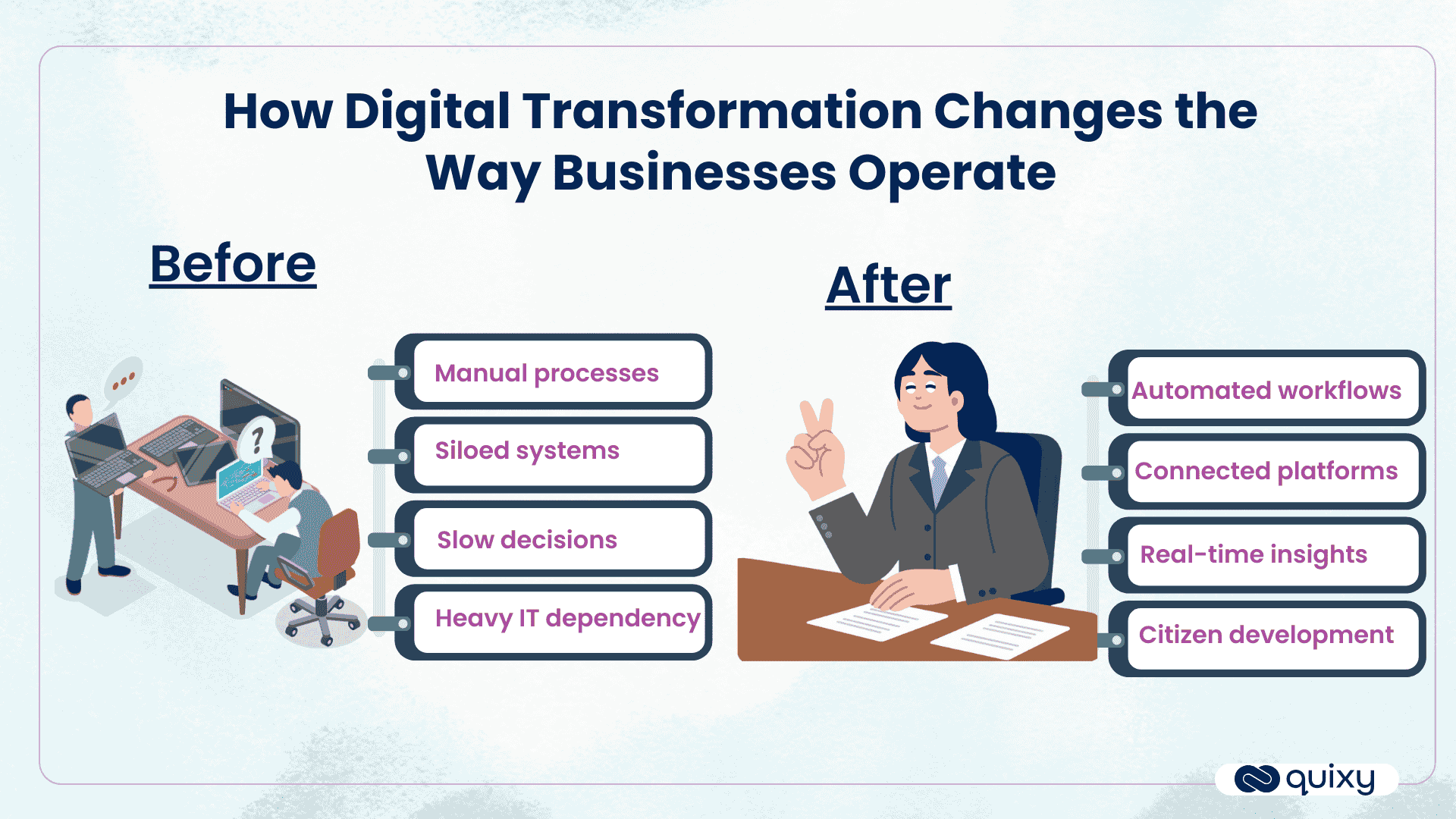
Want to understand why these digital transformation examples work and the business impact behind them?
👉 Read: Digital Transformation Impact & Benefits
Technologies Behind These Digital Transformation Examples
Below the Digital transformation examples will how how it isn’t driven by a single tool but by a combination of technologies that help organizations move faster, work smarter, and deliver better experiences.
- Cybersecurity and integration layers to ensure resilience and trust
- Low-code/no-code platforms for rapid app development and workflow automation
- Cloud and data platforms for scalability and real-time decision-making
- AI, RPA, and analytics to automate processes and personalize experiences
Best Examples of Digital Transformation in Real-world
Companies across various sectors will continue implementing digital transformation strategies to remain competitive in the ever-evolving marketplace. Here are five real-world big brand examples of digital transformation:
1. The Digital Transformation of Netflix
Netflix is our best option for keeping up with the latest movies & television shows that everyone talks about. Their mission is to entertain the world by hosting movies, TV shows, and documentaries.
The company is currently valued at $149 billion, and much of its success can be attributed to its ability to anticipate the future and transform.
To improve customer experience and satisfaction, Netflix CEO Reed Hastings approached Blockbuster with an offer. Initially, Blockbuster was a video rental service, but by 2007, technology was advancing, and people were becoming more comfortable using it.
As a result of their online viewing system, Netflix was able to address the concerns customers had with Blockbuster, such as late fees, and they were successfully able to deliver new value to their customers through a Digital Transformation, as well as change their buying habits and the way they watch movies in general.
2. NIKE’s Digital Transformation through SNKRS App
NIKE, a leading brand in sports footwear, is now focusing on mobile devices. Using machine learning and recommendation algorithms, it uses advanced technologies.
One of the company’s mobile applications helps choose the best shoe based on a leg scan.
A 13-point map of the feet is created by scanning the feet. In addition, the application provides the company with valuable information for making future footwear projects.
Its NIKE + loyalty program, which rewards its most active members, is one of the company’s most important projects. Sales increased significantly in Japan after the solution was implemented, and the Nike SNKRS application also recorded a 100% increase in sales.
In NIKE’s case, innovation has also led to a modernization of internal company operations. Design teams can work more quickly and efficiently by digitizing 6,000-footwear materials, and this directly affects response time to market demands.
Also Read: Crafting A Winning Digital Transformation Strategy: 7 Key Components
3. Starbucks Using AI Technology to Enhance Customer Satisfaction
Starbucks, a well-known coffee chain with over 32,000 stores in 80 countries, is famous to all coffee lovers. Unsurprisingly, Starbucks recognized the benefits of digital transformation and introduced the ‘Digital Flywheel’ in 2017.
The initiative focused on transforming rewards, personalization, payments, and ordering based on customer feedback. Cloud-based platforms improved Starbucks’ ability to offer tips and order products while managing inventory and production.
In addition to technology, Starbucks has integrated Artificial Intelligence into its app, allowing them to personalize its product offerings and offer rewards based on consumer preferences. According to Starbucks’ CEO, he wants to continue harvesting new technologies, which is why Starbucks is the world’s most famous coffee brand.

4. AUDI’s Digital Showroom
It is hard to find a more analog industry than the automotive one. Despite this, AUDI has decided to enter the digital world with its new services and is now one of the most successful examples of digital transformation.
Under the name Audi City, the company introduced an innovative showroom concept in 2012. Rather than traditional showrooms with many exhibited cars, micro-showrooms in city centers let users explore the entire catalog of the brand’s cars.
Discovering and buying cars can be done while wandering around city center stores, making the experience enjoyable and accessible for everyone. Audi City is where forums and exhibitions are held in the evenings, further enhancing the brand’s position.
Advanced car configuration is possible on interactive screens in stores using full-size car images. Using your tablet to look inside the car, watch it move, and hear the engine sound is possible.
Compared to traditional showrooms, sales increased by 60% in Audi City, where only four cars are permanently exhibited (savings for Audi!).

5. Adobe’s Digital Transformation
Adobe was founded in 1982 and is an American software company. Photoshop (for editing images), Adobe Acrobat Reader (for viewing and editing PDF files), or Illustrator (for creating vector-based illustrations) are probably some of their flagship products.
In the past, Adobe sold boxed software under the name Adobe Systems. During the 2008 crisis, the company made a risky move from a license-based model to a subscription-based model. Their service offering was redefined and divided into three cloud-based solutions: Creative Cloud, Document Cloud, and Experience Cloud. As a result, Adobe became a cloud company that offers software-as-a-service (SaaS).
They also acquired an e-commerce platform (Magento) and a web analytics company (Omniture) as part of their digital transformation. Furthermore, the company realized it could achieve its goals only if it had the best talent. Adobe invests in employee-focused work cultures, benefits, and employer branding to ensure employee satisfaction. A data-driven operation model was also employed to monitor the company’s health.
Their digital transformation encompassed many elements: a new business model (SaaS), new technology (cloud), a new HR management strategy, data-driven operations, etc. Adobe’s digital transformation example demonstrates the following two points:
- A business can gain a substantial competitive advantage through digital transformation.
- The change must affect everyone in the organization and redefine how things are done.
6. Airbnb Disrupting Hospitality with a Sharing Economy Platform
Imagine a world where your next adventure isn’t confined to cookie-cutter hotels but a symphony of unique spaces awaiting your exploration. This is the magic of Airbnb’s digital transformation solution. By defying traditional norms, Airbnb has turned the hospitality industry on its head. With a few clicks, travelers can unlock a universe of one-of-a-kind accommodations hosted by locals who open their doors to share their spaces and stories.
Gone are the days of mundane booking processes. Airbnb’s sleek digital interfaces take you on a journey from dreaming to experiencing. The platform thrives on transparency, fueled by user reviews that breathe life into each stay. The once-anonymous hosts now become your virtual tour guides, offering insider tips and creating bonds that stretch beyond geographical boundaries.
Security is paramount in this new era of travel, and Airbnb’s secure payment systems provide both hosts and guests peace of mind. This trust, combined with a gamut of accommodations, from treehouses to castles, fosters a sense of belonging that’s unmatched in conventional lodging.
In rewriting the rules of hospitality, Airbnb’s transformation is not just digital; it’s a movement that champions connection, adventure, and a tapestry of human experiences.
7. Amazon Reinventing Retail with Data and Automation
Picture a bookstore evolving into a digital behemoth that can summon your heart’s desires with a single click. Enter Amazon, the epitome of retail digital transformation that has rewritten the story of shopping. Their journey began with books, but their destination was a global marketplace that transcends borders and time zones.
At the core of Amazon’s transformation is a symphony of data. They’ve harnessed the power of analytics to understand customers better than they understand themselves. With AI-driven recommendations, they curate personalized shopping experiences that leave traditional retail in the dust.
But Amazon’s impact doesn’t stop at the screen; it echoes in the warehouses where algorithms orchestrate an intricate dance of products, ensuring quick deliveries that defy imagination. Supply chain optimization isn’t just a phrase; it’s the pulse that keeps this retail titan ticking.
Automation is the heartbeat of Amazon’s revolution. Behind the scenes, robots navigate the aisles, and drones prepare for takeoff, making doorstep deliveries a reality straight out of science fiction.
And the customer experience? It’s the gold standard. From easy returns to seamless payments, Amazon has rewritten the rulebook, turning shopping into an adventure rather than a chore.
In the digital age, Amazon isn’t just a retailer; it’s a trailblazer that’s redefined convenience, speed, and the very essence of how we shop and live.
Digital Transformation Example in Banking
The banking sector is undergoing a profound transformation, extending far beyond the adoption of mobile banking and cash apps. Today, consumers are embracing innovative financial tools such as cash airdrops, cardless payments via services like Apple Pay on smartphones or smartwatches, and even entirely bankless banking solutions.
However, these advancements represent only the baseline for staying relevant in the rapidly evolving financial landscape. To foster customer loyalty and deliver superior experiences, banks must continuously innovate and push the boundaries of what’s possible.
Capital One stands as a prime example of digital transformation in banking. After acquiring ING Direct, a pioneer in digital banking, Capital One embarked on an ambitious journey to redefine itself as a leader in digital innovation. By placing software at the heart of its operations, the company has emerged as a technological powerhouse, boasting a workforce of approximately 11,000 tech professionals and holding over 500 artificial intelligence (AI) patents.
Intergiro has reimagined banking and business operations through its concept of embedded banking. This approach automates payroll systems, invoicing, and reconciliation processes, seamlessly integrating with apps for checkouts, digital wallets, and card management. Intergiro envisions a future where every company evolves into a financial technology (fintech) entity, embedding financial services directly into their operations.
Meanwhile, J.P. Morgan is making strides in the virtual realm by entering the metaverse. The bank has launched the Onyx Lounge in Decentraland, a blockchain-based virtual world. In this digital space, J.P. Morgan aims to replicate its real-world banking services, offering financial solutions tailored to the needs of the metaverse community.
These examples of digital transformation illustrate how digital transformation is reshaping the banking industry, driving innovation, and creating new opportunities for both financial institutions and their customers.
Also Read: From Paper to Digital: 9 Simple Steps for a Successful Digital Procurement Strategy
Digital Transformation Example in Healthcare
Atria Senior Living in Kentucky addressed its prospect management challenges by developing a customized customer relationship management (CRM) system. This system was equipped with essential features to monitor website interactions, such as tracking how often prospects used specific keywords like “need” in chatbot conversations, flagging important actions for the sales team, and analyzing how prospects engaged with their different communities.
Atria introduced an engagement app designed to help families stay connected and communicate with their loved ones, especially during the pandemic. To further enhance operational efficiency, they also launched a care management app, streamlining time management and improving the quality of care for their residents. These innovations not only improved internal processes but also strengthened relationships with families and prospects.
Digital Transformation Example in Consumer Goods Sector
nilever took digital transformation a step further by integrating AI-driven tools into its internal HR processes. The company uses AI to screen job applicants, conduct video interviews, and assess candidate fit through platforms like HireVue. This has streamlined recruitment, reduced bias, and improved the quality of hires. Unilever also uses AI for employee training and development, offering personalized learning paths through platforms like Degreed.
Digital Transformation Example in Energy & Industrial Equipment Sector
GE developed the Predix platform, an industrial IoT solution, to monitor and manage internal assets in real time. The platform collects data from sensors embedded in machinery, enabling predictive maintenance and reducing downtime. For example, GE uses Predix to monitor gas turbines, predicting failures before they occur and optimizing performance. This has significantly improved operational efficiency and reduced costs.
Digital Transformation Example in Logistics and Shipping Industry
Maersk partnered with IBM to create TradeLens, a blockchain-based platform that improves supply chain transparency. The platform digitizes and tracks shipping documents, reducing paperwork and delays. For instance, Maersk used TradeLens to streamline the shipment of flowers from Kenya to the Netherlands, cutting processing times from days to hours. This has enhanced efficiency and reduced costs for both Maersk and its customers.
Digital Transformation Example in Aerospace & Building Technologies Sector
Honeywell uses AI and machine learning to monitor internal manufacturing equipment and predict maintenance needs. For example, the company uses AI to analyze data from sensors in its aerospace components, predicting failures before they occur. This has reduced downtime, improved operational efficiency, and lowered maintenance costs. Honeywell also applies AI in its building technologies division to optimize HVAC systems and energy usage.
Digital Transformation Example in Heavy Equipment & Machinery Industry
Caterpillar uses IoT sensors to monitor the performance of its internal equipment and machinery. The data collected is analyzed to optimize operations, reduce fuel consumption, and improve equipment lifespan. For instance, Caterpillar’s CAT Connect platform provides real-time insights into equipment health, enabling proactive maintenance and reducing downtime. This has improved efficiency and reduced costs for Caterpillar and its customers.
Digital Transformation Example in the Chemical Industry
BASF uses digital twins to simulate and optimize internal chemical production processes. For example, the company created a digital twin of its Ludwigshafen plant, allowing engineers to test and refine production workflows in a virtual environment. This has improved efficiency, reduced waste, and enhanced product quality. BASF also uses digital twins to train employees and simulate emergency scenarios.
Digital Transformation Examples in Action with Quixy
1. Jatagan Security with 50% Higher Productivity
Jatagan Security, based in Sacramento, CA, is known for going above and beyond to provide innovative and cost-efficient options and conquer tough challenges like limited power and communication lines.
As Jatagan Security continued to grow, its manual inventory management system faced a major challenge – scalability. Managing larger inventories, multiple locations, and surging order volumes manually led to inefficiencies and costly errors. They needed a solution to maintain their stellar service. Jatagan Security decided to embrace innovation by choosing Quixy. The no-code platform allowed them to create a tailored inventory management system that automated processes like inventory tracking, order management, and more. It eliminated manual work and boosted efficiency. Learn More.
2. Revolutionizing Inspections at HMWSSB
Imagine a scenario where everything related to inspections is done manually using Excel sheets and documents. For the executives at HMWSSB, this was a daily struggle. They faced challenges in validating information and keeping track of the status of thousands of Customer Account Numbers (CANs). But then, they discovered Quixy, and things started to change. Under HMWSSB’s jurisdiction, there are nearly 10 Lakh water and sewerage connection CANs, each requiring periodic inspection. The records related to payments, customer details, arrears, and more needed to be meticulously tracked. Unfortunately, this was being done using Excel and manual sheets, which led to issues with data accuracy and real-time updates.
Thanks to Quixy’s no-code capabilities and problem-solving expertise, HMWSSB achieved a digital transformation within 15 days. They built an automated inspection solution that simplified their entire process. Learn More.
3. Fenesta brings down TAT
Fenesta’s strength lies in its ability to design windows and doors that can withstand India’s challenging climate, thanks to its in-house uPVC blend and profiles manufacturing. Fenesta operates in over 327 cities through various channels, including sales offices, factories, studios, and partner showrooms, supported by a robust sales team of 500+ executives. As their sales orders increased, processing them in a timely manner became a daunting task. The existing manual system, relying on emails and reminders, led to errors and lost requests buried in email threads. Lack of process control and standardization affected customer interactions and satisfaction with the sales team.
The Quixy-powered workflow brought control and transparency, boosting sales team satisfaction. Manual reminders and follow-ups became history, as Quixy ensured timely notifications. Mandatory form fields improved data accuracy, and built-in business rule validations ensured requests were routed correctly. Determining TAT was simplified, and audit trails were effortlessly compiled with timestamped actions. Learn more.
4. Adani Green’s Digital Transformation Journey
Adani Green, a major player in India’s energy sector, handles over 1400 purchase requisitions (PR) every month. Their challenge? An outdated process relies on a mix of emails, Excel, SAP, and manual efforts to track the PR to PO (Purchase Order) process. It was time-consuming, error-prone, and impacted turnaround times. That’s when Quixy stepped in to drive their digital transformation.
PRs poured in from different businesses, each with its unique nature and criticality. The existing methods, including emails, Excel, SAP, and SAP Ariba, made it tough to track PR statuses. Mismanagement and lack of data visibility led to endless follow-ups and project delays, affecting the business’s project life cycle. Adani Green sought a solution to reduce errors, and delays, and improve data transparency. Quixy’s no-code capabilities made designing a comprehensive workflow for end-to-end purchase requisition tracking possible in just a month. Learn More.
What These Digital Transformation Examples Have in Common
Successful digital transformation initiatives share common principles that drive efficiency, innovation, and competitiveness across industries. A customer-centric approach remains key, with companies enhancing user experiences through personalization and accessibility, as seen in Netflix, Starbucks, and Airbnb. Data-driven decision-making plays a crucial role, with organizations like Amazon, GE, and Unilever leveraging AI and analytics to optimize operations. Automation further improves efficiency, reducing costs and streamlining processes, as demonstrated by Caterpillar, Honeywell, and Intergiro. The adoption of emerging technologies such as AI, IoT, blockchain, and digital twins keeps businesses ahead, with Maersk, BASF, and J.P. Morgan leading the way.
Beyond technology, a cultural shift towards innovation empowers employees, as seen in Adobe, Unilever, and Quixy. Scalability and flexibility ensure digital solutions evolve with business needs, much like Salesforce, Quixy, and Netflix. Improved collaboration and communication tools foster seamless interactions, benefiting organizations such as Marriott, Atria Senior Living, and Salesforce. Security and compliance remain critical, with companies like J.P. Morgan, Equifax, and Quixy prioritizing data protection. Continuous innovation ensures sustained competitiveness, as demonstrated by Tesla, Adobe, and Netflix.
Measurable ROI links digital initiatives to tangible business outcomes, driving growth for brands like NIKE, Caterpillar, and Quixy. Integrating ecosystems enables smooth operations, with DHL, Schneider Electric, and Quixy excelling in this area. Lastly, a focus on sustainability ensures responsible digital evolution, as exemplified by Schneider Electric, John Deere, and BP. Ultimately, to stand as a successful example of digital transformation is not just about adopting new technologies butaligning them with business goals, fostering a culture of innovation, and prioritizing customer and employee needs to drive meaningful change and long-term success.
Not every digital transformation succeeds. Understanding common pitfalls can help avoid costly mistakes.
👉 Read: Digital Transformation Challenges & Failures (And How to Avoid Them)
While Digital transformtion examples show what success looks like, execution requires a clear roadmap. A structured approach helps organizations avoid delays, resistance, and costly missteps during transformation.
👉 Follow a framework: Digital Transformation Roadmap 101
The ROI of Digital Transformation
It’s Behind every successful digital transformation example is a measurable return—whether through cost savings, productivity gains, or revenue growth. Understanding how to track ROI helps justify and scale transformation initiatives.
👉 Measure success: Digital Transformation ROI – A Step-by-Step Guide
Conclusion
Digital transformation looks different for every organization—but the digital transformation examples across industries make one thing clear: success comes from solving real operational problems, not chasing technology for its own sake. Whether it’s eliminating manual work, improving customer experiences, or enabling faster decision-making, the most impactful transformations start small, stay focused, and scale with confidence.
Platforms like Quixy show how organizations can move from ideas to execution without long development cycles or heavy IT dependence. By enabling teams to automate workflows, digitize processes, and adapt quickly, businesses can turn transformation from a one-time initiative into an ongoing capability.
The takeaway is simple: digital transformation isn’t about what tools you adopt—it’s about how effectively you use them to create measurable outcomes. And the right approach can make transformation practical, repeatable, and sustainable.
Schedule a demo with Quixy and experience the power of digital transformation firsthand!
Frequently Asked Questions(FAQs)
Q. What are digital transformation examples in real businesses?
Digital transformation examples include companies automating manual workflows, adopting cloud platforms for scalability, using AI for decision-making, or digitizing customer journeys to improve experience and efficiency.
Q. What is a simple example of digital transformation?
A simple example of digital transformation is replacing paper-based approval processes with digital workflows that automate routing, tracking, and reporting in real time.
Q. What is an example of digital transformation in operations?
An example of digital transformation in operations is using automation and no-code/low-code platforms to streamline procurement, HR onboarding, or compliance processes—reducing errors and turnaround time.
Q. How do digital transformation examples differ across industries?
Digital transformation examples vary by industry: retail uses personalization and analytics, healthcare adopts telemedicine and digital records, manufacturing leverages IoT and automation, and finance focuses on digital customer experiences and security.
Q. Why are digital transformation examples important for businesses?
Digital transformation examples help businesses understand how technology drives real outcomes like cost reduction, faster execution, and better customer experiences—beyond theory or buzzwords.
Q. What is an example of digital transformation using no-code platforms?
An example of digital transformation using no-code is when business teams build apps to automate internal workflows or customer-facing processes without relying heavily on IT or long development cycles.
Q. How can companies apply digital transformation examples to their own strategy?
Companies can study digital transformation examples to identify repeatable patterns—start with high-impact processes, pilot small changes, measure results, and scale successful initiatives across the organization.
Related Post



Please login to comment
0 Comments
Oldest
Recent Posts







- Download the App