

A digital transformation roadmap is not just a timeline for adopting new technology. It is a structured execution plan that connects business goals, processes, people, data, governance, and measurable outcomes.
Many organizations start digital transformation with ambition but struggle during execution. Projects slow down because priorities are unclear, systems are disconnected, teams are not aligned, and success metrics are not defined early.
A strong roadmap for digital transformation helps businesses move from scattered digital initiatives to a clear transformation journey. It shows what needs to change, which processes should be prioritized, how technology should be implemented, and how business value will be measured.
In 2026, the most effective digital transformation roadmaps are practical, phased, and outcome-led. They focus on workflow automation, data visibility, governance, change readiness, and ROI instead of technology adoption alone.
What Is a Digital Transformation Roadmap?
A digital transformation roadmap is a step-by-step plan that guides how an organization will modernize its processes, systems, data, and operating model using digital technologies.
It defines the current state, future goals, priority initiatives, implementation sequence, governance model, timelines, ownership, and success metrics.
In simple terms, a roadmap to digital transformation answers where the business is today, where it wants to go, what needs to change first, who will own the transformation, and how success will be measured.
A digital transformation strategy roadmap is useful because it connects business vision with practical execution. It helps teams move beyond broad planning and focus on the actions, owners, timelines, and outcomes needed to make transformation successful.
| Roadmap element | What it defines |
|---|---|
| Current state | Existing processes, systems, gaps, and pain points |
| Future state | How the business should operate after transformation |
| Priority initiatives | Which projects should be executed first |
| Governance | Owners, roles, controls, and decision-making |
| Execution plan | Timeline, phases, resources, and dependencies |
| Success metrics | KPIs, ROI, adoption, and process performance |
Strategy vs. Roadmap
Strategy defines direction.
The roadmap defines execution.
A digital transformation strategy answers why transformation is necessary and what outcomes are desired. A digital transformation roadmap answers how those outcomes will be delivered and when.
Without a roadmap, even strong strategies can collapse into execution chaos.
A digital strategy roadmap connects the organization’s long-term digital vision with the practical steps needed to achieve it. While the strategy explains the business direction, the roadmap translates that direction into priorities, timelines, owners, technology choices, governance, and measurable outcomes.
In practice, a digital roadmap strategy should not only focus on tools. It should also define how processes, people, data, and workflows will change over time.
Why a Digital Transformation Roadmap Prevents Execution Breakdown
In enterprise environments, transformation without sequencing creates predictable problems:
- Programs compete for shared resources
- Integration challenges emerge late
- Technical debt increases
- Budget overruns multiply
- ROI becomes difficult to track
A digital transformation roadmap introduces discipline. It ensures transformation unfolds in waves, not collisions.
Digital transformation emphasizes three pillars of change- leveraging technology to enhance business capabilities, building operational efficiencies, and constantly improving customer experience.
Also Read: Digital Transformation in Insurance
How to Structure an Enterprise Digital Transformation Roadmap
Before outlining the phases, it’s important to understand that a digital transformation roadmap is not a linear checklist. It is a phased execution model designed to reduce risk, control investment, and align delivery with business capacity.
Each phase builds on the previous one. Skipping steps may accelerate early momentum, but it almost always creates downstream friction — integration gaps, budget overruns, adoption challenges, or governance issues.
The goal of a structured digital transformation roadmap is not speed alone. It is sustainable progress.
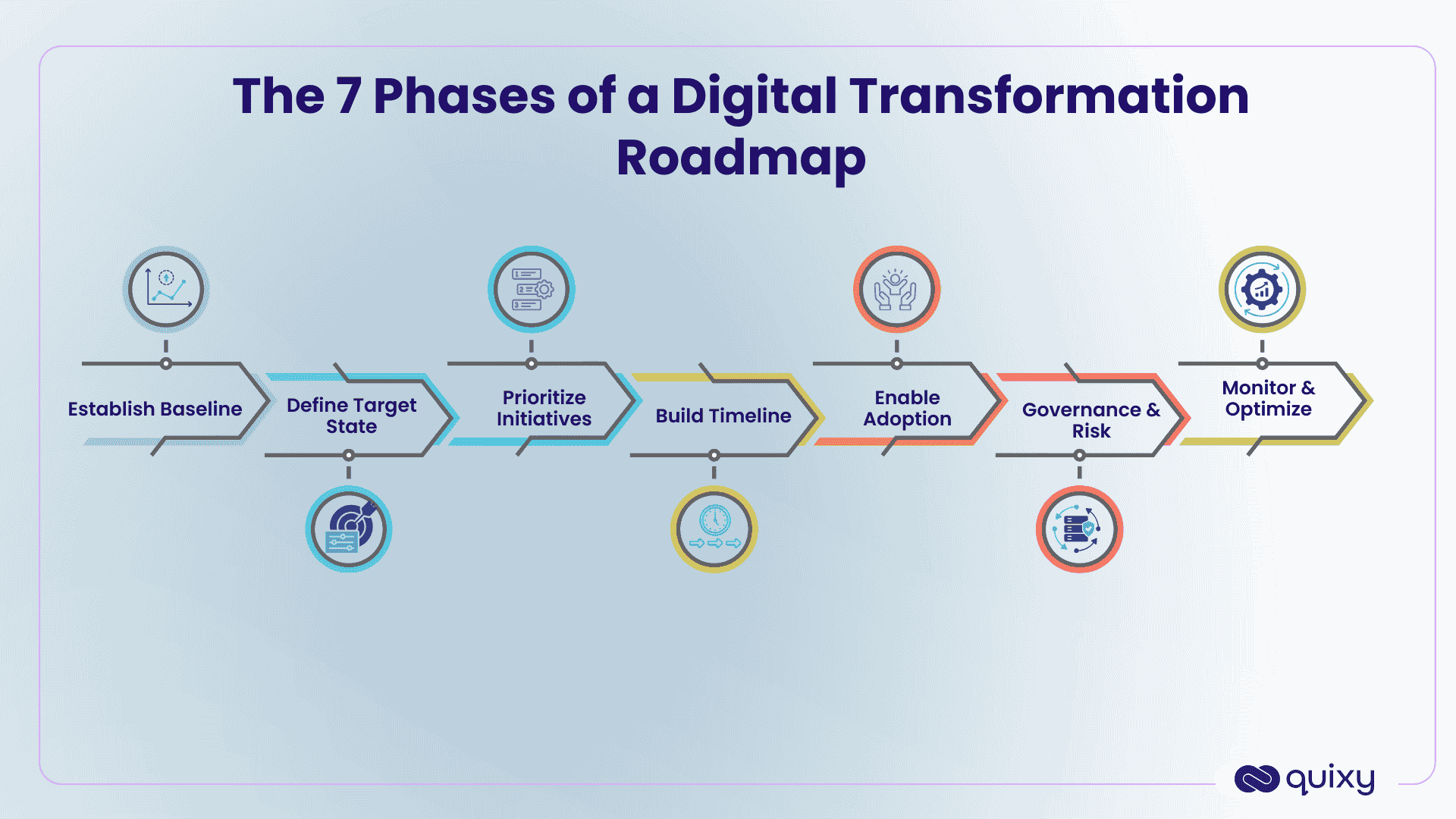
The following phases represent a disciplined, enterprise-ready framework for translating transformation intent into operational execution.
Phase 1: Establish the Baseline
Before launching initiatives, you need operational clarity.
This phase is about grounding ambition in reality.
Digital Maturity Snapshot
Assess where the organization stands across automation, data usage, system integration, customer experience, and governance. This is not a marketing exercise. It’s a delivery reality check.
Technology Inventory
Document existing systems, platforms, integrations, licenses, and redundancies. Many digital transformation roadmap failures stem from building on inaccurate system assumptions.
Process Bottleneck Mapping
Identify high-friction workflows and manual dependencies. These often represent early optimization opportunities — and integration risks.
Change Readiness Scan
Evaluate cultural readiness, skill gaps, and stakeholder alignment. Execution speed depends heavily on organizational absorption capacity.
Skipping this phase leads to unrealistic timelines and misaligned expectations later.
Phase 2: Define the Target Operating Environment
With the current state clear, define what the future operating environment should look like.
This is not strategic philosophy. It is structural clarity.
Target Architecture Model
Outline the intended system landscape: consolidation goals, integration principles, and platform direction.
Experience Benchmarks
Define how internal users, partners, and customers should experience digital interactions once transformation matures.
Data Governance Model
Clarify ownership, accessibility, compliance standards, and reporting structures.
This phase sets the structural guardrails for every initiative that follows.
Phase 3: Sequence and Prioritize Initiatives
Now execution becomes tangible.
Transformation initiatives must be sequenced deliberately — not politically.
Categorize Initiatives
Group initiatives by capability area: automation, analytics, integration, customer experience, security, etc.
Map Dependencies
Identify which initiatives rely on others. For example, analytics modernization may depend on data standardization first.
Evaluate Impact vs. Feasibility
Use a structured framework to assess:
- Business impact
- Technical complexity
- Resource demand
- Risk exposure
Balance Quick Wins and Structural Investments
Quick wins build momentum. Structural investments build durability.
A mature digital transformation roadmap balances both.
Phase 4: Build a Realistic Execution Timeline
This is where operational leadership matters most.
Transformation should be delivered in waves — not as a single monolithic rollout.
Wave-Based Rollout Planning
Break execution into structured phases with clear entry and exit criteria.
Budget Phasing
Align funding allocation with delivery waves. Avoid front-loading all investment without value checkpoints.
Resource Planning
Account for internal bandwidth. Overloading the same teams across multiple initiatives is one of the most common causes of delay.
Governance Cadence
Define steering committees, review checkpoints, and escalation paths early. Governance must scale with execution.
A realistic timeline is not aggressive for the sake of optics. It is disciplined for the sake of delivery.
Phase 5: Enable Adoption at Scale
Implementation does not equal adoption.
Many transformation programs declare success when systems go live — only to discover low usage, shadow systems, or resistance.
Adoption must be engineered.
Stakeholder Mapping
Identify impact levels across business units and roles.
Role-Based Training
Generic training rarely works. Enablement must reflect actual usage patterns.
Structured Communication
Communicate the “what,” “why,” and “what changes for me” clearly and consistently.
Feedback Loops
Capture early friction points and refine rollout tactics quickly.
Adoption discipline protects ROI.
Phase 6: Embed Governance and Risk Controls
As initiatives scale, risk exposure increases.
Governance cannot be reactive.
Security Reviews
Integrate security validation into each phase, not as a final checkpoint.
Compliance Alignment
Ensure regulatory and data privacy standards are embedded from design to deployment.
Vendor Oversight
Track performance, SLAs, and contractual alignment continuously.
Change Control Mechanisms
Define how scope changes are evaluated and approved. Uncontrolled scope is a digital transformation roadmap killer.
Governance sustains execution stability.
Phase 7: Monitor, Measure, Optimize
A digital transformation roadmap is not static.
Performance tracking must continue throughout execution.
Operational KPIs
Track process efficiency improvements, cycle time reductions, automation rates, and system uptime.
Adoption Metrics
Monitor user engagement, active usage levels, and behavioral shifts.
ROI Tracking
Link initiatives to cost savings, revenue impact, and risk mitigation outcomes.
Continuous Iteration
Adjust sequencing or scope based on data, not intuition.
Optimization transforms a roadmap from a plan into a living delivery system.
Digital transformation roadmap example
A simple digital transformation roadmap example can begin with purchase request automation.
The current state may involve employees submitting purchase requests through email, managers approving them manually, and finance teams tracking everything in spreadsheets. This creates delays, missing records, and poor visibility.
The future state could be a centralized workflow where employees submit requests through a digital form, approvals are automatically routed to the right manager, finance receives complete records, and leadership can track pending requests through dashboards.
This example shows how a roadmap digital transformation approach can start with one high-impact workflow, measure results, and then expand to vendor onboarding, invoice approvals, contract approvals, and budget tracking.
Common Digital Transformation Roadmap Mistakes
Even structured roadmaps can fail when discipline slips.
Common pitfalls include:
- Over-sequencing too many initiatives at once
- Underestimating integration complexity
- Ignoring data migration effort
- Skipping change management
- Failing to assign clear ownership
- Allowing scope creep
- Treating governance as optional
Avoiding these mistakes protects execution velocity.
Accelerating Your Digital Transformation Roadmap with No-Code Platforms
Accelerating Roadmap Execution with Enterprise No-Code Platforms
Even the most well-structured digital transformation roadmap can stall due to delivery bottlenecks.
Development backlogs grow. IT bandwidth becomes constrained. Business teams wait months for relatively small workflow improvements. Momentum slows.
This is where enterprise no-code platforms can play a strategic role.
Rather than replacing core systems, no-code platforms complement them. They enable organizations to:
- Digitize internal workflows faster
- Reduce reliance on lengthy development cycles
- Pilot process improvements before large-scale investments
- Empower business teams to build within defined governance boundaries
When implemented with proper oversight, no-code supports roadmap acceleration without compromising architectural standards, security, or compliance controls.
Platforms like Quixy provide enterprise-grade governance, integration capabilities, and centralized visibility — allowing transformation teams to execute faster while maintaining control.
Used thoughtfully, no-code becomes a delivery enabler within the broader roadmap — not a parallel IT experiment.
Also Read: The Conundrum of Digitization, Digitalization, and Digital Transformation
Execution Discipline Turns Ambition into Outcome
A digital transformation roadmap does not guarantee success.
But without one, execution drift is inevitable.
Transformation progresses when:
- Sequencing is disciplined
- Ownership is explicit
- Budgets are aligned with phases
- Adoption is managed proactively
- Performance is continuously measured
A roadmap is not documentation.
It is delivery control.
And in enterprise transformation, disciplined execution is what ultimately turns strategic ambition into measurable results.
According to Gartner, 91% of businesses are engaged in some form of digital initiative, and 87% of senior business leaders say digitalization is a priority.

Also Read: How Quixy Can Help You with Digital Transformation?
Conclusion
It’s impossible to think of digital transformation without considering the difficult transitionary period of change. But digital transformation is less about technology and more about organizational change management and culture- when all the stakeholders related to the business get on board to reinvent old systems, adopt new technology and take the initiative to simplify workflows, the effect can be spectacular.
When companies execute projects with agility, they can deliver high-value solutions to their customers, delight them more accessible and faster, and save costs while they’re at it. There is no right or wrong way to transform a business digitally, and that’s its beauty. The key is to understand business goals, find ways to constantly innovate, and never shy away from adopting technology to build operational efficiencies. To stay relevant in a digital-first world, it’s essential to become digital and move away from legacy technologies. After all, even a caterpillar has to come out of its cocoon to become a butterfly.
Frequently Asked Questions(FAQs)
Q.What is a digital transformation roadmap?
A digital transformation roadmap is a step-by-step execution plan that shows how an organization will modernize its processes, systems, data, and operating model using digital technologies. It includes priorities, timelines, ownership, governance, and success metrics.
Q. Why is a digital transformation roadmap important?
A digital transformation roadmap is important because it gives structure to transformation initiatives. It helps businesses avoid scattered technology adoption, align teams, prioritize high-impact projects, manage risk, and measure business outcomes.
Q. How to create a digital transformation roadmap?
To understand how to create a digital transformation roadmap, start by assessing the current state of processes, systems, and data. Then define future goals, prioritize initiatives, assign owners, build governance, plan phased execution, support adoption, and track ROI through clear KPIs.
Q. What are the key stages of a digital transformation roadmap?
The key stages include assessing the current state, defining future goals, prioritizing initiatives, assigning ownership, building governance, executing in phases, managing adoption, and tracking ROI.
Q. What is the difference between digital transformation strategy and roadmap?
A digital transformation strategy explains the vision, goals, and priorities. A digital transformation roadmap explains how the strategy will be executed through phases, timelines, owners, technology, governance, and measurable outcomes.
Q. How can no-code help in a digital transformation roadmap?
No-code helps businesses execute roadmap initiatives faster by enabling teams to digitize forms, automate workflows, create dashboards, and build department-level applications without traditional coding. It supports faster implementation while IT maintains governance and control.
Related Post



Please login to comment
0 Comments
Oldest
Recent Posts







- Download the App