

Every project has unique demands—some require strict planning and clear milestones, while others thrive on flexibility and rapid iteration. Traditional project management delivers predictability through structured phases, clear timelines, and comprehensive documentation. Agile, on the other hand, prioritizes adaptability, continuous feedback, and iterative progress.
Hybrid Project Management blends these approaches. It lets teams apply structure where stability matters and agility where speed and innovation are critical. This method is ideal for complex projects with mixed requirements, helping organizations deliver on time without sacrificing responsiveness.
Definitions at a Glance:
- Traditional Project Management: A linear, sequential method emphasizing upfront planning, fixed scope, and predictable delivery.
- Agile Project Management: An iterative, flexible approach where tasks are executed in short cycles with ongoing feedback.
- Hybrid Project Management: A combination of Traditional structure and Agile flexibility, allowing teams to balance control and adaptability.
Today’s projects demand a method that can do both: provide clarity while staying adaptable. This blog explains how Hybrid PM works, when to use it, its benefits, real-world examples, and how modern tools like low-code no-code platforms can support it.
The Real Challenge: Data Silos in Traditional PM
Traditional project management tools and workflows often operate in isolation. When teams work with separate spreadsheets, documents, and systems:
- Decisions are delayed due to incomplete or outdated information.
- Resource allocation becomes inefficient.
- Teams struggle to collaborate across departments.
According to a PMI report, 43% of projects fail or face delays due to poor information flow and lack of integration between teams.
Breaking these silos requires tools and processes that connect traditional phases with iterative workstreams, ensuring all stakeholders access real-time project data.
As organizations modernize their delivery models, many find that neither pure Agile nor pure Waterfall fits the realities of today’s work. Teams need structure, but not at the cost of speed. They need flexibility, but not at the cost of governance. This is where hybrid project management stands out.
Why Hybrid Project Management Works
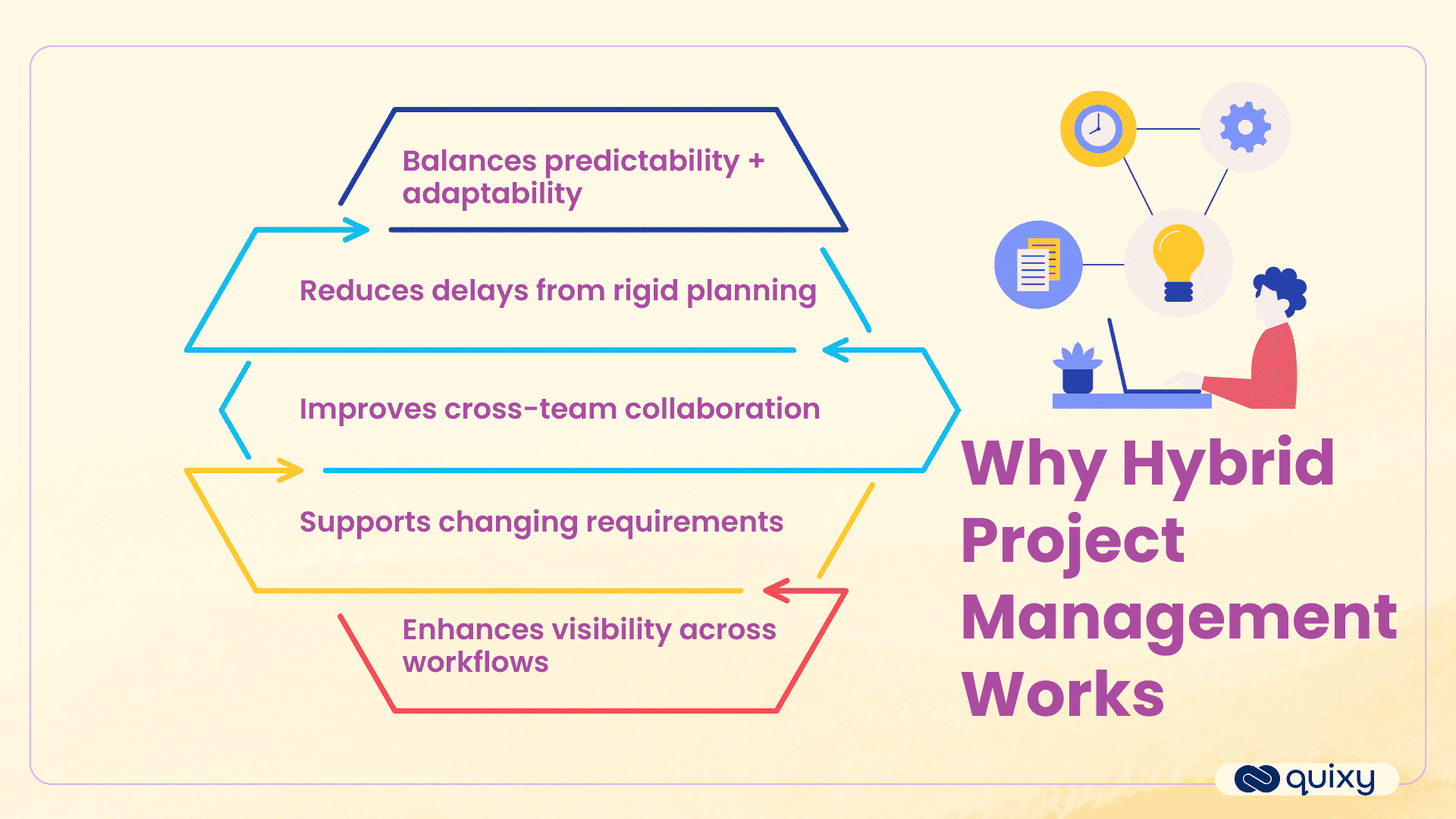
Hybrid PM succeeds because it respects the strengths of both methods instead of forcing a trade-off.
Balances predictability and adaptability
Stakeholders get structured planning, documented milestones, and budget clarity—while Agile teams iterate quickly where flexibility matters.
Reduces delays caused by rigid planning
Instead of waiting for full-phase completion, teams move forward in smaller cycles, incorporating new information early.
Improves cross-team collaboration
Hybrid PM connects Agile boards, documentation workflows, and reporting systems. This reduces the disconnect between development, design, operations, and business units.
Supports changing requirements
When requirements evolve mid-project, Agile sprints absorb changes without derailing the entire timeline.
Enhances visibility across workflows
Integrated dashboards and synchronized platforms ensure everyone—from executives to team members—sees the same real-time data.
Hybrid PM is practical, flexible, and grounded in the realities of enterprise projects.
How Hybrid PM Bridges Traditional and Agile
A Hybrid approach does not replace either methodology. Instead, it merges them intelligently:
Planning
Traditional approach is used for defining scope, dependencies, risks, and high-level milestones—especially in compliance-heavy or long-term initiatives.
Execution
Agile practices drive execution for parts of the project that benefit from sprints, rapid feedback, prototyping, or iterative releases.
Integration
Agile tools (Kanban boards, task boards, sprint dashboards) are integrated with traditional systems (Gantt charts, project charters, stakeholder reports).
This ensures:
- Smooth data flow
- Real-time updates
- Shared visibility
- Aligned decision-making
- Reduced rework
Hybrid PM ultimately creates one connected system, not two isolated methodologies.
Where Hybrid PM Fits Best
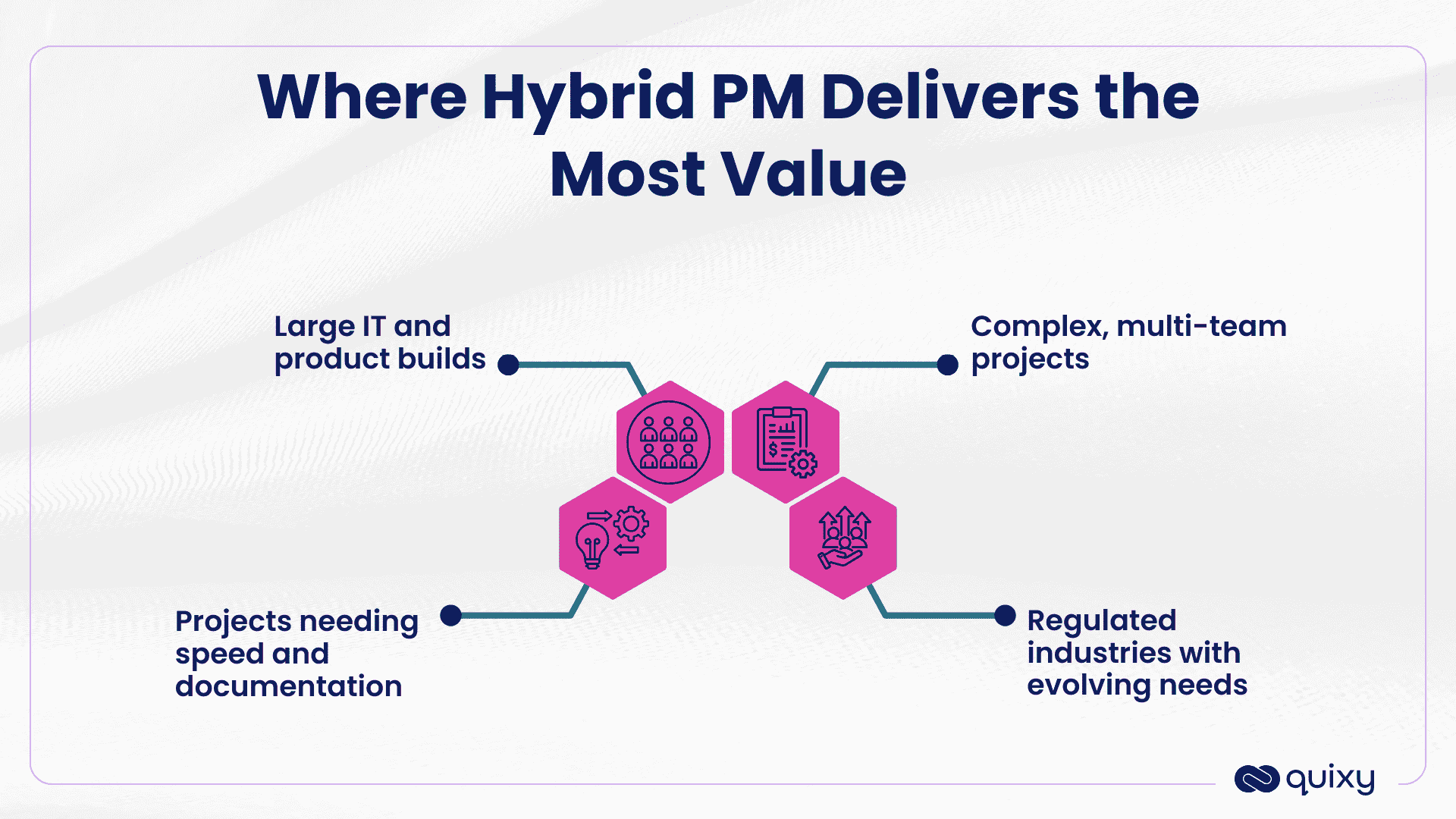
Hybrid PM works exceptionally well in environments where stability and speed must coexist:
Complex, multi-team projects
Large projects with diverse workstreams—design, development, compliance, operations—benefit from a blended approach.
Regulated industries with evolving needs
Finance, healthcare, government, and manufacturing need documentation and adaptability when policies or requirements shift.
Large IT and product initiatives
Infrastructure planning may be linear, but feature development is iterative—making hybrid a natural fit.
Projects requiring speed and documentation
Digital transformation, modernization, or enterprise platform implementations often require both rapid iteration and strict audit trails.
Hybrid PM shines wherever teams must move fast but cannot afford to lose structure.
Agile PM Platforms: Key Features to Break Silos
Integrating Agile PM platforms into traditional setups addresses these challenges:
- Real-Time Collaboration: Teams work on shared boards and dashboards, ensuring everyone sees the latest updates.
- Visual Task Management: Kanban, Scrum boards, and Gantt charts provide both flexibility and structure.
- Integrated Reporting: Automatic updates on progress, resource usage, and timelines keep managers informed.
- Cross-Team Communication: Notifications and activity logs reduce delays caused by miscommunication.
When Agile tools plug directly into traditional planning systems, teams stay coordinated without switching platforms or duplicating data.
Integrating Existing IT Systems with Modern App Development Platforms and Agentic AI
Hybrid Project Management becomes significantly more powerful when organizations integrate their traditional IT systems with modern app development platforms equipped with agentic AI capabilities. Most enterprises already operate with legacy tools—ERP, CRM, ITSM, HRMS, procurement systems, and custom-built internal apps. Instead of rebuilding everything from scratch, hybrid PM allows these systems to work in sync with Agile execution layers.
Modern platforms equipped with agentic AI automatically interpret project data, trigger workflows, surface risks, and recommend improvements in real time. AI-driven insights help teams identify bottlenecks, estimate timelines more accurately, and spot dependencies that might be missed in manual reviews. This reduces the need for rework and improves predictability across both structured and iterative phases.
By connecting legacy systems with AI-powered Agile platforms, organizations unlock:
- Unified visibility across planning, execution, and reporting
- Real-time decision support powered by AI-generated insights
- Automated handoffs between Waterfall-aligned documentation and Agile sprints
- Smarter resource allocation through pattern detection and predictive analytics
- Seamless collaboration between tech and non-tech teams
This integration ensures Hybrid PM is not just a methodology but an intelligent, connected system that evolves with project needs.
Benefits of Integrating Agile Platforms in Traditional Setups
| Benefit | Description | Supporting Data |
|---|---|---|
| Reduced Data Silos | Teams share a central workspace, enabling faster decision-making. | 43% of projects delayed due to poor information flow |
| Faster Feedback Loops | Iterative cycles allow for continuous improvement. | Agile projects report 25–30% faster delivery |
| Improved Collaboration | Cross-team communication is streamlined via shared platforms. | 88% of hybrid PM users report improved collaboration |
| Regulatory & Compliance Alignment | Traditional phase oversight ensures standards are maintained. | N/A |
| Stakeholder Confidence | Transparent dashboards build trust and accountability. | 27% higher project success rates with hybrid PM |
Step-by-Step Guide to Implement Hybrid PM with Agile Tools
- Assess Project Scope and Workflow
Identify which tasks need strict planning and which can benefit from iterative cycles. - Select Methods to Blend
Determine where Waterfall and Agile fit. For example:- Waterfall: Requirements, compliance documentation, long-term roadmap
- Agile: Design iterations, testing, product releases
- Integrate Agile PM Platforms
Use platforms like Quixy, Jira, Trello, or Productive to manage iterative work while connecting them to traditional project schedules. - Train Teams and Define Communication Standards
Ensure everyone understands which processes are managed traditionally versus iteratively. - Create Integrated Dashboards
Centralize data from Agile boards and traditional schedules for real-time reporting. - Monitor, Measure, and Refine
Track KPIs such as cycle times, resource utilization, and milestone completion. Adapt as needed.
Best Practices for Successful Hybrid PM Integration
- Maintain Clear Communication: Regular updates, dashboards, and team check-ins.
- Choose the Right Tools: Integrate Agile PM platforms with traditional schedules.
- Train Teams Effectively: Workshops and hands-on sessions on hybrid workflows.
- Monitor and Iterate: Use KPIs and feedback loops to continuously improve.
- Document Everything: Ensure regulatory and compliance requirements are maintained.
Ideal Scenarios for Hybrid Project Management
Hybrid PM is especially effective for projects that blend predictable phases with areas of uncertainty. It’s an excellent fit for complex, multi-team initiatives where some components require strict documentation, while others need rapid iteration.
Organizations in regulated sectors—such as finance, healthcare, government, or manufacturing—benefit greatly because hybrid PM maintains compliance-driven structure while allowing flexibility where innovation is needed.
Large IT programs, enterprise product development, and cross-functional digital transformation initiatives also thrive under a hybrid approach. They often include well-defined infrastructure or integration milestones alongside Agile development cycles.
Hybrid PM is also ideal for projects with tight deadlines and detailed documentation needs. It enables teams to keep rigorous oversight for must-follow processes while moving quickly on creative or exploratory workstreams.
Modern Improvement: Low-Code No-Code (LCNC)
Modern organizations can further accelerate hybrid workflows by leveraging low-code no-code (LCNC) platforms. These platforms enable teams to create and automate processes without heavy reliance on traditional IT development, making it easier to integrate Agile and traditional project management tools into a cohesive ecosystem.
Key Benefits of LCNC in Hybrid PM:
- Automated Workflow Management
LCNC platforms allow teams to automate repetitive tasks such as status updates, approval routing, and notifications. This reduces manual effort, prevents errors, and ensures that critical project information flows seamlessly across all phases, whether Waterfall or Agile. - Breaking Down Data Silos
Traditional project management often isolates information across spreadsheets, documents, and siloed tools. LCNC platforms connect disparate systems, providing a single source of truth. Teams can access the same real-time data, dashboards, and reports, enabling better collaboration, faster decision-making, and improved resource utilization. - Rapid Integration and Customization
Hybrid projects often require combining multiple tools—Gantt charts for planning, Kanban boards for iterations, and reporting dashboards for stakeholders. LCNC platforms allow organizations to rapidly integrate these tools and customize workflows to fit their unique hybrid model without complex coding. - Enhanced Agility Across the Organization
By reducing the dependency on traditional IT for process changes, LCNC empowers citizen developers—team members from non-technical backgrounds—to make adjustments in real time. This agility supports dynamic project requirements, continuous improvement, and quicker responses to stakeholder feedback. - Scalable Collaboration and Visibility
With LCNC, cross-functional teams can share data, monitor KPIs, and visualize progress across projects in a single, unified platform. This ensures transparency for both executives and team members, enhancing accountability and aligning teams around common goals.
In essence, LCNC platforms amplify the benefits of hybrid project management, enabling organizations to deliver projects faster, maintain compliance, and foster collaboration—all while eliminating the friction caused by data silos.
Conclusion
Hybrid Project Management is more than a methodology—it’s a framework for integrating Agile PM platforms into traditional setups to prevent data silos, improve collaboration, and deliver faster results.
With platforms like Quixy, teams can seamlessly integrate low-code/no-code capabilities, automate workflows, and drive agility at scale. This not only enhances productivity but also ensures that organizations stay competitive, innovative, and future-ready.
Frequently Asked Questions(FAQs)
Q. How can data silos be avoided using hybrid PM?
Hybrid PM combines structured planning with iterative workflows, allowing teams to integrate traditional and Agile tools. By centralizing project data across Gantt charts, Kanban boards, and reporting systems, it ensures a single source of truth. This alignment reduces fragmented information, improves transparency, and prevents data silos across departments.
Q. What types of projects benefit from hybrid PM?
Projects with mixed requirements, regulatory constraints, and evolving client needs benefit most from hybrid PM. Complex initiatives, product development, agency work, and projects with both predictable milestones and areas needing iterative feedback are ideal candidates. It allows teams to balance structure with flexibility, adapting workflows to changing priorities while maintaining oversight.
Q. Can LCNC platforms enhance hybrid PM?
Yes. Low-code/no-code platforms streamline hybrid PM by automating repetitive tasks, integrating Agile and traditional tools, and connecting disparate systems. Teams gain real-time visibility, reduce manual work, and maintain a single source of truth. LCNC platforms accelerate delivery, improve collaboration, and help organizations scale hybrid workflows efficiently.
Q. How do hybrid PM frameworks handle changing project requirements?
Hybrid PM frameworks combine Waterfall’s upfront planning with Agile’s iterative cycles. Requirements that are predictable follow structured phases, while evolving elements are handled in sprints or iterations. Regular checkpoints, feedback loops, and adaptive planning allow teams to incorporate changes without disrupting the overall project timeline or scope.
Q. How do you measure success in hybrid project management?
Success is measured through a mix of traditional KPIs and Agile metrics. Track project timelines, budget adherence, and milestone completion alongside team velocity, iteration quality, and stakeholder satisfaction. Tools that consolidate reporting across both Waterfall and Agile elements provide a clear picture of efficiency, alignment, and overall project outcomes.
Related Post

Login
Please login to comment
0 Comments
Oldest
Recent Posts



- Download the App