
Software used to mean writing every line by hand. In 2026 it increasingly means describing what you want in plain English and letting an AI write, run, and fix the code. That shift has a name: vibe coding. This guide explains what vibe coding is, how it works, where it helps, where it breaks, whether it is safe for enterprises, and how it fits alongside no-code platforms.
Key takeaways
- Vibe coding is the practice of building software by describing intent in natural language while a large language model (LLM) generates the code.
- The term was coined by AI researcher Andrej Karpathy in February 2025.
- Its main benefits are speed, accessibility for non-developers, and less boilerplate work; its main risks are code quality, security, and weak context on large projects.
- Vibe coding is best for prototypes and internal tools; production and enterprise apps still need governance, testing, and version control.
- In the enterprise, vibe coding works best paired with a no-code/low-code (LCNC) platform that adds security, deployment, and lifecycle management.
What is Vibe Coding?
Vibe coding is a way of building software in which a person describes what they want in natural language and an AI model — usually a large language model (LLM) — generates, refines, and tests the code. Instead of writing syntax line by line, the human sets the intent and the AI handles the implementation.
In traditional programming you are the executor: you tell the computer exactly how to do something. In vibe coding you are the orchestrator: you describe what you want, and the model proposes code that you approve, reject, or refine in a fast back-and-forth loop. The name captures that intuitive, conversational style of building.
The term was introduced by Andrej Karpathy (former director of AI at Tesla, founding member of OpenAI) in early 2025, and it spread quickly — from solo builders and Gen-Z developers to Fortune 500 innovation teams. Karpathy described it as simply saying what you want and letting the AI build it for you. See our beginner’s guide to building an app for the wider context.
Also Read: A Guidebook for Application Modernization Success

How does vibe coding work?
Vibe coding works as a loop: you write a prompt describing the outcome, the AI generates code, you run it, and you refine the result through further prompts until it works.
A typical vibe coding cycle has five stages:
- Describe the intent. State the feature or app in plain language, including inputs, outputs, and any rules.
- Generate. The LLM interprets the prompt and produces working code, UI, and logic.
- Run and observe. You execute the output and note what works and what breaks.
- Refine conversationally. You paste back errors or new requirements; the AI corrects and extends the code.
- Validate and ship. A human reviews for quality, security, and fit before the code goes live.
A simple vibe coding example
Suppose a non-developer needs an RSVP page for a team event. They type:
“Create an RSVP page where users enter their name and email, and see a thank-you message after submitting.”
The AI returns a ready-to-use form with a confirmation message. On testing, the submit button throws an error. The user copies the error back to the AI and asks it to fix it. The AI explains the cause (for example, a script running before the page finished loading) and returns corrected code. The user pastes it in, refreshes, and the form works. No syntax knowledge required — the human owned the intent, the AI owned the implementation.
Vibe coding vs no-code vs traditional coding
Traditional coding is manual and syntax-based; no-code is visual and template-driven; vibe coding is conversational and prompt-driven. They are not mutually exclusive — vibe coding is often used on top of a no-code/low-code platform.
| Dimension | Traditional coding | No-code / low-code (LCNC) | Vibe coding |
|---|---|---|---|
| How you build | Write syntax line by line | Drag-and-drop visual builder | Describe intent in natural language |
| Who can build | Trained developers | Business users & citizen developers | Anyone who can describe the outcome |
| Speed to first version | Slowest | Fast | Fastest for prototypes |
| Control & precision | Highest | High, within platform limits | Variable — depends on prompts |
| Best for | Complex, regulated, large-scale systems | Business apps, workflows, scale & governance | Prototypes, MVPs, internal tools |
| Main risk | Time and cost | Platform fit | Code quality & security without review |
For a deeper comparison of the visual approach, read What is Low-Code No-Code? The Ultimate 101 Guide.
What are the Core Principles of Vibe Coding?
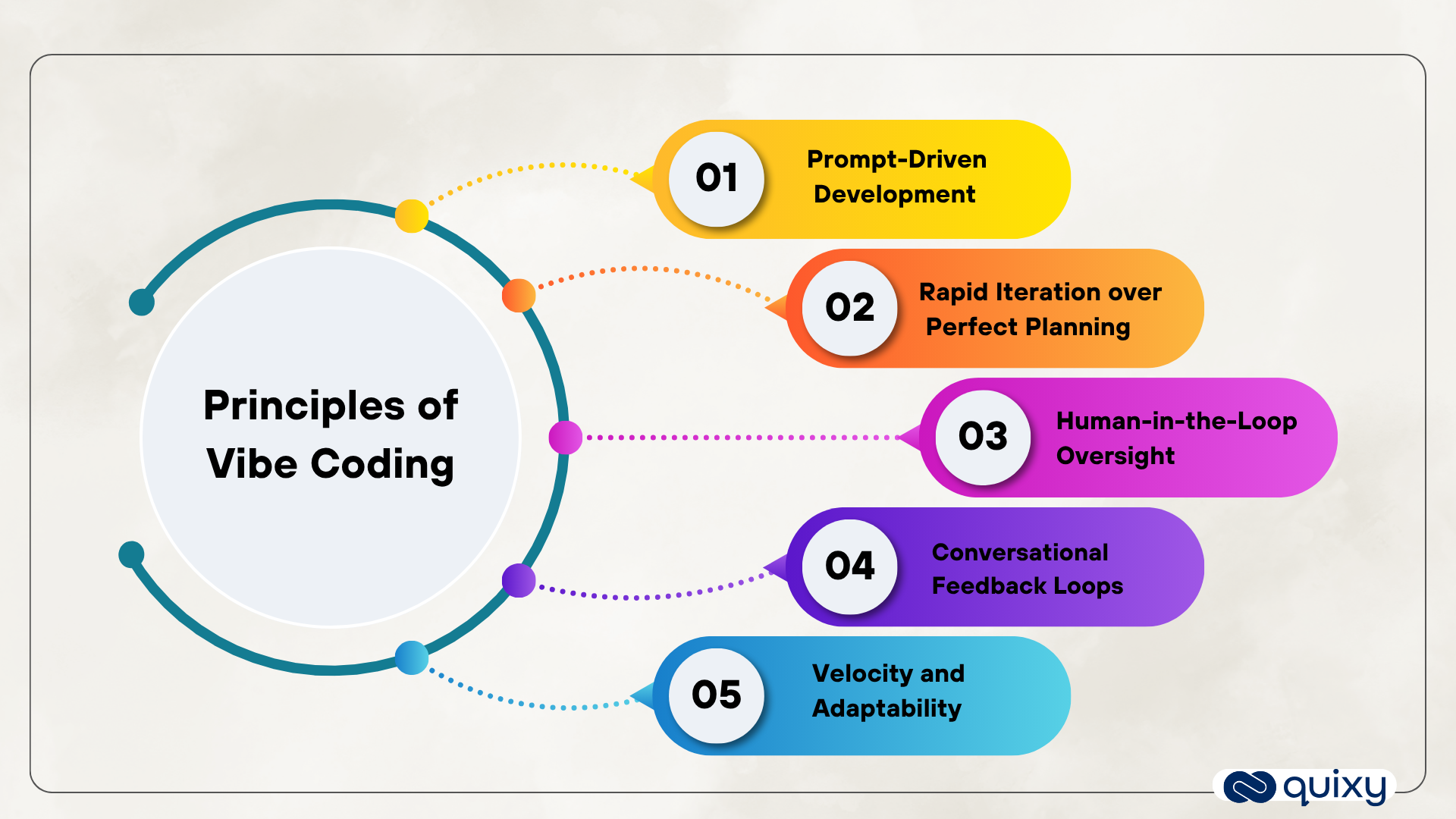
It is a structure of think-plan-code-debug-deploy and replaces it with a fluid, feedback-driven, AI-assisted workflow that feels more like jamming with a creative partner than writing code in isolation. Let’s break down the core principles that define this approach
Prompt-Driven Development
Instead of writing code line by line, developers articulate what they want through natural language prompts. The AI interprets the instruction and generates the initial code output. This approach significantly reduces the time spent on boilerplate coding and increases accessibility for non-technical contributors.
Rapid Iteration over Perfect Planning
Rather than spending extensive time on upfront design and architecture, vibe coding encourages quick experimentation. Developers can prototype rapidly, validate assumptions, and refine code through continuous interaction with the AI. This enables faster delivery without compromising innovation.
Human-in-the-Loop Oversight
While AI handles the generation of code, human oversight remains essential. Developers provide domain context, set boundaries, and guide outcomes. This principle ensures that while AI accelerates the process, human judgment ensures quality, security, and relevance.
Conversational Feedback Loops
Vibe coding isn’t based on one-time inputs. It thrives on ongoing, contextual interaction. Developers engage in multi-turn conversations with the AI—clarifying intent, adjusting outputs, and progressively improving the solution. This feedback loop is central to achieving accurate, functional results.
Velocity and Adaptability
One of the biggest advantages of vibe coding is development speed. By eliminating repetitive tasks and reducing technical complexity, teams can move from idea to execution significantly faster. This agility is particularly valuable in business environments where speed-to-market is a competitive advantage.
Benefits of Vibe Coding
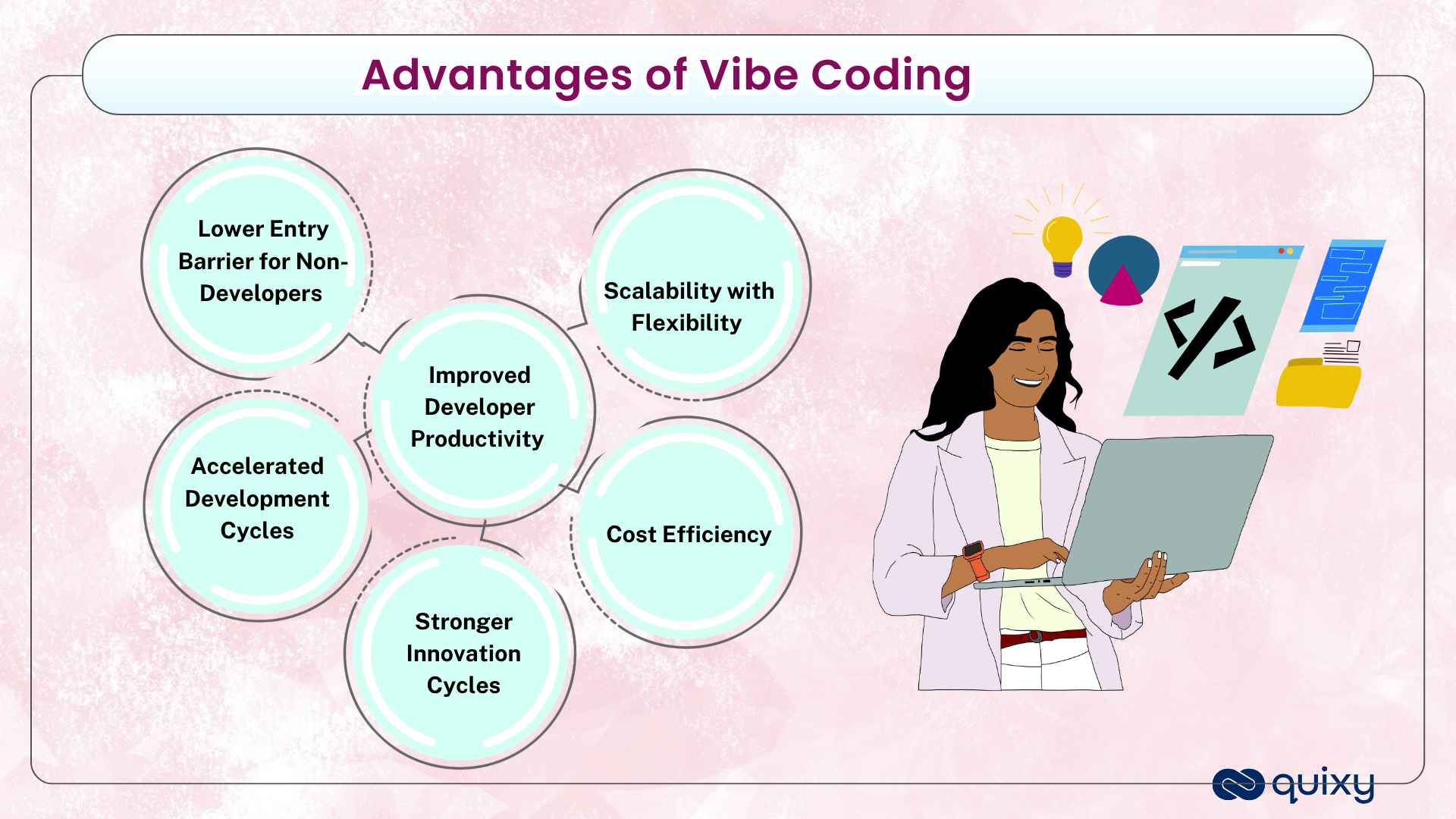
The biggest benefits of vibe coding are faster development, wider accessibility for non-developers, higher developer focus, fewer repetitive errors, and an outcome-first way of working.
1. Accessibility for non-developers
Vibe coding removes the syntax barrier, so entrepreneurs, designers, domain experts, and operations teams can help build software directly. If you understand the problem, you can describe the solution. Example: a customer success manager builds a feedback-tracker app from plain prompts, cutting turnaround from weeks to hours.
2. Faster idea-to-execution
By removing setup and boilerplate, teams can reach a working MVP in hours instead of weeks — valuable for startups, product teams, and enterprise innovation groups. Example: a SaaS team prototypes a customer-onboarding tool in under a day for early testing and demos.
3. More developer focus
AI handles scaffolding — components, routes, default validations — so developers spend time on architecture, integrations, and user experience. It amplifies developers rather than replacing them: you move from being the keyboard to being the architect.
4. Fewer repetitive errors
Because LLMs are trained on large volumes of code, generated output tends to follow established patterns, which reduces routine mistakes in early builds. It does not remove the need for testing, but it lowers structural and boilerplate errors. (Any specific “% fewer bugs” claim should cite a real study before publishing. [verify])
5. Intent-first development
You think outcome-first: describe what the system should do, and the AI translates it into structured logic. Example: a product owner defines a multi-stage approval workflow in plain language and the AI drafts the logic, validations, and fallback conditions. This pairs naturally with a visual workflow builder for production use.
Pure vibe coding is when you just say what you want, and the AI builds it for you.”
Andrej Karpathy, on the future of AI-driven development
Limitations of Vibe Coding
Vibe coding’s main limitations are inconsistent code quality, security and compliance gaps, weak context on large projects, heavy dependence on prompt quality, and scaling limits — all manageable with human review, guardrails, and a structured platform.
| Risk | Why it happens | How to manage it |
|---|---|---|
| Code quality & maintainability | AI output may not meet coding standards | Treat output as a draft; enforce code review, linters, and automated tests |
| Security & compliance | LLMs don’t inherently know your policies | Put security requirements in the prompt; add static analysis; keep human review |
| Limited context | Models lose track on long, complex work | Break work into small, scoped tasks; use prompt chaining |
| Prompt dependency | Vague prompts produce vague code | Invest in prompt engineering; build a library of tested prompts |
| Scaling limits | Weak on dependency management, CI/CD at scale | Combine with an LCNC platform that adds versioning and deployment |
| Model bias/dated patterns | Training data can be outdated or biased | Validate against current standards; audit output; refine prompts |
Is vibe coding secure and enterprise-ready?
Vibe coding is enterprise-ready only with the right controls around it. On its own it accelerates building; secure, scalable production apps still require governance, testing, access control, and version management — which is why enterprises pair vibe coding with a governed no-code/low-code platform.
The pattern that works in regulated environments: use vibe coding to move fast on ideas and prototypes, then deploy, secure, and scale those ideas on a platform that provides audit trails, role-based access, compliance features, and lifecycle management. That combination turns rapid experimentation into dependable software.
Vibe coding + no-code: the enterprise sweet spot
Vibe coding and no-code are complementary, not competing. Vibe coding lowers the barrier to creating logic; a no-code/low-code platform provides the structure to run it safely at scale. Together they let a citizen developer go from prompt to a governed, deployable application without a traditional development cycle. This is also where vibe coding connects to the wider shift toward AI workflow automation and AI agents that carry out work end to end.
What is VibeOps?
VibeOps is the extension of vibe coding across the full software lifecycle — the AI-native evolution of DevOps, where people and AI collaborate through prompts to develop, test, deploy, and maintain software.
Where vibe coding is about building with prompts, VibeOps is about delivering and operating software with AI embedded at every stage — accelerating releases and breaking down silos while keeping humans in the loop.
How to get started with vibe coding: 7 steps
To start vibe coding, treat the AI as a partner, write clear outcome-focused prompts, iterate in small cycles, keep humans reviewing every output, and pair it with a structured platform for anything you intend to ship.
Document and reuse effective prompts. A library of tested prompts makes your workflow repeatable.
Treat the AI as a development partner. Let it handle boilerplate and suggestions; you own validation and direction.
Start with clear, outcome-focused prompts. Describe the feature in business terms — specific prompts produce better code.
Iterate quickly and intentionally. Prompt, review, refine, repeat, instead of aiming for a perfect first result.
Break large work into small tasks. Build components one at a time so the AI stays in context.
Keep human oversight at every step. Review anything involving data, integrations, or complex logic.
Use AI to accelerate, not replace. Keep architecture, security, and business logic under human judgment.
Why vibe coding is happening now
Three forces are converging: business demand has outpaced traditional development cycles, developer capacity is stretched, and LLMs have become capable and enterprise-ready. Combined with the rise of citizen development, that makes conversational, AI-assisted building less a trend and more a new default for early-stage software. A McKinsey survey found that while a large majority of companies plan to increase AI investment, only about 1% consider themselves mature in embedding it into workflows — the gap vibe coding and no-code together help close.
Conclusion: The VibeOps Future Is Now
VibeOps isn’t a distant vision—it’s already reshaping how we build software in the AI-native era. By combining the power of large language models, no-code/low-code platforms, and real-time human-AI collaboration, VibeOps redefines speed, scalability, and inclusivity in development. It’s not just about better tools—it’s about a smarter, more adaptive way of working. For organizations ready to embrace this shift, the path forward is clear: build faster, build together, and let AI co-create the future with you.
Frequently Asked Questions (FAQ’s)
1. Can non-developers use Vibe Coding to build apps?
Yes. Vibe Coding with AI and low-code platforms lets business users create apps without writing code, making development accessible to everyone.
2. Is Vibe Coding suitable for enterprise software development?
Yes. Enterprises can use Vibe Coding for scalable, secure, and fast application delivery by combining AI with human validation and governance.
3. Does Vibe Coding replace traditional developers?
No. Vibe Coding enhances the developer’s role. It automates repetitive tasks, accelerates workflows, and frees up time for strategic problem-solving. Developers become orchestrators of AI-driven creation.
4. What is Vibe Coding and how does it work?
Vibe Coding is an AI-powered development approach where users build software using natural language prompts instead of traditional code. It leverages large language models (LLMs) to generate, refine, and co-create applications collaboratively.
5. How can businesses get started with VibeOps?
To adopt VibeOps, businesses should choose platforms that combine AI assistance with low-code tools, train teams on prompt engineering, and foster collaboration between technical and non-technical stakeholders.
6. What tools support Vibe Coding and VibeOps?
Advanced low-code/no-code platforms, LLMs like ChatGPT, and AI-integrated DevOps tools are enabling VibeOps. Platforms that support intelligent prompt inputs and human-in-the-loop workflows are ideal for adopting this mod
7. Difference between Vibe Coding and VibeOps
Vibe Coding is the process of building software using natural language prompts. You tell the system what you want, and AI creates the app logic, design, and flow for you—no manual coding required.
VibeOps is the AI-powered evolution of DevOps. It focuses on managing the full software lifecycle—developing, testing, deploying, and maintaining apps—through intelligent automation and collaboration.
Simple Put:
👉 Vibe Coding = Build with prompts and AI.
👉 VibeOps = Deliver and manage software with AI at every stage.
Related Post

Please login to comment
0 Comments
Oldest
Recent Posts





- Download the App