
If the mere thought of commissioning new enterprise software conjures images of multi-year roadmaps, seven-figure budgets, and a negotiation with your already-overwhelmed IT department, you are operating on a legacy model. That model is now obsolete. We are at the precipice of a fundamental restructuring of how software is created and who creates it. This isn’t merely about new tools; it’s about a new operating principle for innovation & future of app building.
The future of app development is being rewritten by a convergence of three powerful forces: the strategic democratization of creation, the practical magic of AI-assisted development, and the robust foundation of unified, platform-led governance. The outcome? A shift from treating software as a scarce, slowly deployed asset to wielding it as a readily available, dynamic medium for solving business problems—at the speed your market demands.
The Imperative for Change: Why the Old Model is a Strategic Liability
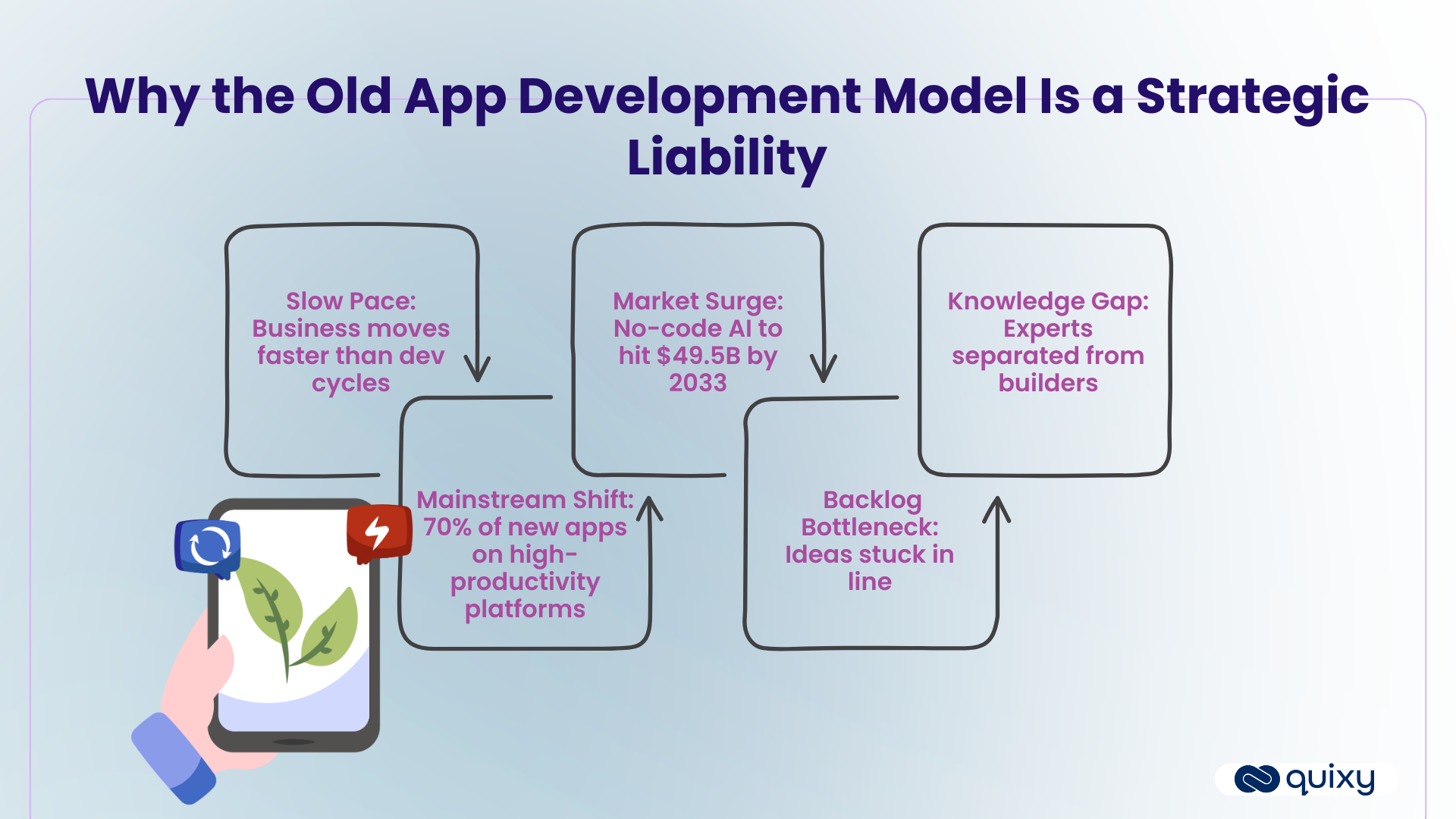
For decades, the enterprise software lifecycle followed a predictable, linear sequence: conceive, specification, development, test, deploy. This model was built for stability in a world of predictable change. Today, it’s a core vulnerability.
The friction is undeniable:
- Pace Mismatch: Business strategy now pivots quarterly; traditional development cycles annually.
- The Innovation Bottleneck: A backlog of hundreds of “small-but-critical” app ideas languishes because scarce, expensive developer resources are allocated only to “major” projects.
- The Context Gap: The people who best understand a process problem (in operations, marketing, finance) are separated from the solution-builders by a thick wall of technical requirements and prioritization committees.
The data validates this breaking point. The global market for no-code AI platforms are carving a clear path toward democratizing AI amid all this complexity. With projected revenues reaching $49.48 billion by 2033 and a compound annual growth rate (CAGR) of 28.3% from 2023 to 2033, the industry is poised for rapid expansion. Gartner previously underscored this said 70% of new enterprise applications would be built with these high-productivity tools. This is not a niche trend; it is the mainstream direction of travel.

The Three Pillars Defining the Future of App Building
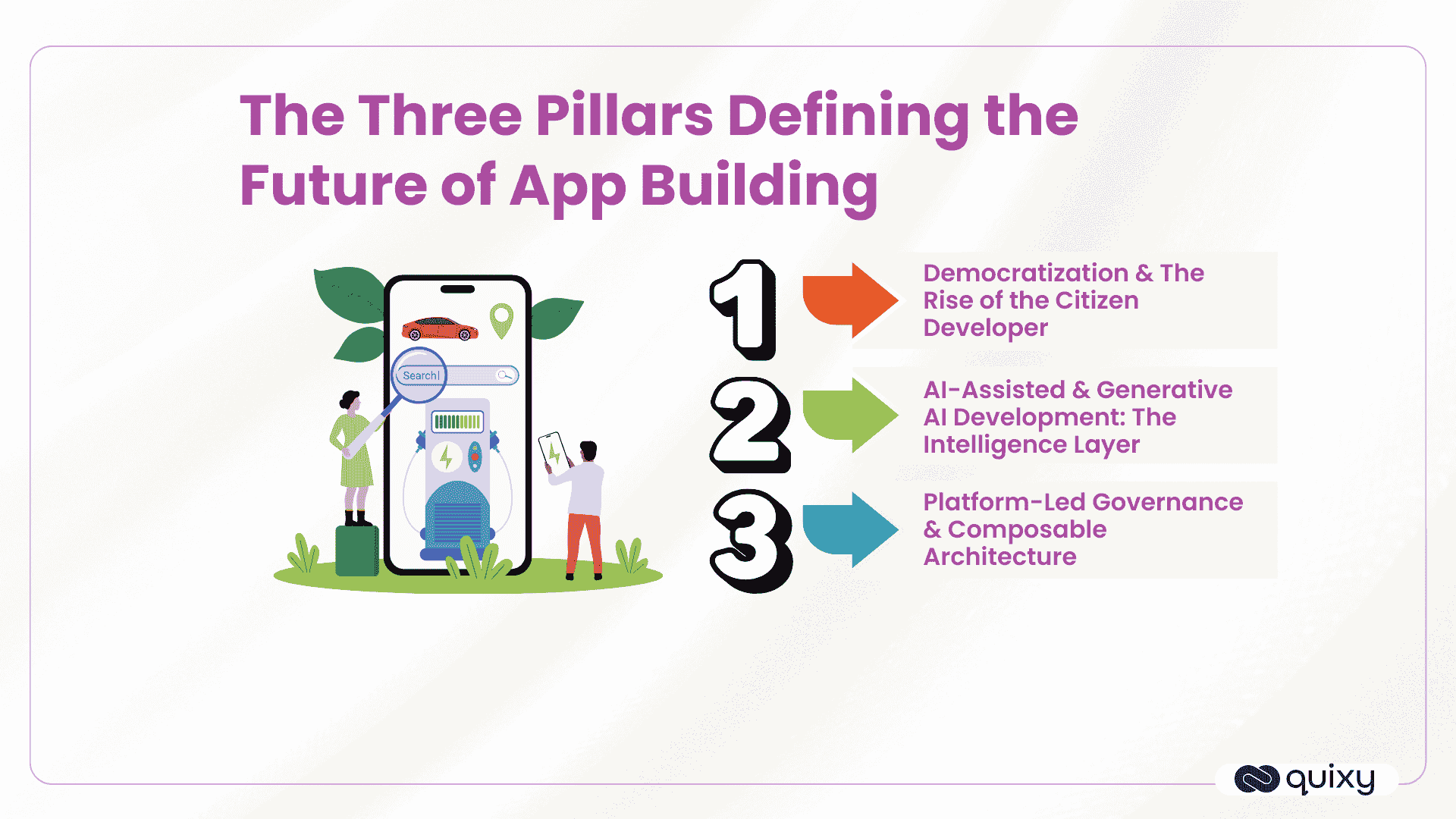
1. Democratization & The Rise of the Citizen Developer
The most significant shift is the expansion of the builder role. Citizen development empowers “business technologists“—analytical employees in business units—to build secure, governed applications using visual development interfaces.
- The New Ecosystem:
- Professional Developers: Become strategic architects, focusing on complex integrations, core systems, and platform governance and control.
- Citizen Developers: The new force multiplier. They use drag-and-drop app builders to solve departmental challenges, driving business agility and application modernization from within.
- AI Co-pilots: Act as productivity multipliers, bridging the gap between intent and execution.
- Executive Impact: This directly attacks the innovation backlog, enabling scalable app development and aligning app development capacity directly with business demand.
2. AI-Assisted & Generative AI Development: The Intelligence Layer
AI code generation has evolved from a simple helper to a core creative partner. Generative AI for apps is now embedded in the application development lifecycle.
- AI in Action:
- From Artifact to App: Turns process documents, spreadsheets, or meeting notes into application prototypes.
- Intelligent Design: Suggests optimal data models, UI/UX, and workflow automation logic.
- Natural Language Interface: Allows users to create reports, forms, or queries using plain English.
- Accelerated Lifecycle: Automates test case generation, documentation, and impact analysis.
- Executive Impact: AI-powered development dramatically compresses the idea-to-app cycle, enabling faster time-to-market and allowing teams to focus on refinement and innovation rather than manual construction.
3. Platform-Led Governance & Composable Architecture
Empowerment requires a secure foundation. A modern unified development platform provides the drag-and-drop app builder tools for creation and the essential governance and control for security.
- The Power of a Unified Platform: It consolidates data modeling, visual development, workflow automation, integration, and deployment into one DevOps-ready environment.
- Built-In Enterprise Controls:
- Centralized Security: IT defines RBAC, data policies, and audit trails at the platform level.
- Composable Architecture: Apps are built from reusable, pre-approved components—a “digital Lego” approach that ensures consistency and accelerates modular application design.
- Managed Lifecycle: Full control over development, staging, and production environments.
- Executive Impact: This transforms IT into a strategic enabler, providing the “freedom within guardrails” that allows safe, widespread innovation while minimizing technical debt and security risk.
The Executive Outcomes: Measurable Business Advantage
Adopting this model is a business automation and agility upgrade with clear ROI.
- Achieve Radical Speed: Attain faster time-to-market with rapid application development cycles, moving from ideas to live apps in weeks, not months.
- Optimize Cost & Resources: Reduce spending on low-differentiation custom code. Elevate developer roles and empower citizen developers to handle application modernization of routine processes.
- Enhance Business-IT Alignment: Foster high-performing fusion teams that directly link technology capabilities to business outcomes, breaking down operational silos.
- Build a Sustainable Innovation Culture: Embed scalable app development capabilities into the organizational fabric, making continuous digital transformation an operational reality.
The Strategic Roadmap: Implementation for Leaders
- Identify Pilot Domains: Target 2-3 high-friction, high-volume processes (e.g., procurement, client onboarding) ripe for workflow automation.
- Select a Strategic Platform: Choose an enterprise application platform that robustly combines AI-assisted development, visual development tools, and enterprise governance and control.
- Launch a Digital Maker Program: Partner IT with a forward-thinking business unit to co-deliver a pilot app using no-code/low-code tools. Measure efficacy in process cycle time reduction.
- Establish a Center of Excellence (CoE): Create a lightweight CoE to curate reusable components, share best practices in modular application design, and scale successes.
- Measure & Communicate Value: Track business metrics: applications shipped, backlog reduced, operational costs saved, and business agility gained.
Conclusion: The Competitive Advantage of Creation
The future of app development is not a waiting game. It is an active, strategic capability that separates market leaders from laggards. By embracing democratization, harnessing generative AI, and instituting platform-led governance, you are not just changing how software is built—you are fundamentally accelerating how your business solves problems and captures opportunity.
The ultimate competitive advantage in the digital age is no longer just in the technology you consume, but in the speed and intelligence with which you can create what’s uniquely needed for your business. The next era of application development is human-centric, intelligently assisted, and strategically governed. The time to build that foundation is now.
Frequently Asked Questions(FAQs)
Q. Does democratized app building pose security and governance risks?
Not when implemented correctly with a platform-led strategy. The core principle is “freedom within guardrails.” Modern enterprise application platforms have robust, built-in governance controls—such as centralized data policies, role-based access (RBAC), automated audit trails, and IT-managed deployment pipelines. This allows business units to innovate quickly while IT maintains oversight, security, and compliance at the platform level, significantly reducing the risks of unmanaged “shadow IT.”
Q.What’s the ROI of an AI-powered app development platform?
ROI manifests in three key areas: Speed, Cost, and Agility.
Speed-to-Value: Reduce application delivery time from months to weeks, allowing faster response to market changes.
Cost Redistribution: Lower the total cost of development by reducing reliance on custom code for every solution. Shift budget from repetitive coding to strategic innovation.
Operational Efficiency: Directly measure ROI through metrics like reduced process cycle times, decreased operational errors, and hours saved from manual work, translating into tangible productivity gains and cost avoidance.
Q. What are Must-have features in an enterprise app development platform?
A strategic platform must be a unified system that provides:
Visual Development & AI Assistance: Intuitive drag-and-drop builders paired with generative AI for logic, forms, and code.
Enterprise-Grade Governance: Centralized security, RBAC, audit logs, and environment management.
Robust Integration Capabilities: Pre-built connectors and APIs to seamlessly connect with your existing core systems (ERP, CRM, databases).
Scalable Architecture: Ability to support from a few to thousands of applications without performance degradation.
Composable Design: A library of reusable components to ensure consistency and accelerate development.
Q. Is this trend only for internal apps or also for customer-facing ones?
It applies to both, but with different emphasis. The primary and immediate value is in rapidly digitizing internal processes (HR, operations, finance), which builds organizational muscle and agility. However, the same platforms are increasingly used to build customer-facing portals, partner dashboards, and front-end interfaces that connect to backend systems. The speed of iteration is a key advantage here, allowing you to test and refine customer experiences quickly. The strategic move is to start internally, demonstrate value, and then extend the capability to external use cases.
Related Post

Login
Please login to comment
0 Comments
Oldest
Recent Posts





- Download the App