

Enterprises everywhere are doubling down on digital transformation—modernizing systems, adopting AI, and investing in automation. Yet many leaders are discovering a recurring pattern: even after new tools and technologies are deployed, teams remain slow, cycles remain long, and operational friction continues to rise.
This disconnect is rarely caused by technology itself. It is caused by workflow debt—the compounding burden of inefficient, outdated, or inconsistent processes that shape how work actually moves through the organization.
In 2026, the stakes are higher than ever. Measuring and managing workflow debt has become critical because it affects not only operational speed but also the success of AI initiatives, the ROI of digital transformation, and employees’ ability to perform at the pace modern business demands. Left unchecked, workflow debt can be more financially damaging than technical debt, undermining the performance of entire teams rather than just systems.
What Exactly Is Workflow Debt?
It refers to the accumulated inefficiency created by workflows that no longer match the organization’s scale, structure, or pace of change. These are the processes that were built years ago, patched over multiple times, or spread across tools that were never designed to work together.
How Workflow Debt Builds Up
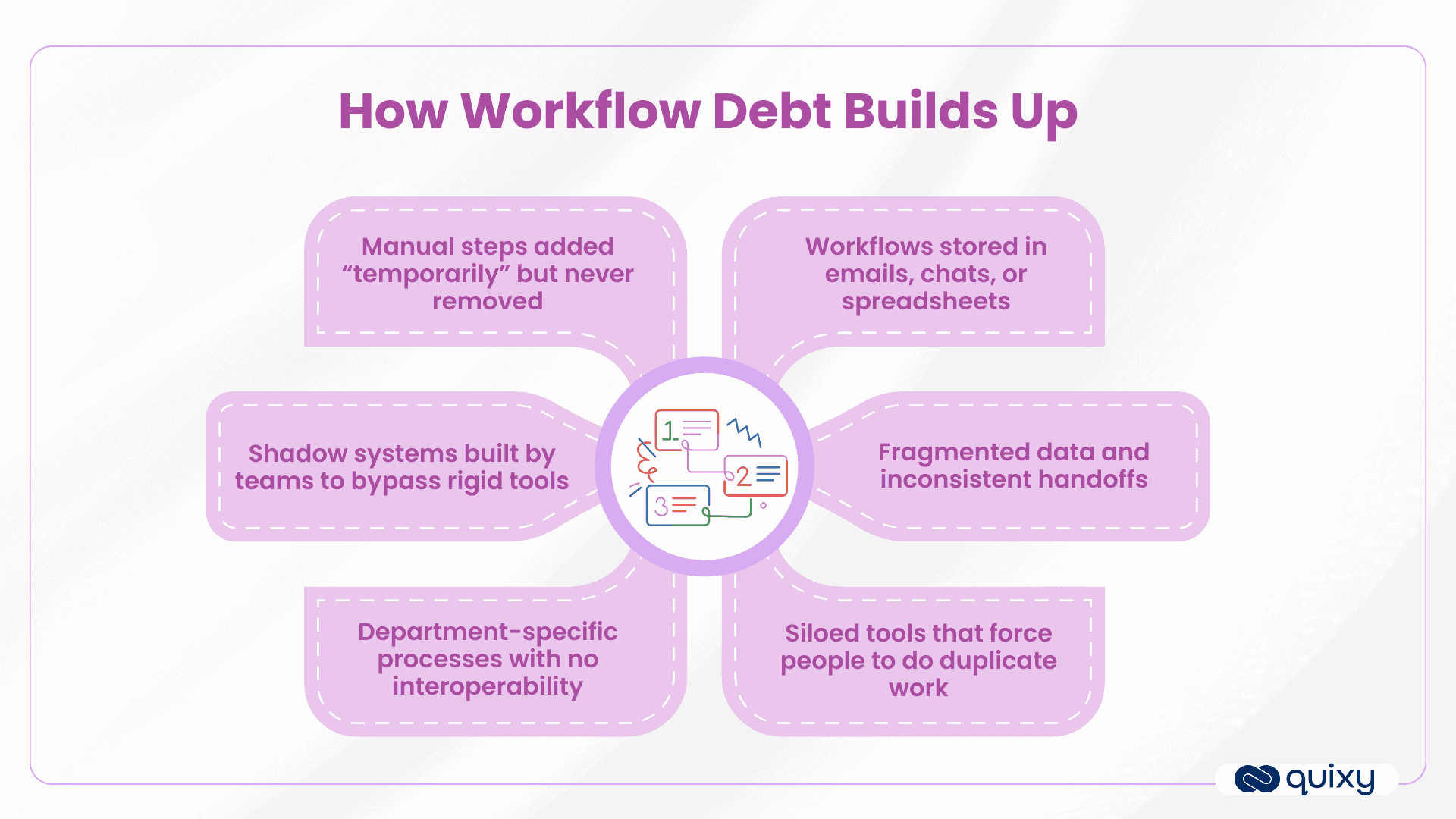
It grows quietly through:
- Manual steps added “temporarily” but never removed
- Workflows stored in emails, chats, or spreadsheets
- Department-specific processes with no interoperability
- Shadow systems built by teams to bypass rigid tools
- Fragmented data and inconsistent handoffs
- Siloed tools that force people to do duplicate work
It shows up in every function—HR onboarding, L&D enrollments, finance approvals, procurement cycles, IT service requests, compliance workflows, customer support operations, and more.
Workflow Debt vs. Technical Debt
Technical debt sits inside systems and requires engineering fixes.
Workflow-debt sits inside operations and affects everyone.
Technical debt slows code.
Workflow debt slows people, decisions, execution, and transformation.
And that is precisely why workflow-debt is now the more expensive form of debt.
Signs of Workflow Debt (Often Overlooked)
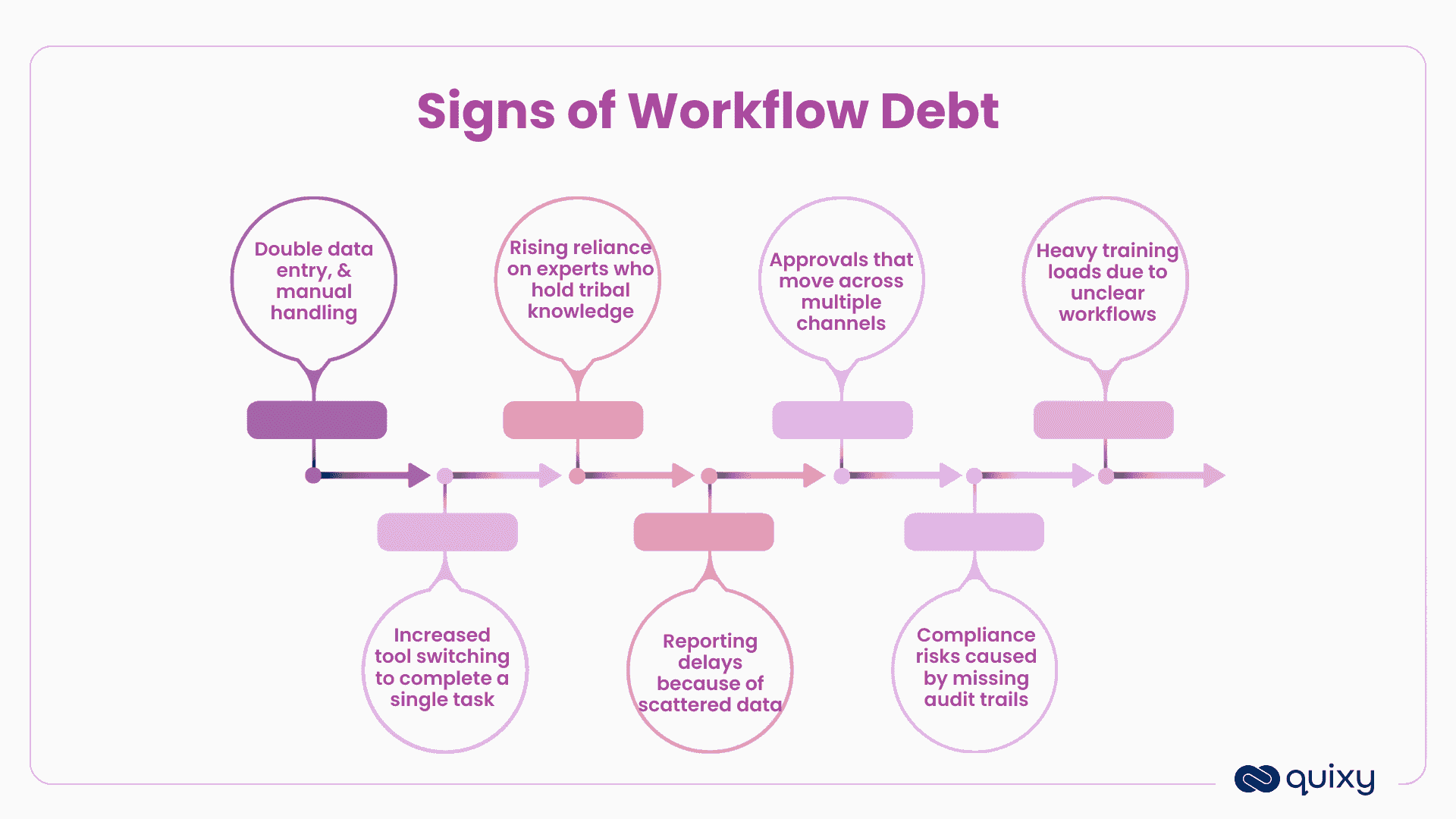
Workflow-debt does not appear as a single crisis. It emerges through small inefficiencies that silently reduce capacity and increase operational drag. Common indicators include:
- Excessive rework, double entry, and manual data handling
- Approvals that move across multiple channels without clarity
- Rising reliance on “process experts” who hold tribal knowledge
- Increased tool switching to complete a single task
- Heavy support and training loads due to unclear workflows
- Compliance risks caused by missing audit trails
- Reporting delays stemming from scattered information
These issues may seem isolated, but together they signal deep workflow inefficiencies that cost far more than leaders often estimate.
Knowledge workers spend 60% of their time on “work about work” – searching for information, coordinating with colleagues, and managing shifting priorities rather than skilled work they were hired to do.
Why Workflow Debt Costs More Than Technical Debt in 2026
As businesses scale their digital and AI initiatives, workflow-debt creates significant barriers.
1. Workflow debt slows people, not systems
Even the best technology cannot offset broken processes. Manual approvals, unclear responsibilities, and inconsistent flows reduce the speed of entire teams.
2. Workflow-debt compounds rapidly
Every new system, team, regulation, or service adds complexity. Without harmonization, this creates exponential friction over time.
3. AI cannot deliver value on top of fragmented workflows
Most enterprises are deploying AI agents and copilots. But AI cannot optimize work that is inconsistent, undocumented, or scattered across tools.
4. Workflow-debt increases operational costs
Delays, errors, slow turnarounds, and repetitive tasks directly affect financial performance.
5. Employee burnout intensifies
Teams become frustrated not by the work itself, but by how difficult the process makes it.
In 2026, when speed and adaptability determine competitiveness, workflow debt becomes a strategic and financial threat.

Measuring and Managing Workflow Debt: A Practical Assessment Framework
Organizations cannot manage workflow debt until they can measure it. A structured assessment helps identify where bottlenecks live, how much inefficiency exists, and what it costs the business.
A. The Workflow Debt Score (WDS)
Evaluate workflows across:
- Handoffs
- Manual touchpoints
- System fragmentation
- Cycle time
- Rework frequency
- Process clarity and ownership
- Ease of training and onboarding
A score above 60 indicates significant workflow debt.
B. Core Metrics to Track
- Cycle Time
- Number of Handoffs
- Rework Rate
- Tool Switching Frequency
- Idle or Waiting Time
- Manual Input Count
- Error Frequency and Escalation Rate
These metrics reveal where time and capacity are being lost.
C. Personas to Interview
To capture the full picture, gather insights from:
- Frontline employees
- Process owners
- Managers
- Support and IT teams
- Compliance and audit teams
Each group uncovers hidden inefficiencies across the flow of work.
D. Quantifying the Financial Impact
Calculate:
- Manual minutes per workflow
- Number of workflow executions per week
- Number of people involved
This helps estimate the total annual cost attributed to workflow debt.
Where Workflow Debt Lives: High-Risk Enterprise Areas
Workflow debt is often most visible in functions that execute high-volume, multi-step, or compliance-driven processes.
- Approvals and internal requests
- HR onboarding and employee lifecycle workflows
- L&D operations, enrollments, and compliance tracking
- Procurement and finance operations
- IT service management
- Customer support escalations and routing
- Cross-functional project management
These areas generate the highest return when workflow debt is reduced.
How to Manage and Reduce Workflow Debt
Effective reduction requires a structured, iterative approach.
Phase 1: Standardize
Document existing workflows.
Identify variations and bottlenecks.
Unify ownership and remove redundant steps.
Phase 2: Automate
Eliminate manual tasks.
Transform email-based workflows into structured automation.
Establish data flow across systems.
Digitize approvals and repetitive actions.
Phase 3: Optimize
Use AI to detect inefficiencies.
Automate decision logic where safe and applicable.
Predict delays and recommend improvements.
Continuously refine workflows as business needs evolve.
This three-phase model ensures both immediate efficiency gains and long-term adaptability.
How No-Code + AI (Quixy) Eliminates Workflow Debt
Quixy enables organizations to modernize workflows at scale by offering the speed, flexibility, and intelligence required for enterprise-wide automation.
Unified Workflow Orchestration
Quixy replaces fragmented workflows with a single platform that manages end-to-end processes.
AI-Driven Workflow Creation
Teams can describe processes in natural language, and Quixy converts them into automated workflows, reducing dependency on technical teams.
Deep Integration Capabilities
Quixy seamlessly connects ERPs, CRMs, HRMS, core systems, and legacy tools—eliminating data silos and manual transfers.
Complete Visibility and Governance
Leaders gain real-time insight into workflow performance, compliance, and bottlenecks, ensuring accountability across teams.
Enterprise-Proven Outcomes
Organizations using Quixy report:
- Shorter cycle times
- Significant reduction in manual hours
- More consistent and compliant processes
- Better cross-departmental coordination
- More effective use of AI and automation initiatives
By reducing workflow debt, enterprises significantly accelerate transformation.
The 2026 Mandate: Workflow Debt Becomes a Board-Level Priority
Enterprises can no longer treat workflow optimization as an operational initiative. It has become foundational to:
- Scaling AI successfully
- Reducing operational costs
- Improving employee experience
- Enhancing customer interactions
- Strengthening compliance posture
- Achieving digital transformation goals
No amount of technology investment will deliver returns if workflows remain fragmented. Leaders must treat workflow debt as a measurable risk and prioritize its reduction with the same seriousness as technical debt.
Conclusion: The Organizations That Win in 2026 Will Be the Ones That Control Workflow Debt
Workflow debt is now one of the biggest, least acknowledged inhibitors of enterprise performance. It slows teams, deepens burnout, weakens customer experience, and undermines the success of AI and automation strategies.
The organizations that excel in 2026 will be those that:
- Measure workflow debt objectively
- Remove inefficiencies with automation
- Build adaptable processes using no-code platforms
- Leverage AI to continuously improve workflows
- Replace manual operations with intelligent orchestration
Workflow debt is not inevitable. It can be identified, measured, and systematically eliminated. And companies that invest in doing so will operate with greater speed, clarity, and resilience than their competitors.
Frequently Asked Questions(FAQs)
Q. How is workflow debt different from technical debt?
Technical debt affects software and requires engineering efforts to fix. Workflow debt affects operations and impacts entire teams. While technical debt slows code, workflow debt slows decision-making, execution, and productivity.
Q. Why has workflow debt become more expensive in 2026?
AI adoption, rapid digitization, and distributed workforces have increased the cost of slow or inefficient workflows. As change cycles accelerate, outdated processes create greater delays, compliance risks, and productivity loss than ever before.
Q. What are the common signs my organization has workflow debt?
Typical indicators include repetitive manual work, long approval cycles, heavy email dependence, frequent rework, poor data visibility, scattered tools, and rising employee frustration.
Q. How do I measure workflow debt within my organization?
You can use metrics like cycle time, handoffs, manual touchpoints, rework rate, tool switching, idle time, and error frequency. Interviewing frontline teams also helps uncover hidden process friction.
Q. How can no-code platforms help reduce workflow debt?
No-code platforms allow teams to standardize, automate, and optimize workflows without relying on IT backlogs. They make workflows consistent, faster, and AI-ready across departments.
Related Post


Login
Please login to comment
0 Comments
Oldest
Recent Posts





- Download the App