

Workflows are important because they bring structure, clarity, and consistency to how work gets done, ensuring tasks are completed efficiently, accurately, and on time.
Every business runs on workflows whether they’re defined or not.
From approving a leave request to onboarding a new employee or closing a deal, work moves through a series of steps. The problem? In many organizations, these steps are unstructured, inconsistent, and heavily dependent on individuals.
That’s where workflows make the difference.
Workflows bring structure, clarity, and consistency to everyday operations. They ensure that tasks are completed in the right order, by the right people, and within the right timelines without constant follow-ups or confusion.
In a business environment where speed, accuracy, and coordination define success, this level of structure is no longer optional it’s essential. Well-designed workflows not only streamline operations but also create a foundation for scalability, accountability, and continuous improvement.
What Is a Workflow?
A workflow is a structured sequence of tasks that defines how work moves from start to finish.
It answers three simple questions:
- What needs to be done?
- Who is responsible?
- When should it happen?
Example:
Consider an invoice approval process:
- Employee submits invoice
- Manager reviews and approves
- Finance processes payment
Without a workflow, this process can get delayed or lost. With a workflow, it becomes predictable and efficient.
Why Workflows Matter in Modern Businesses
As businesses scale, operations become more complex. Teams become distributed, tools multiply, and dependencies increase.
Without workflows:
- Tasks fall through the cracks
- Communication gaps widen
- Productivity suffers
With workflows:
- Processes become repeatable
- Teams stay aligned
- Performance improves
Research shows that organizations implementing workflow automation can reduce operational costs by 20–30%, while improving speed and accuracy.
In short, workflows are no longer optional they are essential for operational efficiency.
Also read: 5 No-Code Ways to Upgrade Automated Workflows
What is the Need for a Custom Workflow?
Custom workflows are essential because they enable your organization to streamline operations and reduce errors effectively. According to McKinsey, investing in tailored systems and workflow automation can reduce operational costs by 20–30% within a year a direct gain in efficiency.
Additionally, a McKinsey survey found that two-thirds of businesses using automation reported better quality control, happier customers, and improved employee experience, which highlights the quality and consistency benefits that customized workflows bring.
McKinsey cost reduction stat: Companies optimizing processes with specialized systems can cut operational costs by 20% –30% within a year.
Importance of Workflow: 10 Reasons Why Workflows Drive Business Success
Workflows are not just operational tools they are the foundation of how work gets executed, measured, and improved. When designed effectively, workflows bring structure to complexity and enable organizations to operate with clarity and consistency.
Here are 10 key reasons why workflows are critical for modern businesses:
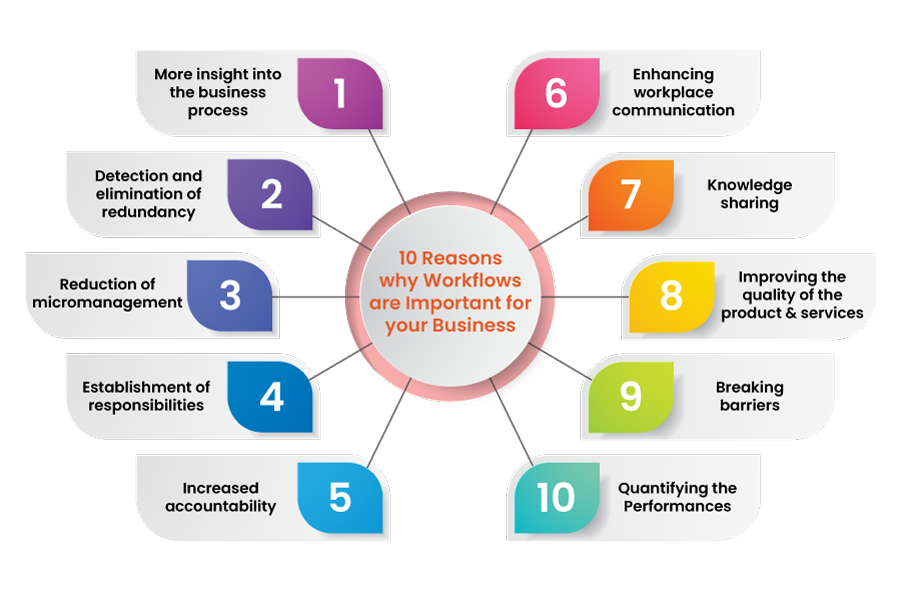
1. Deeper Insight Into Business Processes
One of the biggest advantages of workflows is the visibility they provide.
When processes are mapped into workflows, businesses gain a clear understanding of:
- How tasks move across teams
- Where delays occur
- How data flows through systems
Instead of relying on assumptions, leaders can see exactly how work is progressing at every stage.
Why it matters:
This level of insight allows organizations to make informed decisions, optimize operations, and continuously improve performance.
2. Detection and Elimination of Redundancy
Redundancy is one of the most common and costly inefficiencies in business operations.
Without structured workflows, teams often:
- Repeat the same tasks
- Duplicate data entry
- Perform unnecessary approvals
Workflows bring these inefficiencies to light. Once identified, redundant steps can be removed or streamlined.
Why it matters:
Eliminating redundancy frees up time, reduces operational costs, and allows employees to focus on work that truly adds value.
3. Reduction of Micromanagement
Micromanagement is often a symptom of unclear processes.
When managers don’t have visibility into tasks or confidence in execution, they tend to step in frequently leading to:
- Reduced employee autonomy
- Lower morale
- Slower decision-making
Workflows solve this by creating a structured system where tasks, timelines, and responsibilities are clearly defined.
Why it matters:
Managers can shift from constantly supervising tasks to focusing on strategic priorities, while employees gain the independence to perform more effectively.
4. Clear Establishment of Responsibilities
In many organizations, lack of clarity around ownership leads to confusion and delays.
Workflows eliminate this ambiguity by assigning specific responsibilities at each step of a process.
Every team member knows:
- What they need to do
- When they need to do it
- How their work impacts the larger process
Why it matters:
Clear ownership ensures smoother execution and reduces dependency on constant coordination.

5. Increased Accountability Across Teams
When responsibilities are clearly defined, accountability naturally follows.
Workflows make every task visible and trackable, which means:
- Delays can be identified quickly
- Performance can be measured objectively
- Teams are more responsible for outcomes
Why it matters:
Accountability drives consistency and ensures that work is completed on time without excessive follow-ups.
6. Enhanced Workplace Communication
Poor communication is one of the leading causes of inefficiency in organizations.
Without workflows, communication is often:
- Scattered across emails and chats
- Misaligned between teams
- Dependent on manual updates
Workflows centralize communication by creating a single source of truth where all stakeholders can track progress and access relevant information.
Why it matters:
Clear and structured communication reduces misunderstandings, aligns teams, and ensures that everyone is working toward the same goals.
7. Better Knowledge Sharing and Transparency
In many organizations, critical knowledge is often siloed held by individuals rather than systems.
Workflows change this by documenting processes in a structured and accessible way.
This enables:
- Easier collaboration across teams
- Faster onboarding of new employees
- Reduced dependency on specific individuals
Why it matters:
When knowledge is shared and accessible, organizations become more resilient and scalable.
Also read: Enterprise-Wide Automation: Understanding the Challenges, Possibilities, and the Future
8. Improved Quality of Products and Services
Consistency is the foundation of quality and workflows enable consistency.
By standardizing how tasks are performed, workflows ensure that:
- Processes are followed correctly every time
- Errors are minimized
- Outputs meet defined standards
Over time, this leads to continuous improvement in both products and services.
Why it matters:
Higher quality directly impacts customer satisfaction, brand reputation, and long-term business success.
9. Breaking Down Organizational Silos
In many organizations, departments operate in isolation, leading to:
- Limited information sharing
- Misaligned goals
- Delays in execution
Workflows connect these silos by creating a unified process where information flows seamlessly across teams.
Why it matters:
Collaboration improves, decisions are made faster, and the organization operates as a cohesive unit rather than disconnected parts.
Explore Infographic: Workflow Automation Benefits
10. Measurable Performance and Continuous Improvement
What cannot be measured cannot be improved.
Workflows make it possible to track:
- Task completion times
- Process efficiency
- Bottlenecks and delays
With this data, businesses can continuously refine and optimize their processes.
Why it matters:
Data-driven insights enable organizations to improve performance, reduce inefficiencies, and drive long-term growth.
Common Problems Businesses Face Without Workflows
The absence of structured workflows doesn’t just create minor inefficiencies it creates systemic challenges that slow down the entire organization.
What’s more concerning is that many of these issues are often normalized. Teams begin to accept delays, miscommunication, and rework as part of “how things operate,” without realizing that the root cause is a lack of defined workflows.
Let’s break down the most common problems:
1. Missed Deadlines and Constant Delays
When there’s no clear sequence of tasks or ownership, deadlines become flexible and eventually unreliable.
Tasks sit idle because:
- No one knows they are responsible
- Dependencies are unclear
- Follow-ups are manual and inconsistent
Over time, this leads to project delays, missed opportunities, and reduced team efficiency.
Business impact: Slower execution and inability to meet commitments consistently.
2. Lack of Accountability
In the absence of workflows, responsibility becomes blurred.
When something goes wrong, teams often struggle to answer:
- Who was responsible?
- Where did the delay happen?
- What step was missed?
Without clear ownership, accountability weakens and so does performance.
Business impact: Tasks fall through the cracks, and outcomes become unpredictable.
3. Communication Breakdowns
Without a centralized system, communication becomes fragmented.
Important updates are scattered across:
- Emails
- Chat tools
- Meetings
- Personal follow-ups
This leads to:
- Misaligned expectations
- Missed information
- Repeated clarifications
Business impact: Increased confusion, slower collaboration, and avoidable delays.
4. Repetitive Manual Work
One of the biggest hidden costs in any organization is time spent on repetitive tasks.
Without workflows, employees often:
- Manually assign tasks
- Send follow-up reminders
- Re-enter the same data across systems
These activities don’t add strategic value but consume a significant portion of time.
Business impact: Reduced productivity and employee burnout.
5. Increased Error Rates
Manual processes are inherently prone to errors.
When tasks are not standardized:
- Steps are skipped
- Data is entered incorrectly
- Approvals are missed
Even small mistakes can compound, affecting quality and customer experience.
Business impact: Reduced reliability, increased rework, and potential loss of trust.
6. Difficulty in Scaling Operations
What works for a small team often breaks at scale.
As organizations grow:
- Task volume increases
- Dependencies become more complex
- Coordination becomes harder
Without workflows, inefficiencies multiply making it difficult to maintain performance.
Business impact: Growth leads to chaos instead of efficiency.
The Bigger Picture
These problems don’t exist in isolation they are deeply interconnected.
- Poor communication leads to missed deadlines
- Lack of accountability increases errors
- Manual work slows down execution
At the core of all these challenges is a single issue:
Lack of structured workflows
Also Read: Workflow-First Application Modernization: A Smarter Path to Enterprise Transformation
Real-World Workflow Examples Across Teams
Workflows are not theoretical they are embedded in everyday business operations across departments. When implemented effectively, they transform how teams execute tasks and deliver outcomes.
Here’s how workflows play out in real-world scenarios:
HR: Employee Onboarding Workflow
Employee onboarding involves multiple steps documentation, system access, training, and compliance.
Without a workflow, this process often becomes inconsistent, leading to delays and a poor first impression.
A structured workflow ensures:
- Documents are collected systematically
- IT access is provisioned on time
- Training schedules are assigned automatically
Impact: Faster onboarding, improved employee experience, and higher retention rates.
Finance: Invoice Processing Workflow
Invoice processing is a critical yet often delayed function in many organizations.
Without workflows:
- Invoices get stuck in inboxes
- Approvals are delayed
- Payments are missed
A structured workflow ensures invoices move seamlessly through:
- Submission → Verification → Approval → Payment
Impact: Reduced processing time, fewer errors, and stronger financial control.
Customer Support: Ticket Resolution Workflow
Customer support teams handle high volumes of requests daily.
Without workflows:
- Tickets are not prioritized properly
- Responses are delayed
- Issues remain unresolved
With workflows:
- Tickets are automatically categorized
- Assigned to the right agent
- Tracked until resolution
Impact: Faster response times and improved customer satisfaction.
Sales: Lead Management Workflow
Sales teams rely heavily on speed and consistency.
Without workflows:
- Leads are missed or ignored
- Follow-ups are inconsistent
- Pipeline visibility is limited
A structured workflow ensures:
- Leads are captured and assigned instantly
- Follow-ups happen on time
- Progress is tracked at every stage
Impact: Higher conversion rates and better revenue predictability.
What These Examples Show
Across all departments, the pattern is clear:
Structured workflows eliminate friction and improve outcomes
Workflow vs Process: Understanding the Difference
The terms “workflow” and “process” are often used interchangeably but understanding the difference is critical for improving operations.
The Core Distinction
- A process defines the overall goal or objective
- A workflow defines the step-by-step execution of that process
Example
- Process: Customer onboarding
- Workflow: Document collection → Verification → Account setup → Welcome communication
Why This Matters
Many organizations focus on defining processes but struggle with execution.
The real efficiency gains come from optimizing workflows, because:
- Processes define intent
- Workflows define action
In simple terms:
A process tells you what needs to happen.
A workflow ensures how it actually happens.
When to Move from Workflows to Workflow Automation
Designing workflows is the first step. Scaling them effectively requires automation.
Manual workflows introduce structure but they still rely on human effort for execution.
As businesses grow, this becomes a limitation.
Signs You Need Workflow Automation
You’ll know it’s time to automate when you start seeing:
- Increasing volume of repetitive tasks
- Frequent delays and bottlenecks
- Heavy reliance on manual follow-ups
- Limited visibility into task progress
These are clear indicators that your workflows are no longer sustainable in their current form.
What Workflow Automation Changes
Workflow automation removes manual intervention and enables processes to run seamlessly.
With automation, businesses can:
- Automatically assign tasks based on rules
- Trigger actions without human input
- Send real-time notifications and reminders
- Track performance through dashboards
This significantly improves speed, accuracy, and efficiency.
The Bigger Shift
This is not just a process improvement it’s a transformation in how work is executed.
Businesses move from:
- Managing tasks manually
→ Designing systems that execute tasks automatically
That shift is what enables true scalability.
Key Takeaways
- Workflows bring structure and clarity to business operations
- Lack of workflows leads to delays, errors, and inefficiencies
- Structured workflows improve accountability, communication, and productivity
- Every department benefits from workflow-driven execution
- Workflow automation becomes essential as complexity increases
Conclusion
Workflows are the foundation of efficient and scalable business operations.
They transform how work flows across teams, how decisions are made, and how outcomes are delivered.
In today’s environment where speed, accuracy, and consistency define success informal processes are no longer enough.
Businesses that invest in structured workflows don’t just improve efficiency.
They build systems that enable long-term growth.
The question is no longer whether you need workflows.
The real question is: are your workflows designed to scale?
Frequently Asked Questions(FAQs)
Q. What are the types of workflows?
A workflow is a sequence of tasks, steps, or processes used to accomplish a specific goal. It’s important because it streamlines work, increases efficiency, reduces errors, and helps in tracking and managing tasks effectively.
What is the benefit of workflow process?
Workflow processes offer benefits such as improved efficiency, consistent task execution, reduced bottlenecks, better visibility into tasks, and enhanced collaboration among team members.
Why is project workflow important?
In project management, workflows define how project tasks are executed, monitored, and controlled. They ensure that project activities are organized and that everyone knows what to do and when to do it, leading to successful project completion.
What is the purpose of a workflow plan?
A workflow plan outlines the tasks, roles, and sequence of activities required to complete a process. It helps in setting clear expectations, tracking progress, and ensuring that the process is executed efficiently.
What are the 3 basic components of workflow?
1. Tasks/Activities: Specific actions to be performed.
2. Sequence: The order in which tasks are executed.
3. Flow of Information: Communication and data exchange between tasks.
Related Post



Please login to comment
0 Comments
Oldest
Recent Posts






- Download the App