

Workflow tools become operational bottlenecks when they can no longer adapt to evolving business processes, governance requirements, and cross-functional collaboration needs. Common warning signs include increasing manual workarounds, delayed approvals, fragmented data, poor visibility, rising compliance risks, and growing dependence on IT teams for routine process changes.
For enterprises, workflow inefficiencies rarely appear overnight. They emerge gradually as organizations scale, teams expand, regulations evolve, and operational complexity increases. What initially improves efficiency can eventually slow decision-making, create process friction, and limit business agility.
Why Enterprises Often Outgrow Their Workflow Systems
Many organizations invest in workflow platforms with the expectation that automation alone will eliminate inefficiencies. While automation can streamline repetitive work, enterprise operations are constantly changing.
New regulations emerge. Business units introduce new processes. Customer expectations evolve. Teams become increasingly distributed. As complexity grows, workflow systems that once supported operations effectively may struggle to keep pace.
The challenge is not necessarily that the technology fails. More often, the underlying workflows remain static while the business evolves around them.
This creates a hidden operational risk.
Leaders frequently focus on obvious constraints such as budget limitations, staffing shortages, or technology debt. Yet workflow bottlenecks often remain unnoticed because employees develop workarounds that temporarily mask deeper process problems.
By the time executives recognize the issue, operational inefficiencies may already be affecting productivity, compliance, customer experience, and business performance.

The Workflow Maturity Gap: An Emerging Enterprise Challenge
One of the most overlooked realities in enterprise operations is the workflow maturity gap—the growing disconnect between business complexity and workflow capability.
Organizations often experience:
- More approval layers
- Greater regulatory oversight
- Increased process exceptions
- Cross-departmental dependencies
- Expanding data requirements
However, workflow systems frequently remain designed for earlier stages of organizational growth.
When this gap widens, operational bottlenecks become inevitable.
The Difference Between Efficient Workflows and Bottlenecked Workflows
| Efficient Workflow Environment | Bottlenecked Workflow Environment |
| Processes adapt quickly to business changes | Process modifications require significant effort |
| Approvals move smoothly across teams | Approval delays become common |
| Data flows consistently between systems | Employees manually transfer information |
| Governance is embedded into workflows | Compliance depends on human oversight |
| Teams have real-time visibility | Visibility is fragmented across departments |
| Process ownership is clearly defined | Accountability becomes unclear |
This distinction is important because bottlenecks are rarely technology problems alone. They are operational design challenges that affect how work moves through the organization.
9 Warning Signs Your Workflow Tools Have Become Operational Bottlenecks
1. Employees Depend on Manual Workarounds to Complete Critical Processes
One of the earliest warning signs appears when employees begin creating unofficial processes outside the workflow system.
Examples include:
- Tracking approvals through spreadsheets
- Managing requests via email chains
- Using chat platforms to bypass formal workflows
- Maintaining separate records outside approved systems
While these workarounds may seem harmless, they indicate that the official workflow no longer supports real operational needs.
Over time, manual processes introduce inconsistencies, increase human error, and reduce organizational visibility.
Organizations seeking stronger workflow automation software should view recurring workarounds as a signal that workflow design requires reevaluation rather than simply enforcing existing processes.
2. Approval Cycles Continue to Grow Longer
As organizations scale, approval structures naturally become more complex.
However, when approval times increase significantly despite automation investments, workflow friction may be developing beneath the surface.
Common indicators include:
- Multiple redundant approvals
- Escalations becoming routine
- Frequent approval reassignments
- Delayed decision-making across departments
Lengthy approval cycles affect far more than operational efficiency. They can delay customer onboarding, procurement activities, project execution, hiring decisions, and strategic initiatives.
In many enterprises, approval bottlenecks become a leading cause of organizational slowdowns.
Questions Leaders Should Ask
- Are approvals aligned with current risk levels?
- Have approval requirements accumulated over time without review?
- Can certain decisions be automated through business rules?
These questions often reveal opportunities for meaningful process optimization. Many organizations address approval delays through business process automation guide that eliminates repetitive approval routing and manual escalations.
3. Process Changes Require Significant IT Involvement
Business environments change continuously.
New regulations emerge. Internal policies evolve. Market conditions shift.
When simple workflow modifications require lengthy development cycles, organizations lose operational agility.
Signs include:
- Long queues for workflow updates
- Heavy dependence on technical teams
- Delayed implementation of policy changes
- Business users unable to modify routine processes
This issue creates a compounding effect. The slower workflows adapt, the larger the gap becomes between operational requirements and workflow functionality.
Modern workflow strategies increasingly emphasize business process management systems capabilities that allow organizations to adapt processes without creating excessive technical dependencies.
4. Teams Operate With Limited Process Visibility
Many enterprises struggle with fragmented operational visibility.
Departments often manage their own workflows effectively but lack visibility into upstream or downstream activities.
This creates challenges such as:
- Missed deadlines
- Duplicate work
- Resource allocation conflicts
- Delayed issue resolution
Without end-to-end visibility, leaders make decisions using incomplete information. Effective business process mapping helps organizations visualize workflow dependencies, identify bottlenecks, and improve operational visibility across departments.
Operational performance becomes difficult to measure accurately because no single source provides a complete view of workflow execution.
As organizations expand, visibility becomes a competitive advantage rather than merely a reporting function.
5. Data Exists Across Multiple Systems Without Integration
Workflow bottlenecks frequently emerge when information becomes disconnected.
Employees spend considerable time:
- Re-entering data
- Reconciling records
- Searching for information
- Verifying accuracy across systems
These activities rarely appear in productivity metrics, making their impact difficult to quantify.
However, the cumulative effect can be substantial.
Disconnected systems increase operational costs while reducing confidence in business data.
Organizations pursuing digital transformation initiatives often discover that workflow bottlenecks stem not from automation gaps but from poor information flow between systems.
6. Compliance Relies Too Heavily on Human Oversight
As regulatory requirements expand, enterprises face growing governance obligations.
When compliance depends primarily on manual reviews, organizations introduce unnecessary risk.
Common symptoms include:
- Missing audit trails
- Inconsistent documentation
- Manual policy verification
- Difficulty demonstrating compliance readiness
Workflow systems should strengthen governance rather than depend on individuals to maintain it.
Interestingly, some organizations exploring modern no-code and low-code approaches, including platforms such as Quixy, are doing so because governance requirements increasingly demand greater workflow adaptability without sacrificing operational control.
7. Workflow Exceptions Are Increasing Faster Than Standard Processes
Every enterprise has exceptions. The problem arises when exceptions become the norm rather than the exception.
Examples include:
- Special approval requests
- Customer-specific process variations
- Emergency procurement workflows
- Regulatory exceptions across regions
As organizations grow, exceptions naturally increase. However, workflow systems that cannot accommodate variability often force employees to bypass standard processes.
This creates a dangerous cycle:
- More exceptions emerge.
- Teams create manual workarounds.
- Governance weakens.
- Process complexity increases further.
Leaders should periodically evaluate whether workflows are designed around current business realities or outdated assumptions.
The Cost of Exception Management
Organizations often underestimate how much time employees spend managing exceptions.
The result can include:
- Reduced operational consistency
- Increased compliance exposure
- Slower service delivery
- Higher administrative costs
Effective workflow management requires balancing standardization with flexibility.
8. Business Metrics Reveal Operational Friction
Workflow bottlenecks eventually appear in performance metrics.
Common indicators include:
Productivity Metrics
- Longer task completion times
- Increasing backlog volumes
- Reduced employee throughput
Customer Experience Metrics
- Slower response times
- Delayed onboarding
- Increased customer complaints
Operational Metrics
- Higher process abandonment rates
- Rising error frequencies
- Increased rework requirements
Many organizations focus on individual metrics without recognizing the underlying workflow connection.
The key question is not whether performance is declining.
The key question is whether workflow design is contributing to that decline.
Introducing the FLOW Framework for Workflow Health Assessment
To help enterprises evaluate workflow effectiveness, consider the FLOW Framework:
F — Flexibility
Can workflows adapt quickly to changing business requirements?
L — Line-of-Sight Visibility
Do stakeholders have visibility into workflow performance and bottlenecks?
O — Operational Governance
Are controls, auditability, and compliance embedded into workflows?
W — Workflow Scalability
Can processes handle growth without introducing excessive friction?
The FLOW Framework provides a practical lens for evaluating workflow maturity and identifying operational constraints before they become enterprise-wide challenges.
Because it focuses on business outcomes rather than technology features, it is particularly useful for executive decision-making and operational planning.
9. Growth Creates More Complexity Than Capacity
Perhaps the clearest sign of workflow bottlenecks emerges when organizational growth amplifies operational inefficiencies.
Growth should increase value creation. Organizations that scale successfully often rely on the ability to automate a workflow without coding to maintain operational consistency as complexity increases.
Instead, many enterprises experience:
- Slower execution
- More process delays
- Increased coordination challenges
- Reduced organizational agility
In these situations, workflows become constraints rather than enablers.
The issue is not growth itself.
The issue is that workflow systems fail to evolve alongside organizational complexity.
Why Scaling Exposes Workflow Weaknesses
During early growth stages, inefficiencies can often be absorbed through additional effort.
Employees work longer hours.
Managers manually intervene.
Teams create temporary fixes.
As scale increases, these approaches become unsustainable.
Eventually, workflow limitations begin affecting strategic initiatives, innovation efforts, customer satisfaction, and competitive positioning.
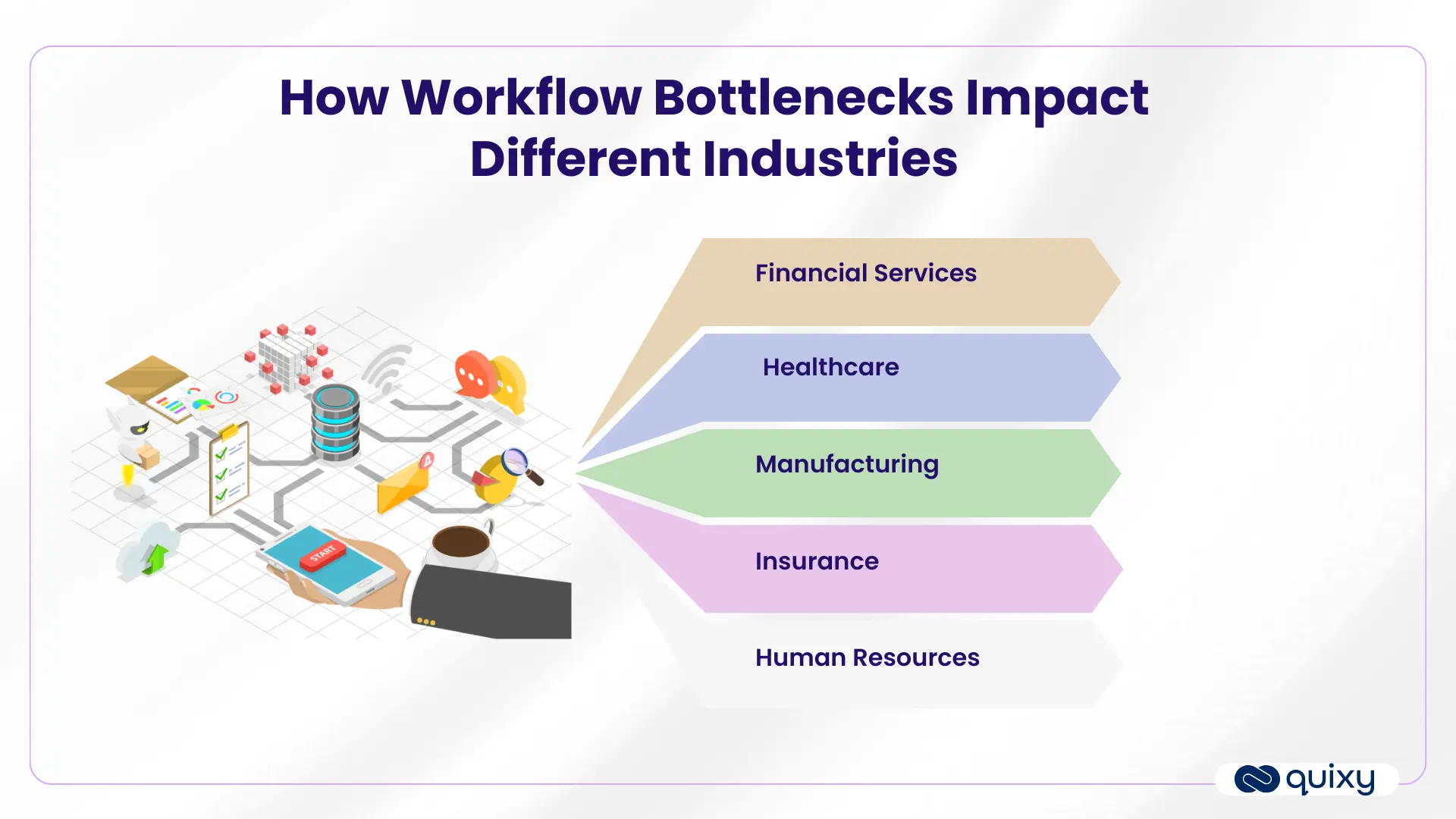
How Workflow Bottlenecks Impact Different Industries
Although workflow bottlenecks are universal, their impact varies significantly across industries.
Financial Services
Financial institutions operate within highly regulated environments.
Workflow bottlenecks often appear through:
- Loan approval delays
- Manual compliance verification
- Customer onboarding inefficiencies
- Audit documentation challenges
Even minor delays can affect customer retention and regulatory readiness.
Healthcare
Healthcare organizations depend on timely information exchange and process coordination.
Common workflow challenges include:
- Patient intake delays
- Authorization bottlenecks
- Clinical documentation inefficiencies
- Compliance management complexity
When workflows become fragmented, both operational performance and patient experiences may suffer.
Manufacturing
Manufacturers rely heavily on process consistency and cross-functional coordination.
Workflow bottlenecks often emerge through:
- Procurement delays
- Change request approvals
- Quality assurance processes
- Supplier management workflows
Small disruptions can cascade across production schedules and supply chains.
Insurance
Insurance organizations frequently manage large volumes of documentation and approvals.
Typical bottlenecks include:
- Claims processing delays
- Policy approval workflows
- Underwriting reviews
- Regulatory reporting requirements
Improving workflow efficiency often has a direct impact on customer satisfaction and operational costs.
Human Resources
HR teams increasingly manage complex employee lifecycle processes.
Workflow constraints may appear in:
- Recruitment approvals
- Employee onboarding
- Performance review cycles
- Policy acknowledgment tracking
As organizations grow, manual HR processes can quickly become significant operational burdens.
How Enterprise Leaders Can Address Workflow Bottlenecks
Identifying workflow bottlenecks is only the first step.
Organizations must also establish a systematic approach to continuous workflow improvement.
Start With Business Outcomes
Rather than focusing solely on technology upgrades, leaders should define desired operational outcomes first.
Examples include:
- Faster approvals
- Improved compliance readiness
- Reduced manual effort
- Better cross-functional collaboration
Technology decisions should support these objectives.
Map Workflow Dependencies
Many bottlenecks exist because organizations lack visibility into process interdependencies.
Mapping workflows across departments often reveals:
- Duplicate activities
- Redundant approvals
- Data handoff challenges
- Resource constraints
Understanding these relationships enables more informed process decisions.
Measure Workflow Health Continuously
Workflow optimization should not be treated as a one-time initiative.
Organizations should regularly evaluate:
- Cycle times
- Process completion rates
- Exception volumes
- Compliance performance
- User adoption metrics
Continuous measurement helps identify emerging bottlenecks before they affect broader operations.
Design for Adaptability
Enterprise workflows should evolve alongside organizational growth.
This requires:
- Flexible governance structures
- Configurable process models
- Strong visibility mechanisms
- Scalable automation strategies
Adaptability is increasingly becoming a competitive capability rather than simply an operational requirement.
The Future of Enterprise Workflow Management
The next generation of workflow management will be defined by adaptability.
Organizations are moving beyond simple task automation toward intelligent operational systems capable of supporting changing business requirements.
Future-ready workflow environments will emphasize:
- Real-time visibility
- Embedded governance
- Cross-functional orchestration
- Scalable automation
- Continuous optimization
The goal is not merely to automate existing processes but to create operational systems that can evolve alongside business needs.
Enterprises that achieve this balance will be better positioned to respond to market shifts, regulatory changes, and growth opportunities.
Conclusion
Workflow bottlenecks are often misunderstood as technology issues. In reality, they represent a broader operational challenge. When workflow systems fail to evolve alongside organizational growth, increasing complexity, and governance requirements, they gradually become barriers to execution rather than enablers of performance.
The warning signs rarely appear all at once. They emerge through delayed approvals, fragmented visibility, manual workarounds, rising compliance risks, growing exception volumes, and declining operational agility.
For enterprise leaders, the critical question is no longer whether workflows are automated. The more important question is whether workflows remain aligned with the realities of how the organization operates today.
Organizations that continuously evaluate workflow health, address emerging bottlenecks, and design processes for adaptability are better equipped to scale efficiently, maintain governance, and support long-term business performance.
Ultimately, workflow systems must evolve at the same pace as the business itself. Otherwise, what once accelerated growth can quietly become one of the biggest constraints to it.
Frequently Asked Questions
What causes workflow bottlenecks in enterprises?
Workflow bottlenecks typically occur when business processes become more complex than the systems supporting them. Common causes include manual approvals, disconnected applications, redundant tasks, poor process visibility, and growing compliance requirements. As organizations scale, these inefficiencies can slow operations, reduce productivity, and impact decision-making across departments.
How do workflow tools become operational bottlenecks?
Workflow tools become operational bottlenecks when they fail to evolve alongside changing business needs. Rigid processes, limited integration capabilities, increasing IT dependency, and slow workflow modifications can create delays. Over time, employees rely on workarounds, causing inefficiencies that hinder collaboration, agility, and overall operational performance.
What are the signs of inefficient workflow management?
Key signs of inefficient workflow management include delayed approvals, rising process backlogs, manual data entry, duplicate work, limited workflow visibility, and increasing compliance issues. Organizations may also notice employees relying on spreadsheets or email chains to complete tasks, indicating that existing workflows no longer support operational requirements effectively.
How do workflow bottlenecks impact compliance?
Workflow bottlenecks can increase compliance risks by creating delays, inconsistent documentation, and incomplete audit trails. When regulatory processes rely on manual oversight, organizations face a greater likelihood of errors, missed deadlines, and policy violations. Efficient workflows help standardize compliance activities and improve governance across the organization.
How can enterprises improve workflow efficiency?
Enterprises can improve workflow efficiency by simplifying processes, automating repetitive tasks, integrating business systems, and increasing end-to-end visibility. Regular workflow reviews help identify inefficiencies before they become larger operational issues. Adopting scalable and adaptable workflow strategies enables organizations to support growth while maintaining governance and operational excellence.



Recent Posts





- Download the App