

Process automation accelerates digital transformation by connecting previously siloed departments into a single, real-time system — so when one team completes a task, the next team’s workflow starts automatically, without manual handoffs. Businesses that automate their core processes report faster decision-making, fewer errors, and significantly lower operating costs, making automation the practical engine behind most successful digital transformation initiatives.
Key takeaways
- Process automation eliminates manual handoffs between departments, making digital transformation initiatives faster to execute
- Business Process Automation (BPA) automates entire workflows end-to-end; Robotic Process Automation (RPA) automates individual repetitive tasks
- Organizations using process automation report improved accuracy, lower costs, and stronger compliance and security posture
- Digital Process Automation (DPA) is the broader discipline that combines automation, low-code development, and AI to modernize processes end-to-end
Let’s dig deeper into how process automation accelerates digital transformation and why it plays a critical role in modern enterprise growth.
Digital transformation – Why has it become crucial?
Forrester’s ongoing research into digital transformation points to a widening gap between ambition and execution: enterprises are entering what Forrester calls a “no-blueprint phase,” facing rising trust gaps, uncertain ROI, and mounting cost pressure as they try to scale AI-driven transformation initiatives (Forrester, December 2025).
So what is digital transformation? It’s the use of digital tools — process automation and analytics among them — to change how a company operates and makes decisions at its foundation.
The retail sector’s global digital transformation market grew at an 18.2% Compound Annual Growth Rate (CAGR) through 2026, reflecting how central automation and digital tooling have become to retail operations specifically — and the pattern holds across most other industries as well.
Digital transformation has become essential in the current market. Companies that delay adopting these tools are falling behind competitors that have already made the shift.
Here are three major reasons why digital transformation has become essential:
1. Larger Scale
As organizations grow, so does the complexity of their data volumes, users, and transactions. Digital transformation helps businesses keep pace with that growing scale.
2. More Complex
Today’s businesses operate across broader endpoints, public and private clouds, and varied application architectures. Automating processes helps simplify this complexity and supports digital transformation.
3. Innovation
Market innovation moves fast, and organizations need to match that pace. Process automation helps accelerate that transformation.
Netflix and Salesforce are well-known examples of companies that reimagined how they operate and became industry leaders by putting available technology to work early.
Digital transformation is a continuous goal — and process automation is the primary means of getting there.
Also read: Big vs Fast Companies
Before going further, let’s define what a business process actually is.
What is A Business Process?
A business process is a set of connected activities that lead to the achievement of an organizational goal that typically ends with the client receiving a product or availing of the benefits of a service.
The inputs involved in business processes are generally clearly defined in nature and lead to a single output that adds value to the organization. These inputs, when linked as meaningful tasks together, create a business process; a lot of business processes are repetitive and are part of the day-to-day workflow.
Such processes can be automated.
Process Automation
Process Automation is a brilliant way to aid collaboration and coordination throughout the organization. It may even be said that it is the key to attaining digital transformation.
For example, If a starter onboarding process was set up to inform all departments then workflows could be started across the organization to ensure a smooth induction and a great employee experience. This means you would get your staff up to speed and effective in their new roles quicker and less expensively with less manpower utilization.
Implementation of automation for daily workflows and operations throughout the business will benefit not only the IT team but every single team working in the organization.
The term “process automation” is not a limited term. There is automation for business processes (from a macro perspective) and within that comes a subset called robotic process automation (RPA) as well.
Watch the Webinar: Learn how to Automate Processes 10X faster with Quixy
BPA – Business Process Automation
Business Process Automation is the in-depth automation of an entire process for across-the-board efficiency. It builds a solution from the ground up and often impacts the whole organization.
BPA enables the reduction of costs and higher productivity through streamlining processes. It is regarded as a sort of stepping stone to digital transformation that can give your organization more clarity and transparency in business processes.
Through BPA, consistent standards are maintained; this standardization brings in customer satisfaction and creates a foundation where digital transformation can be possible.
BPA does not focus on any one department or process; it has a meta outlook on the organization and sees which tasks can be automated to increase efficiency. Therefore, it involves creating a solution for the business inefficiencies from scratch rather than just the optimization of existing processes.
With that being said, there is also RPA – Robotic Process Automation.
Also Read: Process Automation Technology: What It Is and How It Actually Works
RPA – Robotic Process Automation
By contrast, Robotic Process Automation is task-oriented automation that eliminates one or two existing manual processes for greater efficiency and less error. RPA offers simplicity and easy adoption and generally forms a subset of the overall BPA initiative.
As per Forrester, RPA is the ultimate low-touch approach for process improvement. RPA assumes that the process will stay as-is and builds bots that replace low-value human hours. Populating tables, quality and testing, desktop consolidation, and replacing data entry tasks are typical targets.
Also Read: 23 Must-Have Features of a BPM Platform that you definitely need!
How Process Automation Relates to Digital Process Automation (DPA)
Process automation and Digital Process Automation (DPA) are closely related but not identical. Process automation — whether BPA or RPA — focuses on automating specific workflows or tasks. DPA is the broader strategic layer: it combines low-code development, AI, and process automation to digitize an organization’s processes end-to-end, creating consumer-grade digital experiences for both employees and customers.
In short: process automation is a core building block, and DPA is what you get when that building block is combined with low-code platforms and intelligent automation at scale. Learn more about Digital Process Automation on Quixy.
Benefits of process automation in moving toward digital transformation
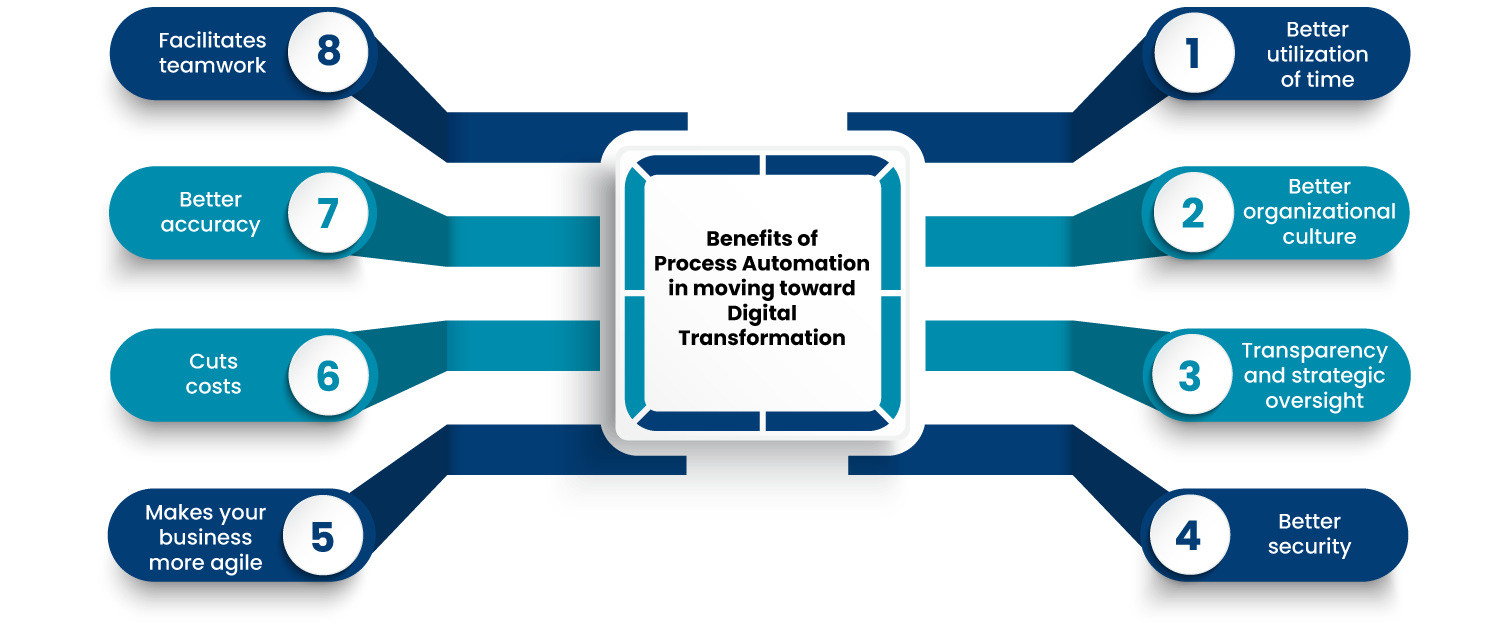
Benefits of Process Automation in Moving Toward Digital Transformation
1. Better utilization of time
When employees spend their time chasing internal approvals, they’re not available to customers when it matters — which hurts satisfaction and leaves staff stuck on unrewarding manual work.
Automation frees up employee time to focus on what actually matters: solving customer problems, not repetitive, error-prone tasks.
2. Better organizational culture
A business is only as strong as its people, and engagement drives productivity. Low-code, no-code platforms with simple visual interfaces let more employees become citizen developers — easing pressure on IT while giving employees a real stake in the organization’s progress.
Also read: Citizen Developer vs Professional Developer
Automation supports a better workplace culture by giving employees room to do more challenging, creative work — and it naturally enables cross-department teamwork.
3. Transparency and strategic oversight
Automated processes generate consistent, trackable data, which creates natural transparency. Greater visibility into which tasks are automated also reveals which tasks could be automated next.
This transparency supports better risk assessment, stronger strategic positioning, and more informed decision-making — all core to digital transformation.
4. Better security
Automation lets businesses take a proactive security posture — identifying vulnerabilities and applying fixes before breaches occur, rather than reacting after the fact.
According to Red Hat’s 2026 State of Cloud-Native Security Report, organizations are shifting security investment toward automation: over 60% now plan to automate security directly within their CI/CD pipelines, moving from manual review gates to security built in as code, and 64% expect upcoming regulation like the EU Cyber Resilience Act to be a primary driver of that investment.
5. Makes your business more agile
Automating processes reduces complexity, improves efficiency, and encourages collaboration — which lets businesses respond faster to client requests or launch new products more easily.
6. Cuts costs
Beyond saving working hours, automation reduces spending on physical resources like paper and printing. Less manual work and less waste both translate directly into lower operating costs.
7. Better accuracy
Automating repetitive manual tasks removes a major source of human error, which improves accuracy and supports scaling operations without a proportional increase in mistakes.
8. Facilitates teamwork
When departments are automatically kept informed of relevant workflows, cooperation improves — employees gain visibility into how their work fits into the bigger picture, which is a prerequisite for successful digital transformation.
Also read: Digital Leadership in a New Era and How Workplace Culture Matters More Than Ever
While automation isn’t synonymous with digital transformation, it’s a critical part of getting there.
How to Automate Processes
Process automation can be achieved through artificial intelligence, machine learning, low-code no-code platforms, Business Process Management (BPM) tools, and RPA tools.
Given the sheer volume of data most businesses now generate, automation has moved from a nice-to-have to a requirement — and platforms that can leverage that data at scale are what make automation practical.
Have You Tried Quixy?
Quixy is a low-code no-code platform built to make complex operations easy to automate and streamline — helping businesses move faster on digital transformation.
Its visual, drag-and-drop interface lets users connect application components to build automated workflows without needing to code, making citizen development genuinely accessible.
Ready to elevate your processes? Get started with Quixy today.he first step and get started with Quixy today.
Frequently Asked Questions(FAQs)
Q. How Process Automation Accelerates Digital Transformation?
Implementing process automation in digital transformation yields significant benefits. It enhances operational efficiency, reduces costs through streamlined workflows, and boosts agility, allowing organizations to adapt swiftly to market changes. Moreover, it improves the overall customer experience, accelerates time-to-market for products and services, and provides valuable data insights, fostering innovation and competitive advantage in the rapidly evolving digital landscape.
Q. How Can Process Automation Improve Collaboration Across Departments?
Process automation fosters collaboration across departments by breaking down silos and facilitating seamless information exchange. Automated workflows ensure that relevant data is readily accessible to all stakeholders, promoting real-time collaboration. This leads to better communication, shared insights, and coordinated efforts, enhancing overall efficiency and productivity as departments work cohesively toward common goals. Quixy, as a versatile process automation platform, excels in promoting cross-departmental collaboration with its intuitive and collaborative features.
Q. What Challenges does Process Automation address in Digitalization?
Process automation addresses various challenges in the digital transformation journey. It mitigates operational bottlenecks, reduces manual errors, and enhances efficiency. The automation of complex tasks streamlines workflows, promoting a faster time-to-market. It also ensures regulatory compliance, minimizes risks associated with manual processes, and fosters a culture of innovation by freeing up resources for strategic initiatives. Quixy, as a comprehensive automation platform, empowers organizations to overcome these challenges seamlessly.
Q. How Does Process Automation Ensure Compliance and Risk Management?
Process automation ensures compliance and risk management by enforcing standardized procedures and reducing human errors. Automated workflows follow predefined rules, promoting adherence to regulatory requirements. Real-time monitoring and audit trails provide transparency, aiding in compliance audits. Additionally, automation identifies and mitigates risks promptly, preventing potential issues. Quixy, as a robust automation platform, incorporates features that enhance compliance and risk management in various business processes, ensuring a secure and regulated digital environment.
Related Post



Please login to comment
0 Comments
Oldest
Recent Posts







- Download the App