
Insurance companies are under pressure to become faster, more customer-focused, and more data-driven. Traditional processes such as manual paperwork, delayed claims, disconnected policy records, and rigid service models make it difficult to meet modern customer expectations.
That is where digital transformation in insurance becomes important. By using automation, AI, data analytics, cloud platforms, and no-code workflow applications, insurers can modernize operations, improve customer experience, reduce manual work, and make faster decisions.
However, insurance digital transformation is not only a technology project. It also requires people, processes, governance, and adoption to work together. New systems create value only when employees use them effectively and customers experience better service.
In 2026, digital transformation in the insurance industry is about claims automation, underwriting efficiency, policy servicing, compliance tracking, fraud detection, document processing, customer experience, and real-time operational visibility.
This article explores what digital transformation for insurance companies means, why it matters, key use cases, benefits, and how insurers can build smarter, faster, and more scalable operations.
What is Digital Transformation in Insurance?
Digital transformation in insurance is the use of digital technologies to modernize how insurers manage policies, claims, underwriting, customer service, compliance, documents, and operational workflows.
It includes technologies such as workflow automation, artificial intelligence, data analytics, cloud platforms, digital forms, customer portals, and no-code or low-code application development.
In simple terms, digital insurance transformation helps insurance companies move from manual, paper-heavy, and disconnected processes to automated, data-driven, and customer-focused operations.
For insurers, this transformation can improve claim turnaround time, underwriting accuracy, customer engagement, compliance visibility, and operational efficiency.
A successful insurance transformation also depends on change management. Insurers need to prepare teams, train users, improve adoption, and make sure new digital processes are sustained after implementation.
Digital transformation in insurance: key use cases
| Insurance area | Digital transformation use case | Business impact |
|---|---|---|
| Claims management | Digital claim submission, automated routing, status tracking | Faster claim settlement and better customer experience |
| Underwriting | Data-driven risk assessment and document review | Better accuracy and faster policy decisions |
| Policy servicing | Digital policy updates, renewals, endorsements, and approvals | Lower manual effort and faster service |
| Customer onboarding | Digital forms, document upload, verification workflows | Smoother customer onboarding |
| Compliance | Audit trails, approval history, access controls, documentation | Lower compliance risk |
| Fraud detection | Pattern analysis, anomaly detection, claim flagging | Better risk control |
| Customer communication | Automated updates, renewal reminders, service notifications | Improved engagement and retention |
| Reporting | Dashboards for claims, policies, service requests, and productivity | Better operational visibility |
What Customers Expect Today
Insurance customers now expect tailored solutions that match their lifestyles, goals, and preferences. They are used to digital experiences in other industries and expect the same from insurers.
According to recent research, 55% of European insurance executives believe that data and analytics will deliver the most value in the next two years. This highlights the increasing importance of personalization and data-driven engagement.
Today’s insurance customers expect simple, fast, and transparent digital experiences. They are used to digital services in banking, retail, healthcare, and travel, and they expect insurers to offer the same level of convenience.
Modern policyholders want:
- Easy digital onboarding
- Fast claim submission and status tracking
- Personalized policy recommendations
- Clear communication across digital channels
- Self-service access to policy details
- Faster support and issue resolution
- Transparent renewal and payment processes
Digital transformation insurance industry initiatives help companies meet these expectations by connecting data, automating workflows, and creating more responsive customer journeys.
Also Explore: [eBook] InsurTech No-Code Low-Code Evolution
How Digital Tools Enable Personalization in Insurance Sector
Technology plays a major role in helping insurers deliver more personalized services. Instead of offering generic products and communication, insurers can use data, analytics, automation, and customer segmentation to tailor experiences around individual needs.
Digital tools help insurers:
- Analyze customer data in real time
- Segment customers based on risk, lifestyle, policy type, and preferences
- Recommend relevant products or add-ons
- Send automated renewal reminders and service updates
- Improve customer communication based on behavior and life stage
- Identify customers who may need policy changes or additional coverage
Personalization is especially useful in life insurance digital transformation and health insurance transformation, where customer needs may change over time due to family, career, lifestyle, or health-related factors. customer needs and expectations. This includes everything from premium pricing to communication style.
Here’s a breakdown of how traditional insurance compares to digital transformation approaches:
| Traditional Approach | Digital Approach |
| Fixed plan options | Customizable coverage tailored to individual needs |
| Manual paperwork | Seamless digital onboarding and claims submission |
| Standard pricing | Real-time pricing based on customer data and behavior |
| Reactive service | Proactive outreach based on predictive analytics |
The integration of tools such as customer relationship management (CRM) systems, process automation platforms, and real-time analytics allows insurers to:
- Send timely updates and personalized renewal reminders
- Predict customer needs before they arise
- Guide sales and support teams with relevant insights
- Continuously improve experiences based on feedback and data
This level of personalization is central to both digital transformation in life insurance and digital transformation in health insurance industry, where tailored offerings drive engagement, loyalty, and long-term growth.

How AI Supports Customization in Insurance Sector
Artificial Intelligence (AI) is a driving force behind digital transformation in insurance operations. It enhances how insurers collect, process, and apply data—making large-scale personalization not only possible, but efficient and consistent.
One of the most impactful developments in this space is the rise of AI assistants. These tools function as intelligent, interactive agents that support both technical and non-technical users. By understanding natural language and offering actionable suggestions, they help insurance teams automate tasks, build workflows, and generate insights in a few simple steps.
Key capabilities of AI assistants in insurance:
- Natural Language Processing (NLP) for Report Generation: Users can request detailed reports by simply typing queries in plain language, such as “Show me the claim approvals for the last quarter.” The AI assistant interprets the request and generates the report instantly, eliminating the need for technical expertise.
- Multi-Document Querying: AI assistants can search across various document types—including PDFs, Word files, and images—to extract relevant information. This capability allows insurance professionals to quickly find answers and identify patterns without manually sifting through documents.
- Anomaly Detection: By analyzing data patterns, AI assistants can identify irregularities or outliers in datasets. For instance, they can flag unusual claim amounts or detect inconsistencies in policy applications, enabling proactive risk management.
- Intelligent Document Processing (IDP): AI can extract and structure data from unstructured documents, converting information from forms, invoices, or scanned images into usable data formats. This streamlines data entry processes and reduces manual errors.
- Dynamic Data Organization: Users can sort, group, and filter data using simple commands. For example, instructing the AI to “Group claims by region and sort by amount” allows for quick data analysis and better insights into regional performance.
- Actionable Insights: Beyond data retrieval, AI assistants analyze trends and provide strategic recommendations. They can suggest areas for operational improvement or highlight opportunities for new insurance products based on customer behavior analysis.
- Centralized Report Management: Generated reports can be saved in a centralized library, making it easy for teams to access, share, and reference past analyses. This ensures consistency and facilitates collaboration across departments.
Also Read: Digital Transformation ROI: A Step-by-Step Guide for Measuring Success
Benefits of Digital Transformation in Insurance Sector
Digital transformation brings measurable improvements to every part of an insurance business. It streamlines operations, cuts down on costs, and creates opportunities for growth through better decision-making and customer engagement.
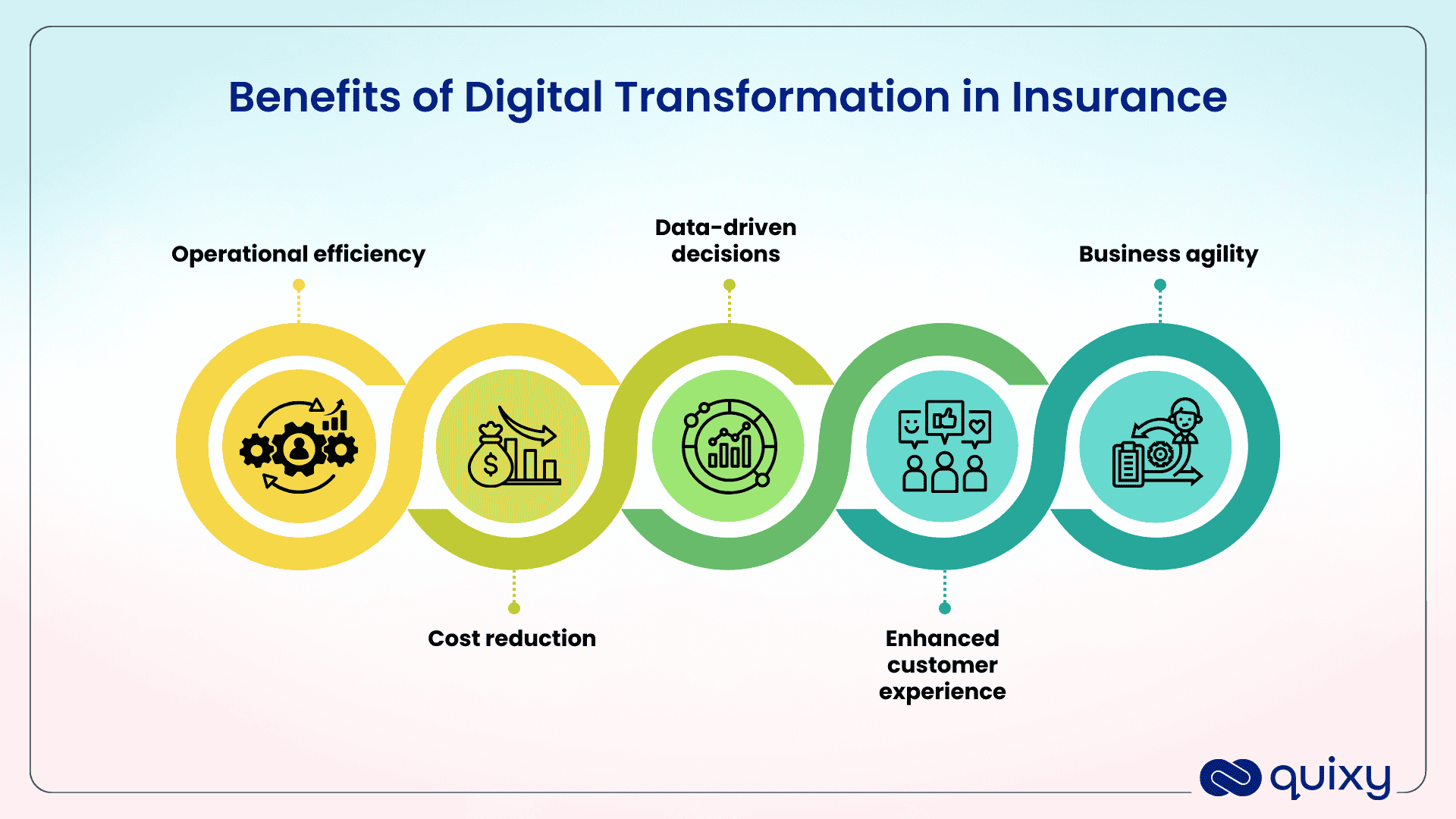
When insurers adopt digital solutions, they benefit in multiple ways:
- Operational efficiency: Automated systems speed up claims, onboarding, and policy issuance, allowing teams to focus on higher-value tasks.
- Cost reduction: By replacing paper processes and manual interventions, insurers reduce overhead and administrative expenses.
- Data-driven decisions: With integrated analytics and AI tools, insurers can price policies more accurately, assess risks more reliably, and predict customer needs.
- Enhanced customer experience: Personalization, proactive communication, and 24/7 access lead to improved satisfaction and retention.
- Business agility: Digital platforms make it easier to launch new products, enter new markets, and respond to customer feedback in real time.
These advantages apply across life, health, and commercial insurance segments, offering insurers a solid foundation for long-term success.

What Insurers Should Focus On
To stay competitive, insurers should focus on digital capabilities that improve both customer experience and operational performance.
This urgency is further echoed in Gartner’s CIO Survey, which found that 58% of insurance respondents acknowledge the pandemic’s role in amplifying funding for digital innovation. The push for transformation is no longer optional—it’s expected.
Key focus areas include:
- Claims automation: Reduce claim processing time with digital intake, automated routing, and status tracking.
- Policy servicing: Digitize renewals, endorsements, policy updates, and customer requests.
- Data analytics: Use customer, claims, and risk data to improve decisions.
- AI-enabled support: Use AI to assist document review, anomaly detection, reporting, and customer service.
- No-code and low-code platforms: Allow teams to build insurance workflows faster while IT maintains governance.
- Compliance and auditability: Maintain secure records, access control, and approval history.
- Customer self-service: Give policyholders easier access to policy details, forms, claims, and support.
- Integration: Connect data across policy, claims, finance, customer service, and operations systems.
- Adoption and change management: Prepare employees to use new digital workflows consistently.
The goal should not be to digitize isolated tasks only. Insurers should build connected workflows that improve speed, visibility, compliance, customer trust, and employee adoption.

Why change management matters in insurance digital transformation
Many digital initiatives in insurance fail to deliver full value because teams are not prepared for new ways of working. Employees may continue using spreadsheets, emails, or manual follow-ups even after new systems are introduced.
This is why change management is important in insurance company digital transformation. Insurers need to align leadership, communicate clearly, train teams, track adoption, and support employees through the transition.
A people-focused approach helps insurers:
- Reduce resistance to new systems
- Improve employee adoption
- Build confidence in digital workflows
- Make digital processes part of everyday work
- Sustain transformation after implementation
- Improve customer outcomes through better internal execution
Technology can enable transformation, but people make it successful.
How Quixy Can Help With Digital Transformation in Insurance
Quixy is an AI powered no-code low-code application development platform that plays a pivotal role in accelerating digital transformation in the insurance industry. It allows insurance businesses to create custom digital solutions without writing code, enabling faster innovation and better alignment with unique operational needs.
In the context of digital transformation in insurance operations, Quixy helps insurers:
- Automate critical processes such as policy generation, claims management, and customer communication.
- Enable self-service capabilities that enhance digital customer experiences across web and mobile platforms.
- Use AI-powered features to interpret data, detect anomalies, and suggest improvements—supporting smarter workflows and personalization at scale.
- Customize forms and dashboards based on department-specific needs, reducing bottlenecks and manual errors.
These capabilities are especially valuable in sectors like digital transformation in life insurance and digital transformation in health insurance, where speed, compliance, and flexibility are essential.
By supporting automation, AI integration, and real-time data handling, Quixy positions insurers to meet the growing demand for tailored services—reinforcing the core benefits of digital transformation in the insurance sector. Schedule a demo to learn more and see how digital transformation can elevate your insurance operations.
Conclusion
Digital transformation in insurance is no longer limited to customer-facing apps or personalized communication. It now affects the full insurance value chain, from onboarding and underwriting to claims, compliance, policy servicing, reporting, and customer support.
Insurers that modernize workflows, connect data, automate repetitive work, improve adoption, and strengthen visibility can operate faster and deliver better customer experiences.
The most effective transformation approach is practical, phased, and people-focused. Insurance companies should begin with high-impact processes, use automation where it creates measurable value, maintain strong governance, support employees through change, and continuously improve based on performance data.
With the right digital tools and workflow automation approach, insurers can build smarter, faster, and more resilient operations for the future.
Frequently Asked Questions(FAQs)
Q. How does AI support personalization in insurance?
AI enables insurers to analyze customer data, detect patterns, identify risks, and recommend tailored coverage—leading to highly relevant, proactive, and responsive services.
Q. Can digital transformation reduce operational costs for insurers?
Yes. By automating repetitive tasks, reducing paperwork, and streamlining workflows, insurers save time and resources—cutting down on overhead and administrative costs.
Q. What role do LCNC platforms play in insurance digital transformation?
No-code/low-code platforms allow insurers to build, modify, and deploy applications quickly—without coding. This enables faster innovation, easier process automation, and broader participation from non-technical teams.
Q. How does data analytics help insurers make better decisions?
Data analytics provides real-time insights into customer behavior, risk assessment, claim trends, and market opportunities—empowering insurers to make informed, data-driven decisions.
Q. How can Quixy support digital transformation in the insurance sector?
Quixy’s no-code low-code AI powered platform helps insurers automate key processes, personalize services using AI, and build custom solutions quickly. It accelerates digital innovation while ensuring compliance and operational efficiency.
Related Post



Please login to comment
0 Comments
Oldest
Recent Posts







- Download the App