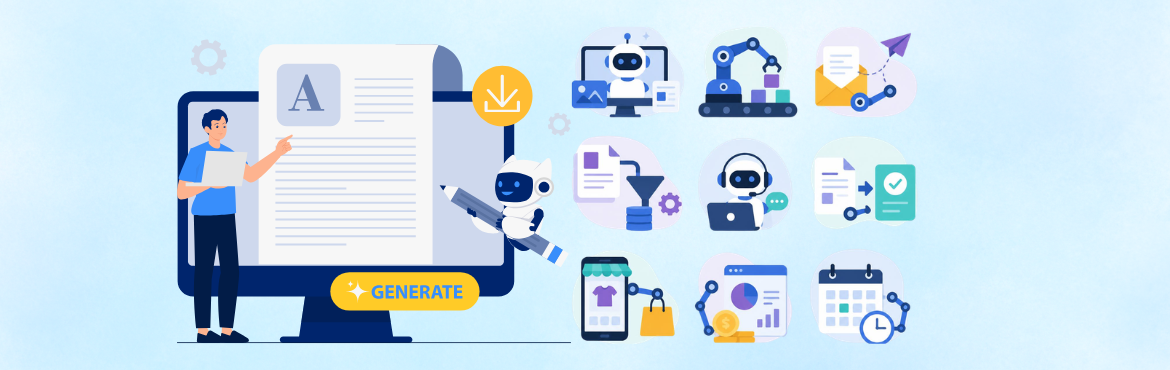

AI automation covers a wide range of everyday business tasks — far more than the headline-grabbing autonomous agents. Most of the value organizations capture today comes from applying AI to high-volume, repetitive work: reading documents, screening applications, routing requests, checking compliance. This guide walks through 12 practical AI automation examples, organized by business function, with the task each one automates and the outcome it delivers — so you can spot the ones worth starting with.
What are examples of AI automation? Common AI automation examples include invoice and document processing, resume screening, employee onboarding, customer-service chatbots, support-ticket routing, compliance monitoring, data entry and validation, email and report automation, and demand forecasting. Each uses AI — machine learning, natural language processing, or computer vision — to complete a repetitive task that once required manual effort, delivering faster, more consistent, lower-cost results.
88% of organizations report regular AI use in at least one business function, up from 78% a year earlier — from McKinsey’s State of AI report.
This page covers the broad category of AI automation by function. For autonomous AI agents specifically — real deployments at companies like Siemens, UPS, and Bank of America — see our guide to real-world examples of agentic AI. New to the topic? Start with what AI automation is; to automate multi-step processes, see AI workflow automation.
AI Automation Examples in Finance & Accounting
1. Invoice and document processing
One of the most widely deployed AI automation examples: AI combined with OCR and natural language processing reads invoices, receipts, and contracts, extracts the data, and enters it — no manual keying. It handles varied layouts and learns from every correction. The outcome is dramatically faster processing and fewer errors; many finance teams cut invoice approval from days to hours. (See finance workflow automation for more.)
2. Compliance monitoring and reconciliation
AI checks transactions and records against policy and regulatory rules, flags exceptions and duplicate payments, and reconciles accounts automatically. The outcome is stronger compliance, fewer manual reviews, and audit-ready records generated as a by-product of the work.
AI Automation Examples in Human Resources
3. Resume screening and candidate matching
AI screens and ranks applications against role requirements, surfacing the strongest candidates in minutes instead of hours of manual review. The outcome is faster hiring and more consistent, less-biased screening than manual sorting.
4. Employee onboarding
AI-driven onboarding automatically triggers document collection, account setup, training assignments, and reminders the moment a hire is confirmed. The outcome is a consistent day-one experience and far less HR administrative overhead.
AI Automation Examples in Customer Service
5. AI chatbots for routine inquiries
AI chatbots handle common customer questions 24/7 — order status, FAQs, password resets — resolving routine requests instantly and escalating complex ones to a human with context. The outcome is faster responses, round-the-clock coverage, and a lighter load on service teams. (For chatbots that act autonomously across systems, see the agentic AI examples.)
6. Ticket categorization and routing
AI reads incoming tickets, classifies them by topic and urgency, and routes them to the right team, with sentiment analysis flagging unhappy customers. The outcome is faster resolution and fewer misrouted requests.
AI Automation Examples in Operations & Admin
7. Data entry and validation
AI captures data from forms, emails, and documents, validates it against existing records, and updates systems automatically — removing one of the most tedious, error-prone manual tasks. The outcome is cleaner data and hours of staff time returned each week.
8. Email and communication automation
AI drafts, sorts, and prioritizes emails, generates routine responses, and summarizes long threads. The outcome is less time lost to the inbox and faster follow-through on what matters.
9. Report generation
AI compiles data from multiple sources and generates recurring reports and summaries automatically, with natural-language insights. The outcome is reporting that takes minutes instead of a recurring manual afternoon.
AI Automation Examples in Sales & Marketing
10. Lead scoring and qualification
AI scores and qualifies leads by conversion likelihood from behavioral and firmographic data, so sales focuses on the prospects most likely to close. The outcome is higher conversion and less time spent on low-intent leads.
11. Content personalization
AI segments audiences and personalizes emails, offers, and on-site content by behavior and lifecycle stage. The outcome is higher engagement and better campaign performance from the same effort.
AI Automation Examples in Supply Chain
12. Demand forecasting
AI forecasts demand from historical and real-time data and recommends inventory and reorder levels. The outcome is fewer stockouts and less excess inventory. (For autonomous inventory and logistics agents that act on these forecasts in real time, see the agentic AI examples.)
AI Automation Examples at a Glance
| Function | AI automation example | Outcome |
|---|---|---|
| Finance | Invoice & document processing | Days → hours, fewer errors |
| Finance | Compliance monitoring & reconciliation | Audit-ready, fewer manual reviews |
| HR | Resume screening; onboarding | Faster hiring, less admin |
| Customer service | Chatbots; ticket routing | 24/7 support, faster resolution |
| Operations | Data entry; email; reporting | Hours returned, cleaner data |
| Sales & marketing | Lead scoring; personalization | Higher conversion & engagement |
| Supply chain | Demand forecasting | Fewer stockouts, less excess stock |
AI Automation vs. Agentic AI: What’s the Difference?
Most of the examples above are what people mean by “AI automation” — AI applied to a defined, repetitive task (read this document, screen this application, route this ticket). Agentic AI is the newer, more advanced subset: autonomous agents that interpret a goal, make decisions, and take multi-step action across systems without waiting for instructions. AI automation does a task; an agentic system pursues an outcome. Both matter — start with straightforward task automation for fast, measurable wins, and move toward agentic systems as your processes and data mature. See our agentic AI examples for what the autonomous end looks like in production.
How to Choose Which AI Automation Example to Start With
The best first project is a high-volume, repetitive, rules-heavy task where delays are costly — invoice processing, onboarding, data entry, and ticket routing are common starting points because they deliver measurable wins fast. Pick one, measure the time and error reduction against a baseline, prove the ROI, then expand. Starting narrow and scaling from a win beats a broad rollout that stalls.
Only 7% of organizations have fully scaled AI, and just 39% can point to any measurable bottom-line impact.
Build Your Own AI Automation — No Code Required
Most of the examples above can be built on a single no-code platform. Quixy lets business teams automate approvals, data capture, and workflows visually and deploy across web and mobile without writing code. Real results follow: Axiom cut invoice approval time by 90%, and YUM! (MENA) reduced cost and time by 70% by automating manual processes. Book a free demo →
Conclusion
These AI automation examples share a pattern: take a repetitive, high-volume task, apply AI to do it faster and more consistently, and free people for work that needs judgment. You don’t need all twelve — start with the one task costing you the most time, prove the win, and build from there. With a no-code platform like Quixy, most are within reach without a development team.
Frequently Asked Questions
What are examples of AI automation?
Examples of AI automation include invoice and document processing, compliance monitoring, resume screening, employee onboarding, customer-service chatbots, ticket routing, data entry and validation, email and report automation, lead scoring, content personalization, and demand forecasting. Each applies AI to complete a repetitive task that once required manual effort.
What is the difference between AI automation and agentic AI?
AI automation applies AI to a defined, repetitive task — reading a document, screening an application, routing a ticket. Agentic AI is a more advanced subset: autonomous agents that interpret goals, make decisions, and take multi-step action across systems on their own. AI automation does a task; agentic AI pursues an outcome.
What are the most common AI automation use cases?
The most common are document and invoice processing in finance, chatbots and ticket routing in customer service, resume screening and onboarding in HR, and data entry and reporting in operations — because these are high-volume, repetitive tasks with clear, measurable ROI.
What is a good first AI automation example to implement?
A high-volume, rules-heavy task where delays are costly — such as invoice processing, employee onboarding, or support-ticket routing. These deliver fast, measurable wins, making them ideal first projects before scaling to more complex use cases.
Can small businesses use AI automation?
Yes. Many AI automation examples — chatbots, invoice processing, data entry, lead scoring — are accessible to small businesses through no-code platforms that require no development team and scale as the business grows.


Recent Posts






- Download the App