

Workflow optimization is the practice of redesigning how a series of tasks flows from start to finish so it runs with fewer delays, less manual effort, and fewer errors — usually by removing bottlenecks, standardizing steps, and automating repetitive work. Unlike one-off fixes, it treats a workflow as a system: you map it, measure it, redesign it, and keep refining it. Done well, an optimized workflow moves faster, costs less, and produces more consistent results without adding headcount.
Every organization runs on workflows — the repeatable sequences of tasks that turn an input into a finished outcome. A purchase request becomes an approved order. A candidate becomes an onboarded employee. An invoice becomes a payment. When those flows are clean, work moves quietly in the background. When they aren’t, the same work generates delays, rework, and frustration.
This guide covers what workflow optimization actually means, how it differs from related ideas, the strategies and frameworks behind it, concrete workflow optimization examples from real operations, and a step-by-step method for how to optimize a workflow of your own. If your goal is more tactical — squeezing speed out of day-to-day work — see the companion guide on how to improve workflow efficiency.
What is workflow optimization?
Workflow optimization is the systematic improvement of a business process so it delivers the same or better output with less time, cost, and effort. It starts from an understanding of what a workflow is — a set of connected tasks that must run in order to complete an objective — and then applies analysis, redesign, and automation to make that sequence more efficient.
An optimized workflow has three signatures: work moves without waiting on avoidable handoffs, each step adds value (nothing exists purely out of habit), and the process behaves the same way every time it runs. Getting there is rarely a single change. It’s a cycle of measuring the current state, finding where value leaks out, redesigning, and monitoring the result.
Workflow optimization vs. related terms
These terms get used interchangeably, which muddies both strategy and search intent. Here’s how they actually differ:
| Term | What it focuses on | Scope |
|---|---|---|
| Workflow optimization | Redesigning a task sequence to remove waste and bottlenecks | A specific workflow or set of workflows |
| Workflow efficiency | The measurable result — speed, cost, and output per unit of effort | An outcome you improve (see the efficiency guide) |
| Business process optimization | Optimizing end-to-end processes across departments | Broader than a single workflow |
| Workflow automation | Using technology to execute steps without manual work | A technique within optimization, not a synonym |
The short version: you optimize a workflow to increase its efficiency, and automation is one of the most powerful tools you use to do it — but automating a broken process just makes the mess run faster. Optimization comes first.
Why workflow optimization matters
Inefficiency is expensive in ways that rarely show up on a single line of a budget. Research firm IDC has estimated that organizations lose a meaningful share of annual revenue to process inefficiency, and Forrester has reported that practitioners realize operational cost savings of up to 30% by applying task automation. The benefits of optimizing your workflows compound across the organization:
- Fewer bottlenecks. A bottleneck is any point where work piles up faster than it clears. Optimization finds and widens these choke points so throughput rises.
- Less waste and rework. Removing redundant approvals, duplicate data entry, and unnecessary steps cuts both cost and error rates.
- Higher productivity. When people stop firefighting handoffs, the same team completes more valuable work.
- Consistency and compliance. A standardized, optimized workflow runs the same way every time, which makes audits and quality control far easier.
- Agility. Clean, well-documented workflows are easier to change when the business needs to pivot.
- Better customer experience. Faster internal flows translate directly into quicker, more reliable responses to customers.
Benefits of Workflow Optimization
There are various advantages to streamlining workflows. The most obvious advantages of streamlining a workflow are improved client connections, data-driven decision-making, and greater insight into a team’s progress. An effective workflow can also reduce human error and make it easier to decide when to grow a business without compromising business goals.
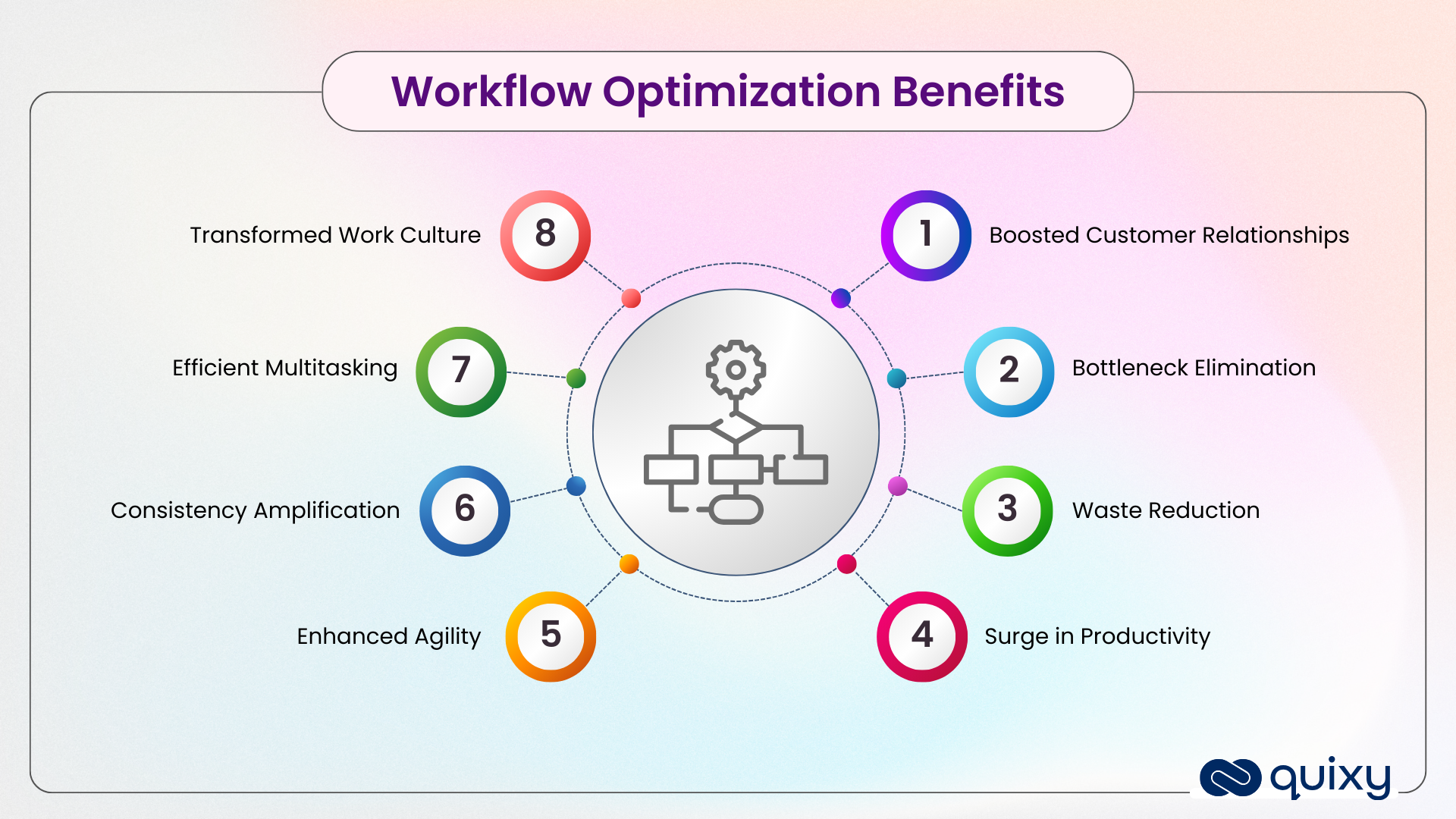
Among the many advantages of workflow optimization are:
1. Improved Customer Relationships
Customers value consistent and fast replies to inquiries and issues. Streamlining workflows by using workflow optimization approaches aids in the elimination of workflow difficulties and frees up time to improve customer satisfaction.
2. Lower Process Bottlenecks
A process bottleneck is a location of congestion in the workflow that causes process execution to be delayed. Bottlenecks slow down production, waste time, effort, and resources, and influence profitability. Workflow optimization aids in the elimination of bottlenecks in the process.
Also Read: What is Business Process Optimization? Proven Techniques & Insights
3. Less Waste
Wasteful activities can be removed from the workflow without hurting process productivity. Workflow optimization assists in identifying waste in the process and removing wasteful steps/tasks from the process.
Also Read: Mastering Processes with Advanced Business Process Management Systems Technology
4. Increased Productivity
When the bottleneck in the workflow is removed, team members may execute jobs more efficiently and rapidly. Manufacturers can increase productivity by streamlining production procedures.
5. Increased Agility
Organizations struggle to adapt to change and business growth due to clumsy and redundant operations. Workflow optimization simplifies workflows by removing unnecessary and duplicate procedures, allowing the company to adapt to new possibilities and problems.
Also Read : 360° of Fundamentals of Business Process Optimization
6. Increased Consistency
Workflow optimization provides clarity and allows all employees to adhere to a common standard of efficiency and quality.
7. Capability to Multitask
The number and complexity of procedures increase as the organization grows. Workflow optimization enables many workflows to run concurrently and without resource contention. Managing and directing workflows becomes easier and more successful when managers streamline processes using appropriate optimization strategies.
8. Enhanced Work Culture and Team Collaboration
Well-documented and simplified processes make life easier for employees since they spend less time-fighting fires and more time on activities that add value to the organization and their careers. Employees can spend more time managing and finishing successful projects since the automated workflow handles all non-essential and labor-intensive processes.
Also Read: Digital Process Automation – Everything You Need to Know
Workflow optimization breaks down process silos and creates a more collaborative workspace in which resources communicate with one another in real-time. A more collaborative and happy work atmosphere can be established by improving workflows.

How to optimize a workflow (step by step)
Optimization is repeatable. Whatever the process — approvals, onboarding, procurement, support — the same seven steps apply. This is the core method for how to optimize workflow performance in any function.
- Map the current workflow. Document every step, decision point, handoff, and owner exactly as it happens today — not the idealized version. Process mining and simple flowcharts both work here.
- Measure a baseline. Capture cycle time, touch points, error rate, and where work sits waiting. You can’t prove an improvement you never measured.
- Analyze root causes. For each delay or defect, ask why it happens. Most trace back to manual handoffs, missing information, unclear ownership, or unnecessary approvals.
- Redesign the flow. Eliminate steps that add no value, combine or reorder where you can, and define clear rules for routing and decisions.
- Automate the repetitive parts. Route tasks, send notifications, validate data, and trigger next steps automatically. A no-code/low-code platform lets business teams do this without waiting on IT.
- Test and roll out. Pilot with one team, compare against your baseline, fix what breaks, then expand.
- Monitor and improve continuously. Track the same metrics over time and treat optimization as an ongoing discipline, not a one-time project. See continuous improvement for the mindset.
Strategies for Workflow Optimization
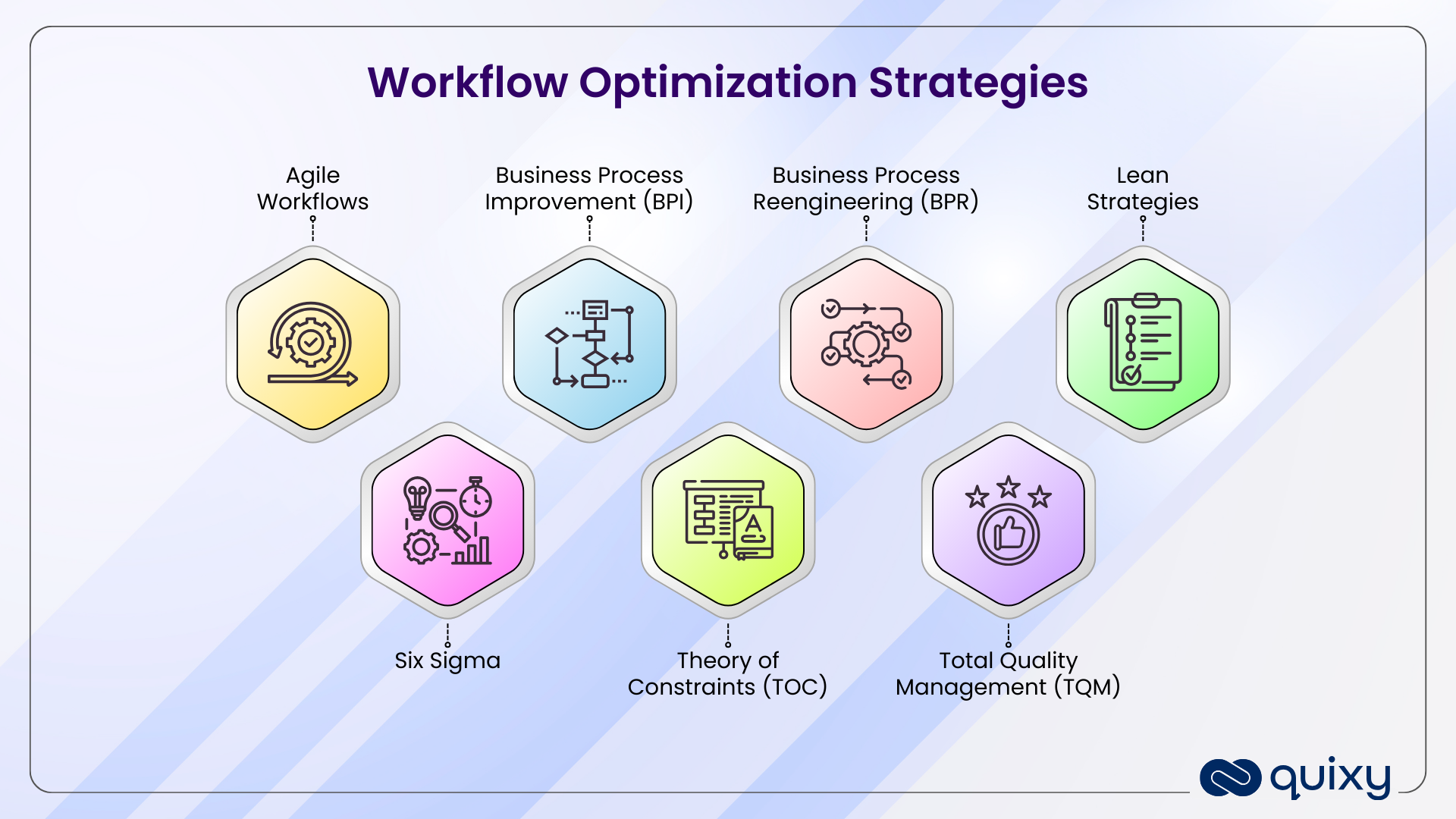
At a high level, workflow optimization seeks to improve the efficiency of business processes. Workflows can be optimized in a number of ways. Below are seven of the most effective methods for optimizing a workflow. Organizations can utilize the tactics listed below to decide how to optimize process models for their specific use case.
1. Agile Workflows
Agile workflows are step-by-step visual representations of a process workflow that stress interaction, collaboration, and adaptability. These workflows were first preferred by software developers but have now been adopted by other popular industries.
2. Business Process Improvement (BPI)
Business Process Improvement (BPI) is a method for optimizing workflows by identifying inefficient and ineffective aspects of the process. Using BPI approaches to optimize processes eliminates errors and tackles issues on an ongoing basis.
Also Read: Business Process Management – The What, Why, and How
3. Business Process Reengineering (BPR)
BPR is an approach for completely revamping procedures. The initial stage in BPR is a thorough examination of existing workflows as well as an evaluation of client feedback. Managers who apply BPR will design totally new workflows to meet organizational goals more efficiently.
4. Lean Strategies
The lean management style is a universal management tool for delivering value and streamlining workflows. Lean management is a corporate strategy for increasing customer value while reducing waste. The Toyota Production System (TPS) pioneered this concept to foster an organizational culture of continuous process improvement.
The primary goal of lean workflows is to increase efficiency and effectiveness by minimizing time spent on non-value-added activities. With the application of Lean techniques, wasteful, unproductive activities such as superfluous meetings, tasks, and documentation processes can be reduced.
Also Read : Introducing Performance Appraisal in KVGB for Transformational Growth
5. Six Sigma
This management strategy aids in identifying and eliminating the root causes of process inadequacies. Six Sigma technique focuses on increasing the capabilities of business processes by lowering the possibility of error. This is a data-driven strategy to defect elimination and profit improvement that uses a statistical methodology.
Six Sigma specialists employ empirical and statistical quality management approaches to calculate a process’s Sigma rating. The rating determines the likelihood of a defect occurring during the process.
6. Theory of Constraints (TOC)
Theory of Constraints (TOC) is a workflow optimization strategy that can help an organization identify and address the variables that limit or prohibit it from accomplishing its goals.
7. Total Quality Management (TQM)
Total quality management (TQM) is the ongoing process of recognizing and decreasing or eliminating production defects, optimizing supply chain management, and improving customer experience. TQM focuses on constantly refining processes to remove inefficiencies and errors. TQM began in the industrial industry. This is a versatile tool that may be tailored to the specific requirements of the team or organization.
Also Read: What is Process Mining? All You Need to Know
Examples of Workflow Optimization
The fastest way to understand optimization is to see it applied. These workflow optimization examples span common business functions, and each follows the same arc: a manual, bottlenecked process becomes a mapped, automated, measurable one.
1. Procurement and purchase-order approval
Procurement is one of the most manual, multi-approver processes in most companies. Handled by email and spreadsheets, a single payment cycle in a large firm can stretch to weeks. By mapping the approval chain, setting rule-based routing, and automating vendor and PO tracking, organizations have reclaimed well over a hundred hours of wasted time per cycle. See procurement process automation for a full walkthrough.
2. Facilities and maintenance work orders
At one of the world’s busiest airports, facilities work orders were arranged by hand in Excel — slow to process and impossible to report on in real time. Automating the intake-to-assignment flow cut work-order processing from roughly 30 hours a week to about 20 minutes, while adding live visibility that manual tracking never provided.
3. Invoice and accounts-payable approval
Finance approval chains are a classic bottleneck — invoices sit in inboxes waiting for sign-off. Quixy customer Axiom Telecom optimized and automated its invoice approval workflow and achieved 90% faster invoice approvals, turning a multi-day cycle into a near-real-time one.
4. Employee onboarding (HR)
Onboarding spans IT, HR, facilities, and a new hire’s manager — perfect conditions for dropped handoffs. Optimizing it means one triggered workflow that provisions accounts, assigns equipment, schedules training, and tracks completion, so nothing falls through the cracks and day one actually works.
5. Customer support ticket routing
When tickets are triaged manually, urgent issues wait behind routine ones. An optimized flow classifies and routes each ticket by type, priority, and SLA automatically, escalating aging cases before they breach — improving both resolution time and customer satisfaction.
6. Enterprise-wide efficiency gains
Optimization scales beyond a single process. Quixy customers YUM MENA and SAICO reported roughly 70% cost-and-time reduction and a 50% efficiency boost respectively after digitizing and optimizing workflows across departments on a single platform.
Techniques for Workflow Optimization
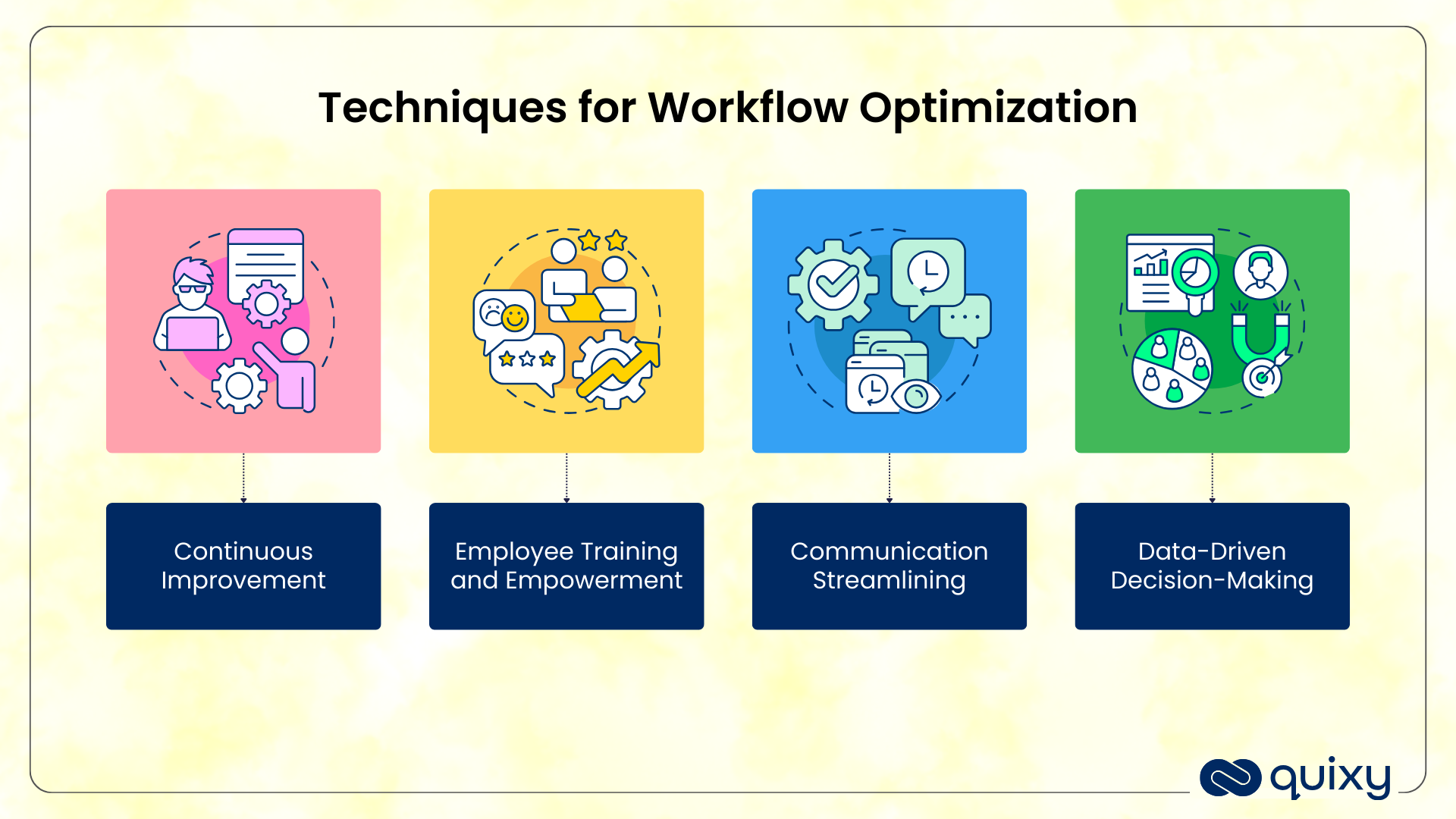
Continuous Improvement
Create a culture of continuous improvement by assessing and modifying your procedures on a regular basis. Encourage team members to provide feedback, assess performance indicators, and be flexible in the face of changing industry trends. This proactive digital business strategy ensures that your optimization efforts are long-lasting.
Employee Training and Empowerment
Invest in training programs to equip your team with the knowledge and skills required to traverse improved workflows. Employees who have received enough training are more inclined to accept new technology and processes, resulting in a smoother and more efficient workflow.
Reduce communication barriers
Simplify channels and implement explicit communication protocols. Effective communication reduces misconceptions, speeds up decision-making processes, and develops a more unified work atmosphere.
Data-Driven Decision-Making
Use data analytics to guide decision-making processes. Use key performance indicators (KPIs) and analytics tools to obtain insight into workflow efficiency, allowing you to make educated adjustments and improvements based on observable facts.
Also Read: Procurement Process Automation with Quixy
Also Read: Quixy as Your Business Process Management Software
The biggest historical barrier to optimization was execution: even after you designed a better workflow, building it meant a long IT queue. No-code and low-code platforms remove that barrier by letting the people closest to a process build and automate it themselves through visual, drag-and-drop design.
That shift matters because it:
- Cuts IT bottlenecks — business teams and citizen developers build workflows without writing code.
- Speeds iteration — pre-built components and templates turn weeks of development into days.
- Keeps optimization close to the work — the people who understand the process own the improvement.
Quixy is a no-code platform built for exactly this: designing, automating, and continuously optimizing business workflows — from approval processes to full enterprise workflow automation, with AI-assisted automation layered on top. Explore process optimization with Quixy to see how it fits your operations.
Conclusion
Workflow optimization isn’t a one-time cleanup — it’s a repeatable discipline: map, measure, redesign, automate, monitor, repeat. Pair a proven framework (Lean, Six Sigma, TOC, or BPR) with the right platform, and the same team can move work faster, more consistently, and at lower cost. Start with your most painful, most repetitive workflow, apply the seven steps above, and measure the difference.
Frequently Asked Questions(FAQs)
Q. What is workflow optimization in simple terms?
It’s improving how a sequence of tasks flows so the same work gets done with less time, cost, and effort — by removing bottlenecks, standardizing steps, and automating the repetitive parts.
Q. How do you optimize a workflow?
Map the current process, measure a baseline, find the root causes of delays, redesign the flow to remove waste, automate the repetitive steps, test with a pilot, and then monitor and refine continuously.
Q. What is the difference between workflow optimization and workflow automation?
Optimization is redesigning the workflow to be better; automation is using technology to run steps without manual effort. Automation is one tool within optimization — and automating a poorly designed workflow only makes its problems run faster.
Q. What are common workflow optimization examples?
Typical examples include automating procurement and purchase-order approvals, invoice and accounts-payable sign-off, facilities work orders, employee onboarding, and customer-support ticket routing — each moving from manual and slow to automated and measurable.
Q. Which workflow optimization strategy is best?
It depends on the problem. Use Lean to remove waste, Six Sigma to reduce errors and variation, Theory of Constraints when one bottleneck dominates, and Business Process Reengineering when the workflow needs a full rebuild. Many teams combine them.
Q. How do no-code platforms help with workflow optimization?
They let the people who run a process build and automate an optimized version themselves, using visual drag-and-drop tools — removing the IT bottleneck and making it fast to iterate as needs change.
Related Post



Please login to comment
0 Comments
Oldest
Recent Posts



- Download the App