

Digital transformation does not break down because organizations lack vision.
It breaks down because foundational digital transformation components are built unevenly.
A company may migrate to the cloud but retain fragmented workflows.
It may invest in analytics but lack data governance.
It may automate processes without aligning accountability.
The result is motion without momentum.
For C-level leaders, understanding the essential elelments of digital transformation is not theoretical. It is the difference between enterprise modernization and incremental digitization.
Digital transformation is not a technology program.
It is an architectural redesign of how the enterprise operates, makes decisions, manages risk, and delivers value.
Digital transformation succeeds or stalls based on ten interdependent components — infrastructure, data governance, process architecture, cybersecurity, customer experience, workforce alignment, change governance, integration, continuous innovation, and governed automation. Enterprises that align these as a system, rather than investing in them in isolation, avoid the fragmentation that causes most transformation initiatives to underdeliver. McKinsey research puts the failure rate at up to 70%, typically due to organizational misalignment rather than technology gaps.
The System Architecture Behind Components of Digital Transformation
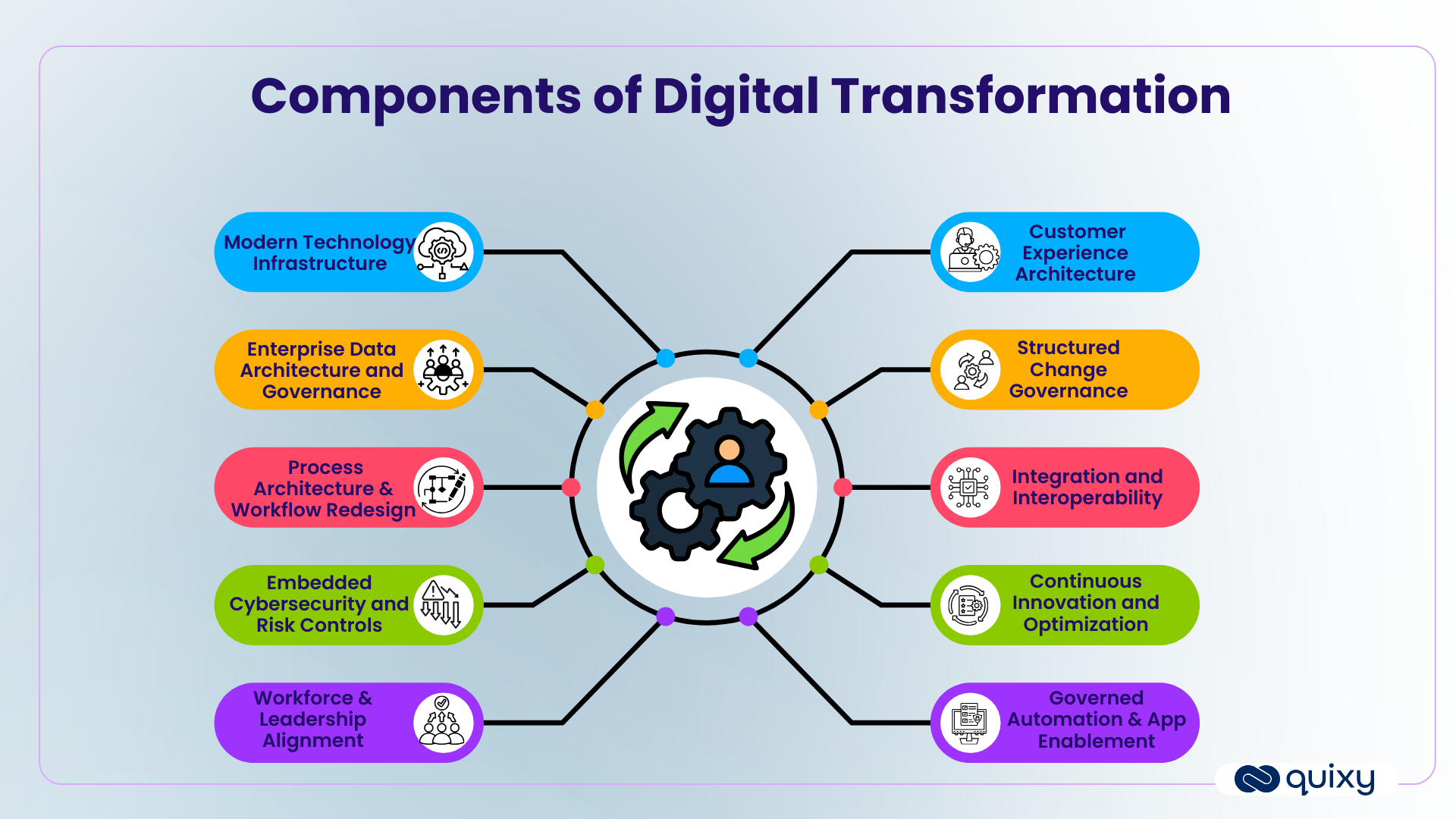
Most transformation efforts begin with urgency: new platforms, automation, dashboards, digital channels.
But technology deployment alone does not create transformation.
Sustainable transformation emerges when core enterprise digital transformation elements align:
- Infrastructure
- Data
- Process architecture
- Governance and risk controls
- Workforce capability
- Customer experience systems
- Integration frameworks
- Innovation capacity
These are not parallel investments. They are interdependent layers.
When one digital transformation elements lags, enterprise performance slows.
When they align, scale becomes possible.
1. Modern Technology Infrastructure
Infrastructure is the foundation upon which all other digital transformation elelments depend.
Legacy environments constrain scalability, integration, and resilience. They increase operational friction and security exposure.
Modern infrastructure whether cloud-native, hybrid, or containerized enables:
- Rapid deployment cycles
- API-driven interoperability
- Geographic scalability
- Operational elasticity
Without infrastructure modernization, every subsequent digital investment becomes harder to scale and more expensive to sustain.
This is the structural base of digital transformation maturity.
2. Enterprise Data Architecture and Governance
Digital transformation is only as strong as its data integrity.
Executive teams rely on accurate, real-time information to manage performance, compliance, and risk. Fragmented data environments undermine that clarity.
A mature data digital transformation component includes:
- Standardized enterprise data models
- Clear ownership structures
- Centralized governance frameworks
- Real-time analytics capability
Without governance, analytics becomes unreliable.
Without trusted data, digital transformation becomes guesswork.
Among all elelments of digital transformation, data maturity most directly influences decision quality.
Recent Gartner research reinforces this: organizations reporting successful AI initiatives invest up to four times more, as a share of revenue, in foundational areas like data quality, governance, and AI-ready change management than organizations with poor outcomes (Gartner, April 2026). Governance isn’t a compliance afterthought — it’s a direct predictor of whether data investments translate into business value.
3. Process Architecture and Workflow Redesign
Automating broken processes accelerates dysfunction.
True transformation requires reengineering how work moves across the organization.
Leading enterprises:
- Eliminate redundant approvals
- Standardize exception handling
- Integrate systems across departments
- Replace email-based coordination with structured workflows
When process architecture improves, outcomes become measurable:
- Shorter cycle times
- Reduced manual intervention
- Clear audit trails
- Improved operational accountability
Digital transformation delivers enterprise value only when workflows are intentionally engineered.
4. Embedded Cybersecurity and Risk Controls
Digital scale increases exposure.
As organizations expand digital touchpoints internal systems, customer portals, partner integrations risk multiplies.
Security must be embedded across transformation architecture through:
- Identity and access governance
- Encryption and data protection protocols
- Continuous monitoring frameworks
- Automated compliance controls
Retrofitting security after deployment introduces cost and vulnerability.
In enterprise environments, cybersecurity is not an IT concern. It is a board-level component of digital transformation.
This shift is already underway: Red Hat’s 2026 State of Cloud-Native Security Report found that over 60% of organizations now plan to automate security directly within CI/CD pipelines, embedding compliance as code rather than relying on manual review gates — a direct response to rising regulatory pressure like the EU Cyber Resilience Act.
5. Customer Experience Architecture
Digital transformation ultimately reshapes how customers experience the enterprise.
Friction in internal systems translates directly into friction in customer journeys.
High-performing organizations design:
- Omnichannel engagement models
- Self-service capabilities
- Personalized digital interactions
- Real-time experience analytics
Customer experience becomes consistent when underlying systems are integrated.
Among the components of digital transformation, experience architecture is where operational design meets competitive differentiation.
6. Workforce Capability and Leadership Alignment
Technology does not transform organizations. People do.
Digital initiatives fail when employees lack clarity, training, or incentive alignment.
A sustainable transformation program includes:
- Workforce upskilling
- Cross-functional collaboration models
- Clear accountability structures
- Leadership sponsorship
When digital tools are embedded into daily decision-making, adoption accelerates.
Cultural readiness is one of the most underestimated components of digital transformation and one of the most decisive.
Research from McKinsey & Company suggests that up to 70% of digital transformation initiatives fail to meet their objectives, often due to organizational misalignment rather than technology limitations.
The data on active sponsorship is stark. Organizations with visible executive sponsorship report a 73% success rate on change initiatives, compared to just 29% for those without it (Prosci, November 2025). Leadership alignment isn’t a soft factor sitting alongside the technical work, it’s one of the highest-leverage variables in whether transformation sticks.
7. Structured Change Governance
Enterprise transformation creates disruption.
Without structured governance, initiatives stall between pilot and scale.
Effective organizations establish:
- Defined ownership models
- Transformation KPIs
- Executive steering committees
- Transparent communication channels
Governed change converts digital ambition into operational discipline.
Prosci’s benchmarking research, tracked since 1998, has consistently ranked sponsorship as the number one contributor to change success across every study cycle, ahead of dedicated funding, structured methodology, and communication. Enterprises that treat sponsorship as a defined, governed role and not an assumed byproduct of seniority, see measurably stronger outcomes.
8. Integration and Interoperability
Few enterprises operate on a single technology stack.
ERP systems, CRM platforms, finance tools, third-party vendors all must communicate seamlessly.
Integration maturity enables:
- Real-time data synchronization
- Reduced reconciliation effort
- Consistent reporting
- Faster cross-functional execution
Disconnected systems produce fragmented transformation outcomes.
Integration converts investments into enterprise capability.
9. Continuous Innovation and Optimization
Digital transformation is not a milestone. It is a capability.
Organizations that outperform peers institutionalize:
- Agile experimentation cycles
- Performance-based iteration
- KPI-driven optimization
- Structured innovation governance
Continuous improvement ensures digital investments remain aligned with evolving market conditions.
Without this digital transformation component, transformation plateaus.
This is now a stated executive priority: McKinsey’s Global Tech Agenda 2026 found that nearly one-third of top performing companies plan to prioritize technology led business model innovation over the next two years, reflecting how deeply innovation capacity is becoming embedded in core strategy rather than treated as a separate initiative (McKinsey, February 2026).
10. Governed Automation and Application Enablement
As digital demand increases, internal requests for new workflows and applications accelerate.
Uncontrolled development leads to shadow IT, security gaps, and compliance risk.
Modern enterprises adopt governed automation platforms that enable:
- Business-led workflow digitization
- Rapid internal application development
- Centralized IT oversight
- Standardized deployment controls
When automation operates within governance guardrails, organizations achieve both speed and stability.
This balance between agility and control increasingly defines enterprise-scale digital transformation.
The Consequence of Imbalance of Digital Transformation Components
Efforts often underperform because digital transformation components evolve unevenly.
Common structural gaps include:
- Cloud modernization without process redesign
- Automation without workforce enablement
- Advanced analytics without data governance
- Integration without cybersecurity alignment
Transformation strength is cumulative.
The enterprise functions as a system. Its digital architecture must do the same.
A Final Perspective for the C-Suite
The essential components of digital transformation are not a checklist.
They are structural capabilities that determine whether an organization can:
- Scale efficiently
- Maintain regulatory compliance
- Respond to market shifts
- Protect enterprise risk
- Deliver consistent customer value
The most resilient organizations do not pursue transformation tactically.
They architect it intentionally, aligning infrastructure, data, process, governance, people, and innovation into a cohesive operating model.
For executive leaders, the question is not whether digital transformation is underway.
It is whether its core digital transformation components are aligned strongly enough to sustain enterprise-scale growth.

Enabling Execution: Structured Platforms and Governed Automation
Defining digital transformation components is a strategic exercise. Operationalizing them is an architectural one.
Execution often falters not because the vision is unclear, but because organizations lack structured mechanisms to digitize workflows, enforce governance, and scale automation without creating shadow IT.
This is where governed, enterprise-grade no-code platforms play a critical role.
Platforms such as Quixy enable organizations to translate transformation strategy into controlled execution. Rather than encouraging fragmented application development, structured platforms provide:
- Centralized governance frameworks
- Role-based access control
- Standardized workflow orchestration
- Audit-ready process automation
- Scalable application lifecycle management
In this model, automation is not ad hoc — it is governed.
Application development is not isolated — it is architected.
For CIOs and COOs, this reduces the tension between speed and control.
For CFOs, it improves visibility and compliance integrity.
For enterprise IT, it shifts focus from reactive system support to structured capability enablement.
Importantly, structured no-code platforms do not replace core systems. They extend them — orchestrating workflows across ERP, CRM, HR, and finance environments without destabilizing the existing architecture.
In a mature digital transformation program, platforms like Quixy function as execution infrastructure — enabling organizations to digitize processes systematically, without compromising governance or security.
Transformation, at scale, requires more than components.
It requires controlled enablement.
Conclusion
Digital transformation stands as a multifaceted process encompassing IT modernization, operational digitization, and innovative business ventures. It represents an incessant integration of technology to create value and ensure competitiveness. With an eye on successful transformation, teams must address specific challenges, ranging from fortifying IT foundations to crafting novel workflows. Undoubtedly, in today’s business milieu, the significance of digital transformation cannot be overstated, offering a competitive edge, agility, and adaptability to market dynamism.
Incorporating digital technology pervasively across operations equips businesses to thrive in the digital epoch, fostering flexibility, heightened productivity, cost reduction, amplified customer satisfaction, competitive advantage, and operational efficiency. Ultimately, digital transformation becomes the catalyst propelling businesses towards unwavering success in the contemporary digital landscape.
Frequently Asked Questions(FAQs)
Q. What are the Key Components of Digital Transformation?
The core components of digital transformation include modern technology infrastructure, enterprise data architecture, process redesign, cybersecurity integration, workforce enablement, customer experience systems, integration frameworks, governance structures, and continuous innovation capability. These components must operate as a coordinated system to achieve scalable enterprise transformation.
Q. How can executives assess digital transformation maturity?
Executives can assess digital transformation maturity by evaluating alignment across infrastructure scalability, data governance strength, process automation levels, cybersecurity integration, workforce adoption, and cross-system interoperability. Maturity increases when these components operate cohesively rather than independently.
Q. Why do digital transformation initiatives fail?
Digital transformation initiatives often fail due to misalignment between critical components such as infrastructure, data governance, and process architecture. Organizations may invest heavily in technology without redesigning workflows, strengthening governance, or preparing the workforce, resulting in fragmented progress and limited ROI.
Q. Which component of digital transformation is most important?
No single component guarantees success. However, data governance and process architecture are often the most influential because they directly impact decision-making quality and operational efficiency. Sustainable transformation requires balanced alignment across all foundational components.
Q. Why do Digital Transformation components need to be aligned across organization?
When DT components evolve independently such as upgrading infrastructure without redesigning processes organizations create fragmentation. Alignment ensures that technology, data, governance, and workflows reinforce one another, enabling enterprise-wide scalability and consistent performance.
Q. What is difference between digital transformation components and a strategy?
A digital transformation strategy defines vision and direction. Digital transformation components represent the structural capabilities infrastructure, data, processes, governance, and talent required to execute that strategy effectively and sustainably.
Related Post



Please login to comment
0 Comments
Oldest
Recent Posts







- Download the App