

In the mobile-first world of 2026, businesses face a critical decision: should they invest in a native app or a Progressive Web App (PWA)? With user expectations higher than ever, the choice between the two can significantly impact engagement, conversion rates, and long-term scalability. Both PWAs and native apps offer unique advantages, but they serve different purposes. Understanding the differences, benefits, and limitations of each is essential for making the right decision.
This guide will explore everything you need to know about Progressive Web Apps vs Native Apps, including their features, advantages, use cases, challenges, and future trends.
What Are Progressive Web Apps (PWAs)?
Progressive Web Apps are essentially websites that behave like native apps. They run in a browser but provide an app-like experience, making them a hybrid between web pages and mobile applications. Users can access PWAs instantly via a URL, and they can even “install” them on their home screens without going through an app store.
The magic behind PWAs lies in modern web technologies such as service workers, web app manifests, and HTTPS. Service workers allow PWAs to work offline or on slow networks by caching data. Web app manifests make the app installable on devices, complete with custom icons and splash screens. Using HTTPS ensures security and trust for users.
PWAs are designed to be responsive, secure, and fast. They can send push notifications, run offline, and provide a seamless experience across different devices and screen sizes. Companies like Twitter Lite, Starbucks, and Pinterest Lite have successfully leveraged PWAs to reach more users without asking them to download an app.
What Are Native Apps?
Native apps are developed specifically for a particular operating system, such as iOS or Android, using platform-specific programming languages. For instance, iOS apps are built with Swift or Objective-C, while Android apps use Kotlin or Java. Unlike PWAs, native apps must be downloaded from an app store before users can access them.
One of the biggest advantages of native apps is deep integration with device hardware. They can fully utilize cameras, GPS, sensors, and other features to deliver a rich, immersive experience. Native apps also provide superior performance, faster load times, and smooth interactions, making them ideal for applications that require intensive processing, such as games or AR-enabled apps.
Popular examples of native apps include Instagram, Spotify, and WhatsApp, all of which rely heavily on device capabilities and offline functionality to deliver a high-quality user experience.

Key Differences Between PWAs and Native Apps
| Aspect | Progressive Web Apps (PWAs) | Native Apps |
|---|---|---|
| Technology | Web-based applications built using modern web technologies | Platform-specific applications built for iOS or Android |
| Development Approach | Single codebase works across devices and platforms | Separate development required for iOS and Android |
| Development & Maintenance | Easier and faster to develop and maintain | More complex and costly to build and maintain |
| Performance | Fast, but limited by browser capabilities | Optimized for the operating system with smoother interactions |
| Hardware Access | Limited access to device hardware | Full access to device hardware and OS features |
| Offline Functionality | Partial offline support using cached data | Full offline functionality with complete feature access |
| Updates | Instant updates without user intervention | Updates require app store approval and user downloads |
| Discoverability | Discoverable via search engines and sharable via URLs | Discovered primarily through app stores |
| User Adoption Barrier | Low—no download required | Higher—users must install the app |
| Reach & Accessibility | Broad reach across devices and regions | Limited to users willing to download the app |
Advantages of Progressive Web Apps
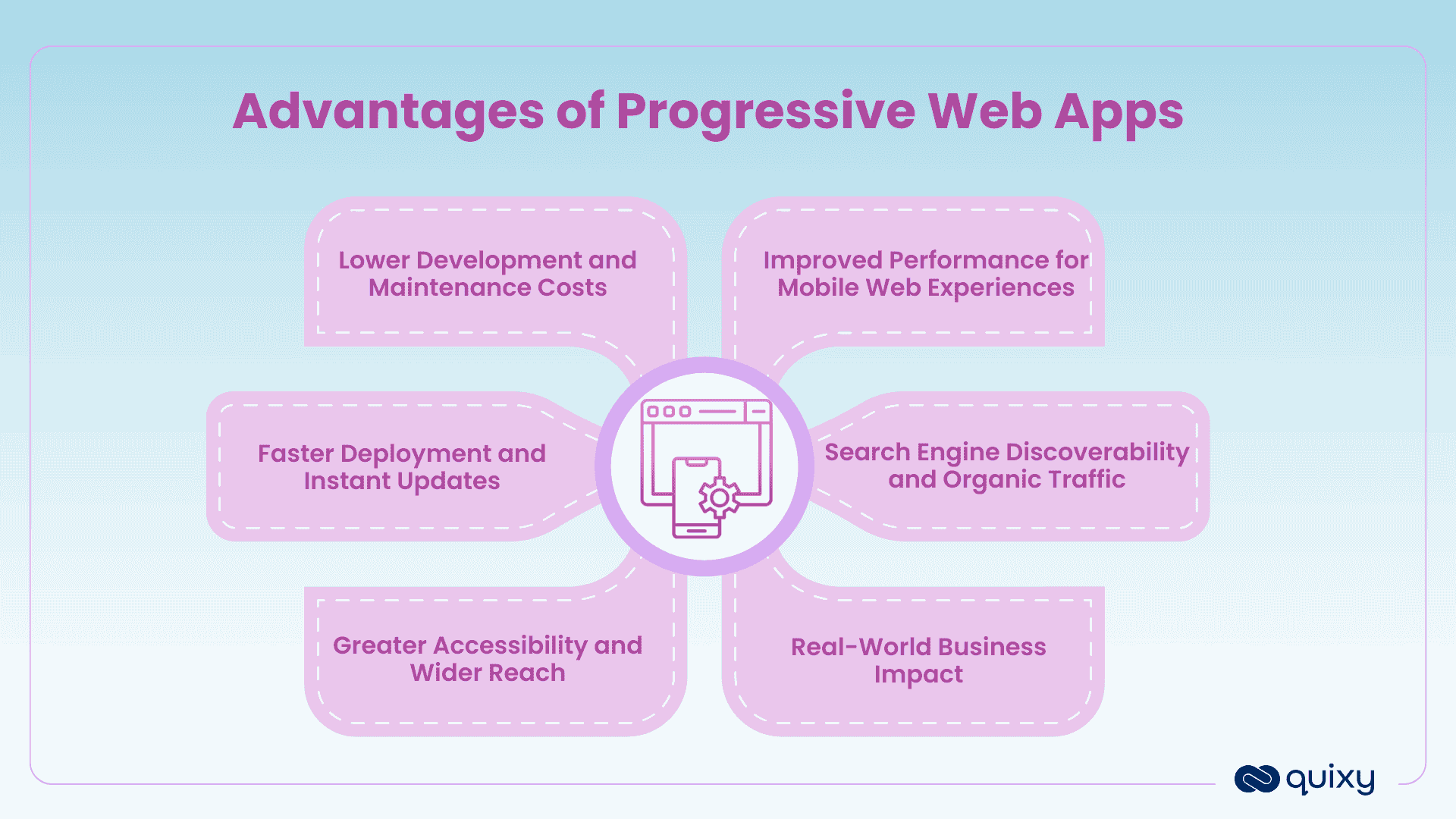
Lower Development and Maintenance Costs
PWAs offer significant benefits for businesses looking for cost-effective and accessible digital solutions. One of the most notable advantages is their lower development cost. Since a Progressive Web App relies on a single codebase that works across devices and operating systems, businesses do not need to build and maintain separate applications for iOS and Android. This unified approach significantly reduces both initial development expenses and ongoing maintenance efforts, making PWAs especially attractive for growing businesses and startups.
Faster Deployment and Instant Updates
Another major advantage of PWAs is their speed of deployment and ease of updates. Because PWAs are web-based, any changes or improvements are instantly available to users without requiring app store submissions or approvals. This allows businesses to iterate faster, fix issues quickly, and respond to user feedback in real time. In fast-moving markets, this agility can be a major competitive advantage.
Greater Accessibility and Wider Reach
PWAs are highly accessible, as users can open them instantly through a URL without downloading large application files. This low-friction access is particularly valuable in regions where devices have limited storage or where internet connectivity is slow or unreliable. By removing the need for app store downloads, PWAs make it easier for users to engage with a product immediately, increasing adoption and reducing drop-offs.
Improved Performance for Mobile Web Experiences
Performance is another area where PWAs stand out. Through intelligent caching and optimized resource loading, PWAs often load faster than traditional websites, even on slower networks. Faster load times reduce bounce rates and improve user retention, which directly impacts engagement and conversions. For mobile-first audiences, this performance boost can make a noticeable difference in user experience.
Search Engine Discoverability and Organic Traffic
Because PWAs are part of the web ecosystem, they are fully indexable by search engines. This means businesses can benefit from organic search traffic in a way that native apps typically cannot. Improved discoverability through search engines not only increases visibility but also helps attract users who may not actively search for an app in an app store.
Real-World Business Impact
Many businesses have already seen tangible results after adopting PWAs. Flipkart Lite, the Progressive Web App version of Flipkart, significantly increased conversions by delivering a faster and more engaging experience to users on slow networks. Similarly, Starbucks’ PWA enables customers to browse menus and place orders even in areas with poor connectivity, ensuring a seamless experience regardless of network conditions.
Advantages of Native Apps
Native apps shine when performance, offline capabilities, and device integration are critical. Because they are built specifically for a platform, native apps can take full advantage of hardware features like cameras, GPS, sensors, and biometric authentication. This allows them to deliver rich, immersive experiences that PWAs cannot fully replicate.
Performance is another area where native apps excel. High-end gaming apps, video editing tools, and AR/VR applications require the speed and optimization that only native apps can provide. Native apps can also function fully offline, making them suitable for productivity apps, messaging platforms, and other services where connectivity may be unreliable.
Being listed on app stores also adds credibility and discoverability. Users often perceive apps from Google Play or the Apple App Store as trustworthy, and app store features like ratings and reviews further enhance visibility.
For example, Instagram leverages native capabilities to offer advanced photo editing and camera integration. WhatsApp relies on native features to provide real-time messaging and offline syncing, while Spotify uses deep device integration to optimize streaming and offline listening experiences.
Studies show that PWAs can reduce development costs by roughly 30–50% compared to building separate native apps for iOS and Android.
Challenges of PWAs and Native Apps
Despite their advantages, both PWAs and native apps have challenges. PWAs, while highly accessible, are limited in their ability to integrate with device hardware. Advanced functionalities like AR, biometric authentication, or background processing are often restricted. Additionally, some users may not recognize PWAs as installable apps, which can impact adoption rates.
Native apps, on the other hand, are more expensive to develop and maintain because separate versions are required for iOS and Android. App store approvals can also delay launches and updates. Furthermore, large app sizes can deter users, especially in regions with limited storage or slower networks.
Progressive Web Apps are a strong fit for businesses that prioritize reach, speed, and cost efficiency. A PWA is the right choice when:
- You want to reach a wide audience across devices and platforms without maintaining separate iOS and Android apps.
- Lower development and maintenance costs are a priority.
- Faster time-to-market and the ability to roll out instant updates matter to your business.
- Your application does not require deep hardware access or performance-intensive features.
- Accessibility and ease of use are critical, especially for first-time or occasional users.
- Your product is content-heavy, service-oriented, or commerce-driven, where fast load times improve conversions.
- You are targeting users in regions with limited connectivity or low-end devices, where offline caching and smaller app sizes make a difference.
Real-world examples like Flipkart Lite and Starbucks’ PWA demonstrate how businesses can deliver app-like experiences to a broad audience without forcing downloads or consuming device storage. By reducing friction and improving accessibility, PWAs make it easier for users to engage instantly, regardless of network conditions.
When to Choose a Native App
Native apps make sense when performance, offline capabilities, or hardware integration is critical. Apps that rely on advanced features like AR, complex graphics, or real-time processing are better suited for native development. Native apps are also preferable when brand presence on app stores matters, or when apps need to engage users with rich notifications and background processes.
Messaging apps like WhatsApp, photo and video apps like Instagram, and gaming apps are classic examples where native apps outperform PWAs. These apps require offline syncing, device sensors, and high-speed performance that only native platforms can deliver.
The Hybrid Approach: Combining PWAs and Native Apps
An increasing number of businesses are no longer choosing between PWAs and native apps—instead, they are using both strategically. This hybrid approach allows organizations to balance speed, reach, and performance without overcommitting too early.
Typically, companies begin with a Progressive Web App to quickly enter the market and engage users with minimal friction. A PWA makes it easy to test demand, gather real-world usage data, and understand user behavior without the cost and complexity of maintaining separate native apps. Because PWAs are instantly accessible through a browser, they help businesses reach a broader audience from day one.
As user engagement grows and product requirements evolve, businesses can then invest in native apps to support advanced functionality, deeper device integration, and performance-intensive use cases. This phased approach ensures that native development is driven by proven user needs rather than assumptions.
The result is the best of both worlds: rapid deployment and wide accessibility through PWAs, combined with high performance and rich user experiences through native apps. Flipkart is a strong example of this strategy. By launching Flipkart Lite as a PWA, the company reached millions of users on low-bandwidth networks. At the same time, it continued to enhance its native app for power users seeking a more feature-rich experience.
For businesses aiming to scale efficiently, the hybrid model offers a practical, future-ready path—one that aligns product investment with real user demand while maximizing reach and engagement.
Where Platforms Like Quixy Fit In
Beyond choosing between Progressive Web Apps and native apps, many organizations are also rethinking how applications are built and managed internally. This is where no-code and low-code platforms like Quixy come into play. Instead of focusing solely on front-end delivery, Quixy enables businesses to rapidly build end-to-end operational and workflow-driven applications, including data models, approvals, integrations, and governance—without heavy coding. In practice, many enterprises use PWAs or native apps for customer-facing experiences, while relying on platforms like Quixy to power the internal systems that support those experiences. Rather than competing, these approaches often complement each other, helping organizations move faster while maintaining control, scalability, and security across their application landscape.
Conclusion: Which Option Is Right for Your Business?
Choosing between a PWA and a native app depends on your audience, goals, and technical requirements. PWAs are ideal for businesses seeking broad reach, fast deployment, and cost efficiency. They allow users to access content instantly, provide app-like experiences, and work in regions with limited connectivity.
Native apps, however, are unmatched in terms of performance, offline capabilities, and deep device integration. They are essential for applications that require advanced functionality, immersive experiences, or presence on app stores for credibility and discoverability.
A hybrid strategy often works best. Launching a PWA first allows you to test your idea, reach a wide audience, and gather insights. Based on user feedback and growth, investing in a native app ensures long-term engagement and access to advanced features.
In 2026, the decision is no longer just about choosing between PWA and native—it’s about understanding your business needs, your users’ expectations, and the technology that will best bridge the two.
By carefully considering the strengths and limitations of each, businesses can make informed decisions that maximize engagement, reduce costs, and deliver exceptional experiences to their users.
Frequently Asked Questions(FAQs)
Q. Can PWAs work offline?
Yes, PWAs can work offline using cached data through service workers. However, their offline functionality is limited compared to native apps, which can operate fully without internet access.
Q. Do users need to download a PWA from an app store?
No. PWAs can be accessed instantly via a browser and installed on a home screen without app store downloads, making them more accessible for users.
Q. How do PWAs improve user engagement?
PWAs improve engagement through fast load times, offline functionality, push notifications, and app-like experiences without requiring downloads, making them accessible and convenient for users.
Q. Which is cheaper to develop: a PWA or a native app?
PWAs are generally more cost-effective because a single codebase works across platforms. Native apps require separate development for iOS and Android, increasing costs and maintenance efforts.
Related Post


Please login to comment
0 Comments
Oldest
Recent Posts






- Download the App