

Task management software helps teams organize tasks, assign owners, set deadlines, track progress, and automate workflows—all from one centralized platform. In 2026, the best solutions go beyond basic task tracking, combining ease of use with powerful automation, customization, and real-time visibility.
If your team is constantly juggling priorities, chasing deadlines, and struggling to stay aligned, you’re not alone. Disconnected tools, manual follow-ups, and lack of visibility often lead to missed deadlines, duplicated work, and operational inefficiencies. What starts as simple task tracking quickly becomes chaos at scale.
This is where modern task management software changes the equation. Instead of reacting to work, teams can proactively plan, execute, and optimize workflows with clarity and control. From assigning responsibilities to automating repetitive processes, the right tool transforms how work gets done across teams.
The shift is already underway. Businesses are moving away from standalone task tools toward integrated, scalable platforms that support complex workflows, cross-functional collaboration, and data-driven decision-making. With the project management software market projected to reach $10.86 billion by 2029, growing at a CAGR of 10.67%, the demand for advanced task management solutions is accelerating.
For decision-makers, the challenge is no longer whether to adopt task management software—but how to choose the right one. The ideal solution should not only help teams stay organized but also improve accountability, streamline operations, and scale with business needs.
In this guide, we break down the best task management software in 2026, along with key features, use cases, and expert insights to help you evaluate, compare, and select the right platform for your organization.
What Is Task Management Software?
Task management software is a digital tool that helps individuals and teams plan, assign, track, and complete work in a centralized platform. It replaces manual methods like spreadsheets, email threads, and sticky notes with structured workflows, deadlines, priority labels, and real-time visibility — so nothing falls through the cracks.
Modern task management tools go beyond simple to-do lists. They integrate automation, reporting dashboards, collaboration features, and AI-driven insights to help teams work faster and more intelligently.
Also Read: Efficient Task Management with Quixy
Why Does Task Management Software Matter in 2026?
Work is more distributed, faster-paced, and cross-functional than ever. Without a structured system, teams face:
- Missed deadlines due to unclear ownership
- Communication silos from using scattered tools
- Limited visibility into project status and workload
- Inability to scale as team size and process complexity grow
The right task management solution directly addresses these pain points. According to IDC research cited by Asana, organizations using structured task management platforms execute business processes 42% faster, complete 40% more processes, and report a 72% improvement in employee satisfaction.
Key Features to Look for in Task Management Software
| Feature Category | Key Capabilities | Why It Matters for Teams |
|---|---|---|
| Core Features | Task creation, assignment, prioritization Due dates, reminders, escalation alerts Subtasks and dependencies Status tracking (To Do → In Progress → Done) | Ensures structured execution, clear ownership, and timely delivery of work |
| Collaboration Features | Team workspaces and shared dashboards File attachments and in-task comments Role-based access control Guest/client access | Improves team alignment, communication, and transparency across stakeholders |
| Views & Visualization | List view, Kanban boards, Calendar view Gantt charts for timeline planning Workload view for resource management | Helps teams visualize work, manage timelines, and balance workloads effectively |
| Automation & Intelligence | Rule-based workflow automation Recurring tasks AI-driven suggestions and prioritization Third-party integrations (Slack, Google Workspace, CRM, ERP) | Reduces manual effort, improves efficiency, and enables smarter decision-making |
| Reporting & Analytics | Real-time dashboards Time tracking and productivity reports Custom reports with drill-down insights | Provides visibility into performance, bottlenecks, and team productivity |
| Customization | Custom fields, forms, and templates Configurable workflows No-code/low-code app building | Adapts the tool to your business processes instead of forcing rigid workflows |
Types of Task Management Software
Not all task management tools are built the same. Here’s a breakdown of the main categories:
1. Simple Task Trackers Best for individuals or small teams with straightforward workflows. Think basic to-do list apps with reminders and labels. Limited in scalability.
2. Project Management Platforms Tools like Asana, Wrike, and Monday.com offer task management as part of a broader project management suite. They add features like project timelines, portfolio views, and resource planning.
3. Collaborative Work Management Tools Platforms that blend task tracking with team communication, document management, and reporting — ideal for cross-functional teams.
4. No-Code Task Management Platforms The most flexible category. Platforms like Quixy allow teams to build fully custom task management applications without writing a single line of code. Instead of adapting your processes to fit a rigid tool, you build a tool that fits your exact process — and update it as your needs evolve.
Comparison: Top Task Management Software in 2026
| Tool | Best For | Customization | Automation | Pricing |
|---|---|---|---|---|
| Quixy | Custom, scalable enterprise workflows | ⭐⭐⭐⭐⭐ | ⭐⭐⭐⭐⭐ | Custom / per user |
| Asana | Cross-team project visibility | ⭐⭐⭐ | ⭐⭐⭐⭐ | Free – $24.99/user/mo |
| Monday.com | Visual project planning | ⭐⭐⭐⭐ | ⭐⭐⭐⭐ | $9–$19/user/mo |
| Wrike | Built-in templates & reporting | ⭐⭐⭐ | ⭐⭐⭐⭐ | Free – $24.80/user/mo |
| Jira | Agile software development teams | ⭐⭐⭐ | ⭐⭐⭐ | Free – $15.05/user/mo |
| ClickUp | All-in-one teams on a budget | ⭐⭐⭐⭐ | ⭐⭐⭐⭐ | Free – $12/user/mo |
| Trello | Simple Kanban-style tracking | ⭐⭐ | ⭐⭐ | Free – $10/user/mo |
| Smartsheet | Spreadsheet-native teams | ⭐⭐⭐ | ⭐⭐⭐ | $9–$32/user/mo |
Best Task Management Software for this Year
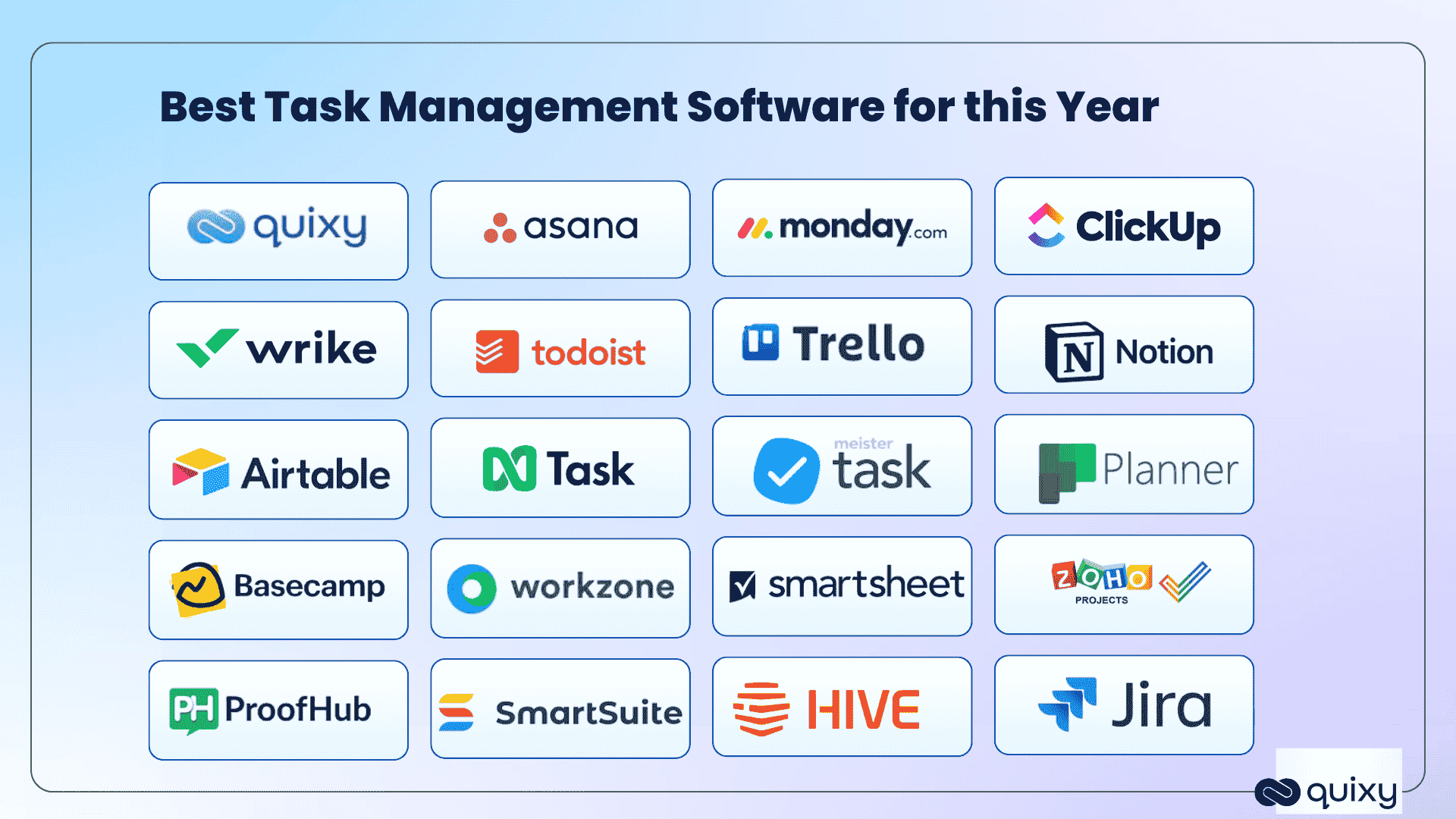
1. Quixy
Best for: Enterprises and growing businesses that need a fully customizable, automated task management system — without writing a single line of code.
Quixy is not a conventional task management tool. It’s a no-code, AI-powered business process automation platform that lets teams build task management applications completely tailored to their workflows. Instead of adapting your processes to fit a rigid tool, you build the tool that fits your exact process — and update it as your needs evolve.
Key Features:
- Drag-and-drop app builder with custom task forms, fields, and layouts
- Kanban boards with configurable stages (To Do → In Progress → Review → Done)
- List View 2.0 for structured, filterable task tables
- Multi-level workflow automation: approvals, escalations, conditional routing
- Real-time dashboards and drill-down reports
- AI-powered task assignment, bottleneck detection, and process insights
- Mobile app with offline access for field teams
- Geo-fencing, role-based access, SSO, and enterprise-grade security
- Integrations with ERP, CRM, HRMS, Slack, Google Workspace, and more
Ideal for: Enterprises, operations teams, IT departments, field service teams, HR teams, and any organization that needs workflow automation beyond simple task lists.
Limitations: Requires initial setup time to configure custom apps; less suited for individuals needing a basic personal to-do list.
Pricing: Custom pricing based on users and modules. Demo available at quixy.com.
Why Quixy wins: Every other tool on this list gives you a fixed structure. Quixy gives you a platform to build your own. That difference compounds over time — especially as your team grows and processes evolve.
2. Asana
Asana is a popular software for task management solution renowned for its ability to handle tasks and projects concurrently. Its user-friendly interface and robust project-tracking features make it a go-to choice for task-tracking systems for remote teams and enterprises.
Key Features
- Manage tasks with deadlines and subtasks efficiently
- Give a comprehensive outline of tasks and projects.
- Simplifies task organization with an intuitive interface
- Integrations with over 100 other apps
- Workload view to monitor and manage team members’ workload
Ideal for: Enterprise clients needing to track company-wide initiatives and break them down into manageable tasks.
Limitations: Limited time tracking functionality, fewer advanced features in the free version, and custom branding is only available on the enterprise plan.
Best for: Managing large teams
3. Monday.com
Monday.com is a robust task management tool that offers customizable templates tailored to your workflow. It also provides automation features that handle routine tasks, allowing you to focus on strategic matters while enabling customized workflows & real-time collaboration.
Key Features
- Customizable templates
- Automate repetitive tasks to enhance productivity
- Real-time dashboards
- Wide integration with popular third-party apps and tools
- Timeline and Gantt views
- Team communication and collaborative workspaces within the platform
Ideal for: Mid-sized to large teams needing a flexible tool for management and collaboration.
Limitations: Can be costly for larger teams and lacks some real-time tracking functionalities.
Best for: Visual project management with advanced customization options
4. ClickUp
ClickUp is a comprehensive tool that integrates task management, time tracking, and project visualization into a single platform.
Key Features
- Organize tasks with custom statuses and fields
- Track time spent on tasks and projects
- Gantt, Kanban, and Calendar views
- Integrated team chat
- Customizable board view
Ideal for: Small teams and individuals needing a versatile tool with powerful customization features.
Limitations: The extensive feature set might be challenging for users to navigate, leading to a steep learning curve, and the user interface requires improvement.
Best for: Budget-conscious businesses
5. Wrike
Wrike is a powerful task management tool designed to streamline workflows and keep projects on track. It simplifies collaboration and helps you meet deadlines with its range of comprehensive features.
Key Features
- Customizable workflows and task dependencies
- Real-time collaboration and commenting
- Project timelines and Gantt charts
- Automation rules for optimizing processes
Ideal for: Marketing teams, agencies, and professional service providers needing advanced project management capabilities and detailed reporting.
Limitations: High cost for advanced features, and a somewhat confusing user interface.
Best for: Managing multiple projects efficiently
6. Todoist
Todoist is a leading task management tool that helps users consolidate all their tasks in one place. It functions as an online to-do list, allowing individuals and teams to manage tasks and projects efficiently.
Key Features
- Organize tasks with priorities and subtasks
- Comment on projects and tasks
- Set prioritization levels
Ideal for: Individuals and small teams focused on personal task management.
Limitations: Lacks advanced features such as timelines, dashboards, and team collaboration tools. Not ideal for managing complex team projects.
Best for: Simple task management
7. Trello
Trello uses a Kanban-based approach to task management, helping users visually organize tasks with boards, lists, and cards.
Key Features
- Organize tasks using a visual Kanban board
- Enhance task details with checklists and file attachments
- Integrate with over a hundred popular tools
- Access to numerous pre-made templates
Ideal for: Smaller projects and teams seeking a visual task management tool.
Limitations: Limited built-in features; less suitable for larger teams or complex project management. Storage is restricted, with upgrades needed for additional space.
Best for: Visual task organization and straightforward project tracking
8. Notion
Notion is a flexible task management software and task management tool that blends notes, databases, and projects into a single workspace. It’s great for helping teams design custom workflows and track progress in real-time.
Key Features
- All-in-one workspace with docs, wikis, and tasks
- Customizable boards for project and task tracking software
- Templates for task scheduling and workflows
- Collaboration with real-time commenting and mentions
Ideal for: Teams seeking a versatile app that combines knowledge management with task management applications.
Limitations: Can feel overwhelming for beginners; requires setup time.
Best for: Creative teams and startups needing an adaptable task management application.
9. Smartsheet
Smartsheet is a powerful project and task management software that feels like a spreadsheet but acts as advanced task manager software. It streamlines workflows while offering automation and scalability.
Key Features
- Gantt charts, Kanban, and calendar views
- Built-in automation for repetitive tasks
- File sharing and collaboration in one platform
- Advanced reporting and dashboards
Ideal for: Enterprises that need robust team task management software with data-driven insights.
Limitations: Complex interface; pricing can be high for smaller businesses.
Best for: Large organizations seeking enterprise-grade task tracking applications.
10. Microsoft Planner
Microsoft Planner is a user-friendly team task management app integrated into Microsoft 365. It’s a simple task scheduling software that helps teams assign, categorize, and track tasks with ease.
Key Features
- Board-style task management with deadlines and priorities
- Seamless integration with Teams, Outlook, and Office apps
- Simple collaboration with file sharing and commenting
- Real-time notifications and progress charts
Ideal for: Organizations already using Microsoft looking for basic applications.
Limitations: Limited reporting and customization options.
Best for: Businesses needing lightweight software for task management.
11. Airtable
Airtable is a hybrid between a database and online task management software. It provides multiple task views while supporting automation, making it a highly customizable task tracking application.
Key Features
- Grid, Kanban, calendar, and gallery task views
- Automation and workflow building
- Integration with popular third-party tools
- Collaboration features for teams of all sizes
Ideal for: Teams needing adaptable task management software with database functionality.
Limitations: Advanced features locked in premium plans.
Best for: Businesses looking for flexible software with creative workflows.
12. ProofHub
ProofHub is an all-in-one employee task management system that consolidates planning, communication, and reporting. It’s a reliable task management app for teams needing centralized workflows.
Key Features
- Task assignments with deadlines and milestones
- Collaboration via chats, discussions, and file sharing
- Custom workflows and project templates
- Built-in time tracking and reporting
Ideal for: Mid-to-large businesses seeking team software to unify operations.
Limitations: Fewer integrations compared to competitors.
Best for: Teams that want streamlined employee task management software.
13. Basecamp
Basecamp is a classic task management software built for simple team task management and collaboration. It helps businesses stay organized without overcomplicating workflows.
Key Features
- To-do lists, task scheduling, and file storage
- Team messaging and group chats
- Project tracking with milestones
- Notifications and reminders for deadlines
Ideal for: Small businesses and startups seeking easy-to-use task management applications.
Limitations: Limited advanced features; not ideal for complex workflows.
Best for: Teams prioritizing straightforward task managing software.
14. Zoho Projects
Zoho Projects is a comprehensive task management app and task tracking software that integrates into Zoho’s suite of business tools. It covers everything from task assignments to reporting.
Key Features
- Task dependencies and milestones
- Gantt charts and visual project tracking
- Time tracking and timesheets
- Integration with Zoho CRM and other apps
Ideal for: Teams already using Zoho looking for software for task management.
Limitations: Steeper learning curve for non-Zoho users.
Best for: Growing companies needing integrated task management applications.
15. Smartsuite
Smartsuite is an adaptable task management workflow software that enables businesses to design custom solutions for projects and teams.
Key Features
- Custom workflows and automation rules
- Templates for multiple industries
- Task tracking dashboards and reporting
- Collaboration with chat and file sharing
Ideal for: Enterprises looking for flexible task managing applications.
Limitations: Newer tool with fewer integrations compared to competitors.
Best for: Businesses seeking scalable task management software.
16. Hive
Hive is a modern management app that unifies projects, email, and tasks. Known for its analytics, it’s a high-performing task management tool.
Key Features
- Kanban, Gantt, and calendar views
- Task automation and recurring tasks
- Analytics dashboards for workload insights
- Integrations with hundreds of third-party tools
Ideal for: Teams needing task tracking software with advanced analytics.
Limitations: Can be complex to navigate for new users.
Best for: Leaders searching for the best task management app with data insights.
17. Jira
Jira is a trusted task tracking application widely used for agile project management. It’s more than a task management app—it’s a complete solution for planning and monitoring complex workflows.
Key Features
- Agile boards, sprints, and backlog management
- Issue tracking and prioritization
- Reporting and dashboards for progress monitoring
- Integration with Confluence, Bitbucket, and more
Ideal for: Software and IT teams needing team task management software.
Limitations: Learning curve; too technical for non-IT users.
Best for: Agile teams requiring advanced project and task management software.
18. MeisterTask
MeisterTask is a visually appealing task management application built around Kanban boards. It’s simple, intuitive, and effective for task management workflows.
Key Features
- Visual Kanban task boards
- Task assignments and recurring schedules
- Integration with Slack, Google Workspace, etc.
- Time tracking add-ons for productivity monitoring
Ideal for: Small teams needing lightweight software.
Limitations: Limited reporting and analytics features.
Best for: Businesses wanting clean, visual task managing software.
19. nTask
nTask is a budget-friendly employee task management software that consolidates meetings, projects, and timesheets. It’s designed as an easy-to-use task management tool for small businesses.
Key Features
- Meeting scheduling and agendas
- Timesheets for tracking employee hours
- Task prioritization and reminders
- Risk management and reporting
Ideal for: Startups needing affordable software.
Limitations: Limited integrations compared to larger competitors.
Best for: Teams focused on simple employee task management.
20. Workzone
Workzone is a professional-grade team software that provides visibility across multiple projects. It’s a long-standing task managing software trusted by enterprises.
Key Features
- Centralized project dashboards
- Task assignments with deadlines and dependencies
- File sharing and team collaboration tools
- Reporting for project progress and workloads
Ideal for: Enterprises managing complex, cross-department projects.
Limitations: Outdated interface compared to modern competitors.
Best for: Companies needing enterprise-level management applications.
How to Choose the Right Task Management Software
Use this framework to evaluate options for your team:
Step 1 — Map Your Workflows Are your tasks linear (one stage to the next) or iterative (multiple reviews and revisions)? Do tasks require cross-departmental approvals? Understanding your workflow structure first prevents buying a tool that won’t support it.
Step 2 — Assess Team Size and Structure A five-person startup has different needs than a 500-person enterprise. Consider whether external stakeholders — clients, vendors, partners — also need access to task data.
Step 3 — Define Non-Negotiable Features Make a short list of must-have capabilities: time tracking, automation, file attachments, offline access, specific integrations. Be ruthless — every “nice to have” adds cost and complexity.
Step 4 — Test for Adoption Ease The best task management software is the one your team will actually use. Run a pilot with a real project and measure adoption honestly.
Step 5 — Think About Tomorrow, Not Just Today Can the platform scale with you? Will you be locked into rigid templates when your processes evolve? No-code platforms like Quixy give you the flexibility to adapt without re-platforming every 18 months.
Also Read: Quixy as Your Business Process Management Software
Conclusion
The best task management software in 2026 is not a one-size-fits-all answer. For teams with simple needs and modest budgets, tools like ClickUp, Asana, or Trello are solid starting points. For growing organizations that need customizable, automated, scalable workflows without depending on developers, Quixy stands in a category of its own.
Quixy doesn’t just give you a task manager — it gives you the power to build the exact task management system your business needs, and evolve it as your needs change. That’s not a feature. That’s a competitive advantage.
Ready to Build Your Own Task Management System — Without Writing a Line of Code?
See how Quixy can transform the way your team tracks, automates, and delivers work.
Frequently Asked Questions(FAQs)
Q. Can task management software integrate with my existing ERP?
Yes, many task management software tools like Quixy are designed to integrate with existing ERP systems seamlessly. This integration allows for real-time data synchronization, ensuring that tasks, projects, and resource management are aligned with your broader business processes. By connecting these systems, you can streamline workflows, reduce manual data entry, and enhance overall operational efficiency.
Q. How task management software enhance team collaboration?
Task management software enhances team collaboration and communication by centralizing all project-related information in one platform. It allows team members to assign tasks, share updates, comment on progress, and attach relevant files in real time. This transparency ensures everyone is on the same page, reduces the risk of miscommunication, and promotes more efficient teamwork.
Q. Is task management software adaptable to evolving needs of a business?
Yes, most task management software like Quixy is highly adaptable to the evolving needs of a growing business. Many platforms offer scalable features, allowing you to add more users, customize workflows, and integrate additional tools as your business expands. This flexibility ensures that the software continues to meet your operational requirements as your projects become more complex and your team grows.
Q. Does task management software improve project accountability?
Task management software improves project transparency and accountability by providing a clear view of task assignments, deadlines, and progress. Features like dashboards, real-time updates, and automated notifications ensure that all team members know their responsibilities and the project’s status. This visibility fosters accountability, as everyone can track who is responsible for what and ensure deadlines are met.
Related Post


Please login to comment
0 Comments
Oldest
Recent Posts




- Download the App