
Your customer data is only as valuable as your ability to organize and act on it. The right customer database software turns scattered contacts, deals, and interactions into a single, searchable source of truth — and the wrong one becomes another silo. This guide compares the 10 best customer database software tools for 2026, with honest pros and cons, pricing, and dedicated picks for small businesses and for teams that need a genuinely free option.
According to Software Advice, approximately 47% of businesses using CRM report a significant improvement in customer service efficiency.
What Is Customer Database Software?
Customer database software is a tool that stores, organizes, and manages all of a business’s customer information — contact details, interactions, purchase history, and communication records — in one centralized, searchable system. It helps teams track relationships, personalize outreach, and make data-driven decisions, and it can run as a standalone database or as part of a wider CRM suite.
In practice, good customer database software gives you a unified view of every customer, automates data capture and follow-ups, and turns raw records into reports and dashboards your whole team can use — replacing the spreadsheets and disconnected tools that cause data to go stale or get lost.
Forrester reports that 75% of organizations using CRM software have experienced a significant improvement in customer satisfaction metrics.
The 10 Best Customer Database Software Tools
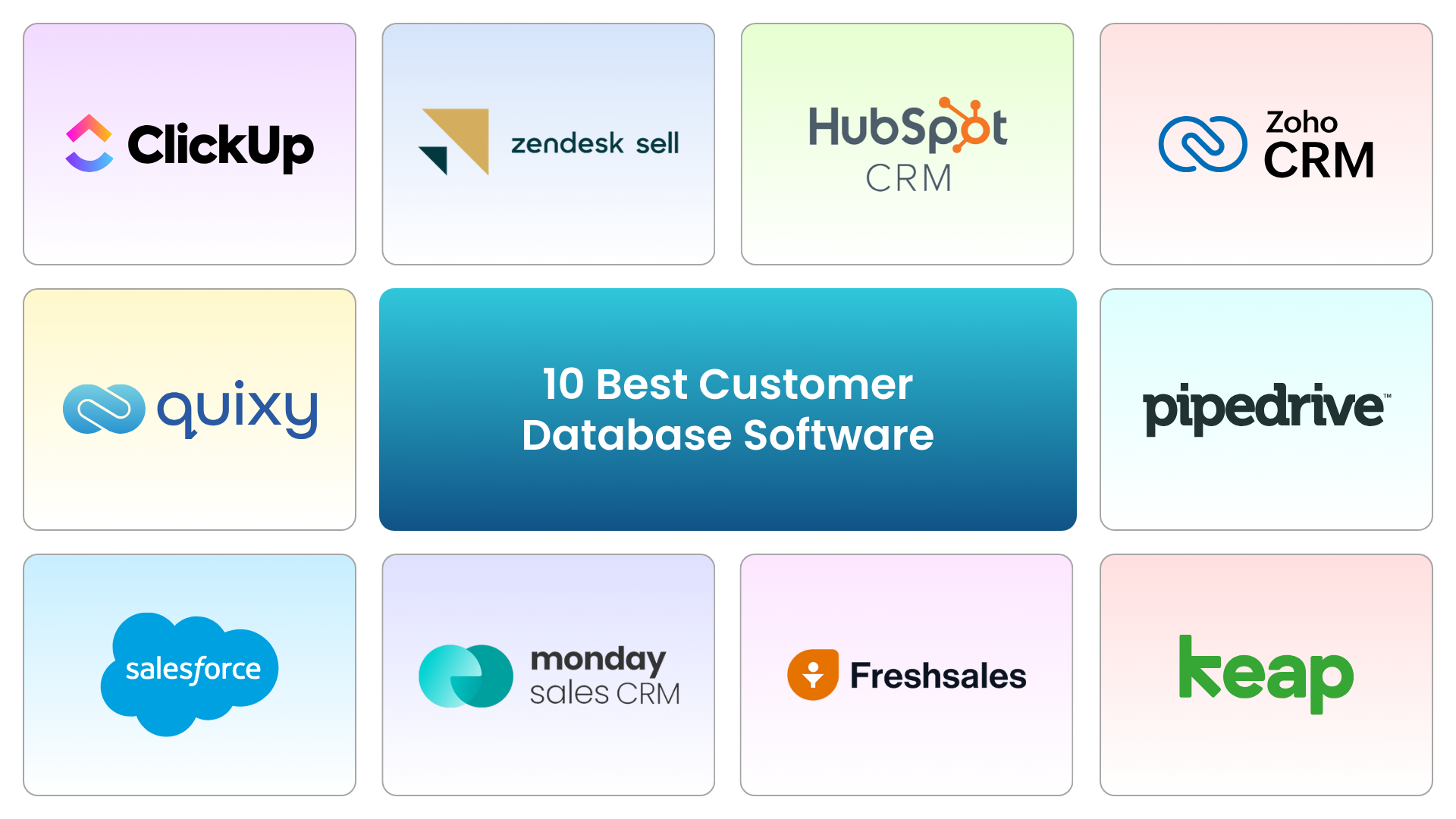
1. Quixy — Best for a fully customizable, no-code customer database
Best for: Custom customer databases built around your exact process · Pricing: Enterprise (contact sales) · Free tier: Trial
Quixy is a no-code platform that lets you build a customer database application tailored precisely to your business — without writing code. Instead of adapting your data to a fixed CRM template, you design your own fields, forms, and workflows: lead and deal management, contact and account tracking, product and service records, and custom pipelines that match how your team actually sells and serves.
Its drag-and-drop builder, 40+ field types, role-based access, and real-time reports and dashboards let business users create and adapt a customer database in days. With Caddie AI, you can query that data in plain language and surface insights without an analyst, and native ERP/CRM integration keeps records unified across your stack.
Standout: Complete customization — build exactly the customer database you need, then change it in hours as requirements evolve. Limitation: The depth of options means complex builds take some initial setup. Best for: Teams whose customer data doesn’t fit an off-the-shelf CRM.

2. HubSpot CRM — Best free all-in-one CRM
Best for: Startups and small businesses aligning sales & marketing · Pricing: Free · paid from ~$20/mo · Free tier: Yes (generous)
HubSpot CRM offers one of the strongest free plans available — contact and pipeline management, email tracking, and deal stages at no cost — making it ideal for teams starting out. It scales into paid marketing, sales, and service hubs as you grow. The catch: advanced features (automation, reporting, templates) sit behind paid tiers that get expensive.
Standout: Best free tier for growing teams. Limitation: Costs rise sharply as you add hubs and contacts.
3. Zoho CRM — Best value for scaling businesses
Best for: Small to large businesses wanting features per dollar · Pricing: Free (up to 3 users) · paid from ~$14/user/mo · Free tier: Yes
Zoho CRM packs customizable dashboards, workflow automation, lead and contact management, and its AI assistant Zia into affordable plans. It’s a strong fit for teams that want capability without enterprise pricing, and it integrates tightly with the wider Zoho ecosystem. Support quality and the free plan’s storage limits are the main trade-offs.
Standout: Feature depth at low cost. Limitation: Support can be inconsistent; free tier is storage-limited.
4. Salesforce — Best for large enterprises
Best for: Enterprises with complex sales cycles · Pricing: From ~$25/user/mo · Free tier: No (trial)
Salesforce Sales Cloud is the most powerful and customizable CRM for large teams, with advanced opportunity management, forecasting, and an enormous integration ecosystem. That power comes with real complexity and cost: setup, admin overhead, and paid add-ons make it best suited to organizations with the resources to run it.
Standout: Depth and extensibility at enterprise scale. Limitation: Expensive and complex to implement.
5. Pipedrive — Best for sales-focused teams
Best for: Sales teams that live in the pipeline · Pricing: From ~$14/user/mo · Free tier: No (trial)
Pipedrive is a sales-first CRM built around a visual, drag-and-drop pipeline, with lead scoring, activity tracking, and built-in email integration. It excels at keeping deals moving. It’s intentionally lean, so marketing automation, service, and advanced reporting are lighter than in all-in-one suites.
Standout: Clean, sales-centric pipeline management. Limitation: Lighter on marketing and service features.
6. Freshsales — Best for AI-assisted sales insights
Best for: Growing SMB sales teams · Pricing: Free · paid from ~$9/user/mo · Free tier: Yes
Freshsales combines pipeline management with AI-powered insights — its Freddy assistant scores leads and flags at-risk contacts — plus built-in phone and email. It’s a practical, affordable choice for account and client tracking. Customization is more limited than heavier CRMs, and support response times can lag.
Standout: AI lead scoring on an affordable plan. Limitation: Less customizable; slower support.
7. Monday CRM — Best for ease of use
Best for: Small and medium teams wanting a visual CRM · Pricing: From ~$12/seat/mo · Free tier: Limited
Monday CRM brings a colorful, intuitive interface to customer management, with customizable pipelines, boards, and collaboration built in. Teams get productive fast. It’s less deep on advanced CRM automation than dedicated tools, and some export and integration limits apply.
Standout: Fast onboarding and visual clarity. Limitation: Lighter automation than specialist CRMs.
8. ClickUp — Best for combining CRM with project management
Best for: Teams wanting CRM plus work management in one · Pricing: Free · paid from ~$7/user/mo · Free tier: Yes
ClickUp isn’t a traditional CRM, but its customizable databases, multiple views, and task management let teams manage account details, pipelines, and customer interactions alongside their projects. That flexibility is its strength and its learning curve: setting it up as a CRM takes configuration.
Standout: One tool for CRM and project work. Limitation: Requires setup; steeper learning curve.
9. Zendesk Sell — Best for service-led sales teams
Best for: Teams pairing sales with customer support · Pricing: From ~$19/user/mo · Free tier: No (trial)
Zendesk Sell focuses on pipeline management, collaboration, and automation, with a strong mobile app and solid reporting — a natural fit for teams already using Zendesk’s support suite. Integration across the broader Zendesk stack isn’t always seamless, and some users report support friction.
Standout: Sales + support in one ecosystem. Limitation: Cross-suite integration can be uneven.
10. Keap — Best for sales and marketing automation
Best for: Small businesses automating sales + marketing together · Pricing: From ~$79/mo · Free tier: No (trial)
Keap combines a customer database with lead-capture forms, landing pages, marketing automation, and client communication tools, making it strong for small businesses that want sales and marketing in one place. It’s pricier than lean CRMs, and some reports and invoices aren’t fully customizable.
Standout: Built-in marketing automation. Limitation: Higher entry price; limited report customization.
Comparison: Best Customer Database Software 2026
A side-by-side view. Verify pricing on each vendor’s site before deciding.
| Software | Best for | Free plan | Starting price | Standout feature |
|---|---|---|---|---|
| Quixy | Custom no-code database | Trial | Contact sales | Build your own DB + Caddie AI |
| HubSpot CRM | Free all-in-one | Yes | ~$20/mo | Best free tier |
| Zoho CRM | Value at scale | Yes (3 users) | ~$14/user/mo | Zia AI, low cost |
| Salesforce | Large enterprise | No | ~$25/user/mo | Depth & ecosystem |
| Pipedrive | Sales teams | No | ~$14/user/mo | Visual pipeline |
| Freshsales | AI sales insights | Yes | ~$9/user/mo | Freddy AI scoring |
| Monday CRM | Ease of use | Limited | ~$12/seat/mo | Visual & intuitive |
| ClickUp | CRM + projects | Yes | ~$7/user/mo | All-in-one workspace |
| Zendesk Sell | Sales + support | No | ~$19/user/mo | Zendesk integration |
| Keap | Sales + marketing | No | ~$79/mo | Marketing automation |
Best Customer Database Software for Small Business
For small businesses, the priorities are low cost, fast setup, and ease of use over enterprise depth. The best customer database software for small business in 2026:
- HubSpot CRM — the strongest free plan; start at zero and upgrade only as you grow.
- Zoho CRM — the best value once you need paid features, with a free tier for up to three users.
- Freshsales — affordable, with AI lead scoring that punches above its price.
- Quixy — when your business has a unique process and you’d rather build a database that fits it exactly than force-fit a template.
Start with a free plan, test it on real customer data, and only pay when you hit a feature you genuinely need.
Best Free Customer Database Software
Several tools offer genuinely useful free customer databases — ideal if you’re bootstrapping or testing before you commit:
- HubSpot CRM — free contact and pipeline management with no user cap.
- Zoho CRM — free for up to three users with core CRM features.
- ClickUp — a free plan you can configure as a customer database alongside your projects.
- Freshsales — a free tier for small teams tracking accounts and contacts.
Free plans typically limit users, storage, automation, or reporting — check those ceilings against your needs before you rely on one long-term.
Customer Database Software Examples: The Main Types
“Customer database software” spans a few different categories. Knowing the type you need makes the choice much easier. Common examples:
- CRM-based databases — customer data inside a sales/marketing suite. Examples: HubSpot, Zoho CRM, Salesforce, Pipedrive.
- No-code / custom-built databases — you design the database around your process. Example: Quixy.
- Sales-focused databases — optimized for pipeline and deal tracking. Examples: Pipedrive, Freshsales, Zendesk Sell.
- All-in-one work + customer databases — CRM combined with project or work management. Examples: ClickUp, Monday CRM.
- Sales + marketing automation databases — customer records tied to campaigns. Example: Keap.
What to Look for in Customer Database Software
- Ease of use — a clean interface your whole team will actually adopt.
- Unified customer view — one centralized, searchable record accessible to everyone who needs it.
- Customization — the ability to shape fields, workflows, and dashboards to your process (where no-code platforms like Quixy stand out).
- Automation — automated data capture, follow-ups, and task routing across sales and marketing.
- Integrations — open APIs or pre-built connectors to your email, ERP, and marketing tools.
- Reporting — clear dashboards and analytics for data-driven decisions.
- Scalability & security — room to grow, plus encryption, access controls, and compliance (GDPR, etc.).
Conclusion
The right customer database software depends on your size, budget, and how unique your process is. For a free start, HubSpot and Zoho are hard to beat; for enterprise depth, Salesforce; for sales focus, Pipedrive and Freshsales. And when your customer data doesn’t fit any off-the-shelf template, Quixy lets you build exactly the customer database you need — no code required — and turn it into insights with Caddie AI. See how Quixy can build your custom customer database — book a free demo.
Frequently Asked Questions(FAQs)
Q. What is the best customer database software?
The best customer database software depends on your needs: HubSpot and Zoho CRM are best for free, all-in-one use; Salesforce for large enterprises; Pipedrive and Freshsales for sales teams; and Quixy for a fully customizable, no-code database you build around your own process. Most teams should shortlist two or three and test them on real data.
Q. What are the benefits of using customer database software?
Customer database software offers a wealth of benefits: improved customer relationships, increased sales & marketing efficiency, data-driven decision making, better team collaboration & productivity, and improved customer service.
Q. How much does customer database software cost?
Costs vary depending on features, users, and deployment model. Options include free plans, freemium models, paid subscriptions, and enterprise solutions (quoted by vendor). Consider the total cost of ownership (TCO) when evaluating software.
Q. Can database software be integrate with my existing applications?
Yes! Many software solutions offer integrations with popular business applications like marketing automation, accounting, project management, email marketing, and e-commerce platforms. Look for software with open APIs or pre-built connectors to ensure easy integration and eliminate manual data entry.
Q. Can I customize the software to fit my specific business needs?
Depends on the CRM! Some offer high flexibility, letting you tailor workflows and dashboards. Others are more pre-built, with limited customization options. Research each CRM’s capabilities to see how well it adapts to your unique needs. Also, platforms like Quixy, known for their flexibility, can help you develop customer database and invoice software as per your business requirements.
Q. What is the difference between customer database software and a CRM?
A customer database is the centralized store of customer information. A CRM (customer relationship management) system adds tools on top of that database to manage sales, marketing, and service workflows. Many CRMs include a customer database, but you can also build a standalone customer database with a no-code platform like Quixy.
Related Post


Please login to comment
0 Comments
Oldest
Recent Posts






- Download the App