

Enterprise growth rarely stalls because of a lack of ambition. More often, growth slows when operational systems, processes, and governance structures fail to keep pace with increasing complexity. As organizations expand across business units, geographies, and customer segments, manual processes, disconnected systems, and fragmented workflows create significant operational challenges.
This is why enterprise automation has become a strategic priority for business leaders. However, implementing automation technology alone does not guarantee scalable operations. Organizations must first evaluate whether they possess the operational maturity, governance capabilities, technology infrastructure, and organizational alignment necessary to support automation at scale. Establishing a strong digital transformation roadmap can help organizations align automation initiatives with broader business objectives and long-term growth strategies.
An Enterprise Automation Readiness Assessment provides a structured framework for determining whether an organization is prepared to automate effectively, sustainably, and securely. It helps leaders identify gaps before investing in large-scale transformation initiatives and ensures automation drives long-term business value rather than creating new operational bottlenecks.
What Is Enterprise Automation Readiness?
Enterprise automation readiness refers to an organization’s ability to successfully implement, manage, govern, and scale automation initiatives across multiple business functions while maintaining operational efficiency, compliance, and organizational control.
Organizations that demonstrate high readiness typically have:
- Standardized business processes
- Clear governance frameworks
- Reliable data management practices
- Scalable technology infrastructure
- Strong executive sponsorship
- Effective change management capabilities
Without these foundational elements, automation initiatives often struggle to deliver expected outcomes.
Why Enterprise Leaders Are Prioritizing Automation Readiness
Business environments have become increasingly complex. Organizations must balance growth, customer expectations, regulatory requirements, workforce productivity, and operational efficiency simultaneously.
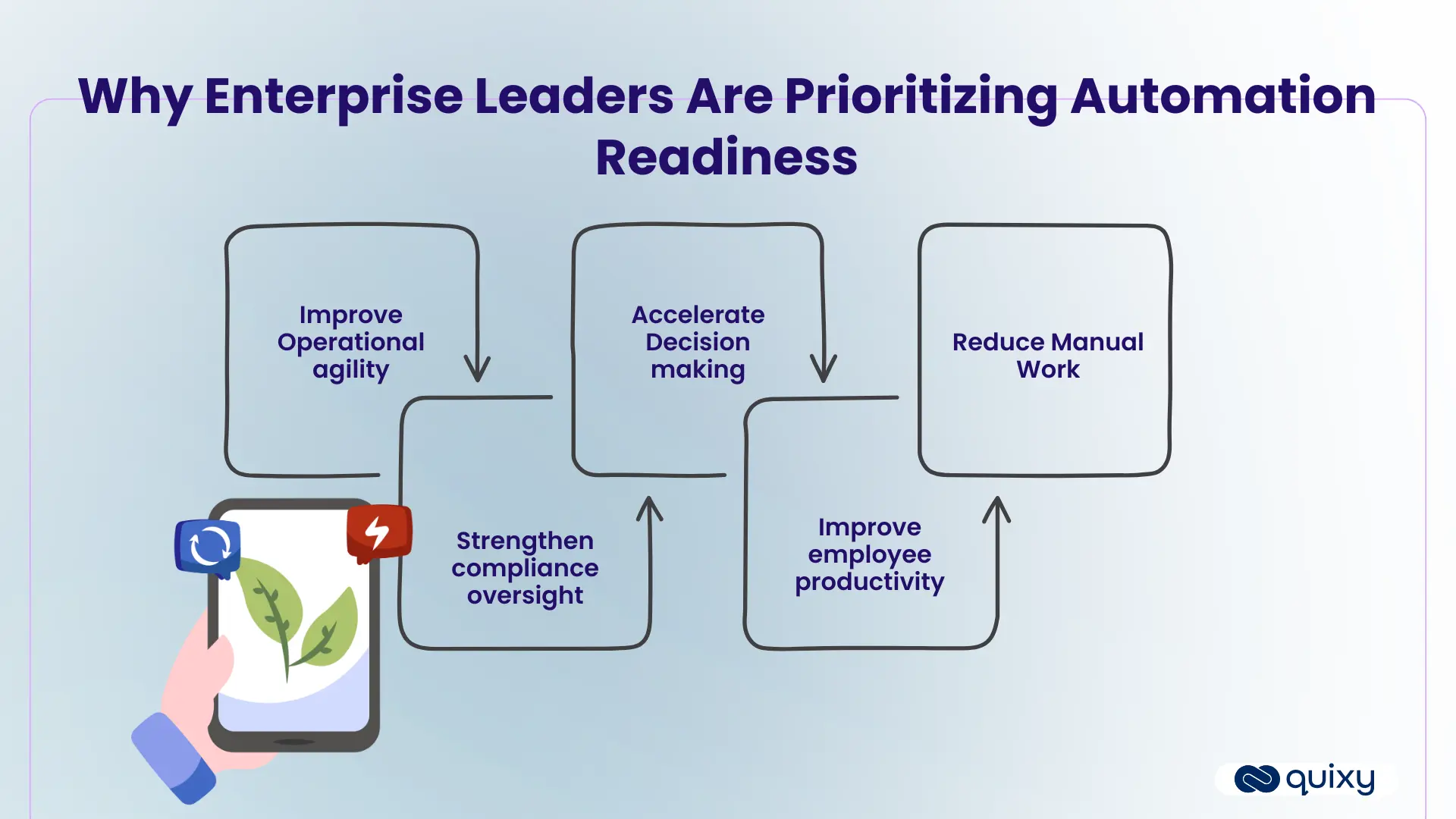
As a result, enterprise leaders are seeking ways to:
- Improve operational agility
- Accelerate decision-making
- Reduce manual work
- Strengthen compliance oversight
- Improve employee productivity
While automation can support these objectives, successful implementation requires preparation. Organizations that evaluate readiness before automation projects begin are often better positioned to achieve sustainable results.
Automating Processes vs. Building an Automation-Ready Enterprise
Establishing strong business process management practices helps organizations standardize workflows before scaling automation across the enterprise. Many organizations successfully automate individual workflows. However, scaling automation across the enterprise requires a different level of operational maturity.
| Automating Individual Processes | Building an Automation-Ready Enterprise |
| Focused on task efficiency | Focused on organizational scalability |
| Department-specific initiatives | Enterprise-wide transformation |
| Short-term gains | Long-term operational resilience |
| Limited governance | Structured governance framework |
| Isolated workflows | Connected business processes |
| Tactical improvements | Strategic business capability |
Organizations frequently underestimate the complexity of moving from isolated automation projects to enterprise-wide automation programs.
Understanding Automation Maturity
Enterprise readiness exists on a maturity continuum.
Manual Operations
At this stage, processes rely heavily on emails, spreadsheets, paper forms, and manual approvals.
Common challenges include:
- High administrative effort
- Limited process visibility
- Data duplication
- Increased error rates
- Delayed decision-making
Digital Workflow Adoption
Organizations begin replacing manual activities with digital workflows.
Benefits typically include:
- Faster approvals
- Better accountability
- Improved process tracking
- Reduced manual intervention
Process Standardization
Teams adopt consistent workflows across departments.
Characteristics include:
- Defined process ownership
- Standard operating procedures
- Consistent business rules
- Improved governance
Enterprise Automation
Automation expands across multiple business functions.
Organizations achieve:
- Cross-functional workflow integration
- Enterprise visibility
- Greater operational efficiency
- Strong governance oversight
Intelligent Operations
Automation becomes embedded within organizational strategy.
Characteristics include:
- Continuous optimization
- Predictive insights
- Data-driven decision-making
- Enterprise-wide operational intelligence
Process Standardization: The Foundation of Automation Readiness
Organizations often invest in business process optimization to remove inefficiencies and improve workflow consistency before introducing automation technologies. One of the most overlooked automation prerequisites is process consistency.
Automating inconsistent processes simply accelerates inefficiency.
Before scaling automation, organizations should evaluate:
Process Documentation
Are workflows fully documented and easily understood?
Process Ownership
Is accountability clearly assigned?
Workflow Consistency
Do teams execute processes in the same manner?
Exception Management
Are process variations governed appropriately?
Organizations with strong process standardization typically achieve higher automation success rates because workflows are easier to automate, monitor, and improve.
Technology Infrastructure Readiness
Technology readiness plays a critical role in automation scalability.
Most enterprises operate within complex ecosystems consisting of:
- ERP systems
- CRM platforms
- HR applications
- Financial systems
- Legacy software
- Custom business applications
Automation readiness requires evaluating how effectively these systems can support connected workflows.
Key considerations include:
Integration Capabilities
Can systems exchange information seamlessly?
Scalability
Can infrastructure support future growth?
Accessibility
Can users access information efficiently?
System Compatibility
Can workflows operate across platforms without excessive customization?
Technology readiness is less about having modern tools and more about ensuring systems can support enterprise-wide automation objectives.
Data Readiness: The Hidden Success Factor
Successful digital process automation initiatives depend on accurate, accessible, and well-governed business data. Automation depends on accurate and reliable data.
Poor-quality data often undermines automation initiatives by creating workflow errors, reporting inconsistencies, and compliance concerns. Effective business workflow automation relies on accurate data flows to ensure processes execute reliably and consistently.
Organizations should assess:
Data Accuracy
Can business data be trusted?
Data Consistency
Are data standards applied uniformly?
Data Governance
Are ownership and accountability established?
Data Accessibility
Can authorized stakeholders access critical information when needed?
Organizations that address data quality challenges before automation implementation often experience smoother deployments and better outcomes.
Governance Readiness and Operational Control
As automation expands, governance becomes increasingly important. Effective workflow governance ensures automation initiatives remain compliant, secure, and aligned with organizational objectives.
Without governance, organizations may encounter:
- Duplicate workflows
- Security vulnerabilities
- Compliance risks
- Uncontrolled automation initiatives
- Operational fragmentation
An effective governance framework should address:
Workflow Ownership
Clear accountability for process performance.
Compliance Oversight
Alignment with regulatory requirements.
Security Management
Protection of sensitive information.
Change Control
Structured management of workflow modifications.
Performance Monitoring
Continuous measurement and improvement.
Governance enables enterprises to scale automation while maintaining operational control.
Organizational Readiness and Change Management
A well-defined digital transformation strategy can help leaders drive adoption and reduce resistance during enterprise-wide automation initiatives. Technology alone does not determine automation success. People and organizational culture remain equally important.
Organizations should evaluate:
Leadership Alignment
Do executives support automation objectives?
Employee Readiness
Are teams prepared for process changes?
Cross-Functional Collaboration
Can departments work together effectively?
Capability Development
Do employees possess the skills necessary to operate within automated environments?
Organizations that invest in change management often experience stronger adoption rates and greater automation success.
Indicators of Strong Automation Readiness
Several operational characteristics suggest an organization is prepared to scale automation.
Consistent Process Performance
Workflows produce predictable outcomes.
Clear Performance Metrics
Organizations actively measure process effectiveness.
Strong Governance Structures
Decision-making responsibilities are clearly defined.
Enterprise Visibility
Leaders can monitor performance across business functions.
Continuous Improvement Culture
Teams actively identify opportunities for optimization.
These indicators demonstrate that an organization possesses the operational maturity required for scalable automation.
Common Barriers to Enterprise Automation
Many organizations face obstacles that limit automation success.
Fragmented Processes
Departments follow inconsistent procedures.
Legacy Technology Constraints
Critical systems lack integration capabilities.
Data Quality Issues
Inaccurate information creates workflow disruptions.
Weak Governance
Automation initiatives lack oversight.
Organizational Resistance
Employees struggle to adapt to new operating models.
Addressing these challenges before implementation significantly improves long-term outcomes.
Building an Enterprise Automation Readiness Framework
A comprehensive readiness assessment should evaluate five core dimensions.
Process Readiness
Assess workflow maturity and standardization.
Technology Readiness
Evaluate infrastructure and integration capabilities.
Data Readiness
Review governance, quality, and accessibility.
Governance Readiness
Establish accountability and compliance structures.
Organizational Readiness
Measure leadership support and workforce adoption capacity.
Together, these dimensions provide a complete view of enterprise automation preparedness.
The Role of Modern Workflow Automation Platforms
Modern organizations increasingly rely on workflow automation software, business process automation, digital workflow management, enterprise process automation, and no-code workflow platforms to support transformation initiatives.
These platforms help organizations:
- Standardize processes
- Improve visibility
- Strengthen governance
- Reduce operational inefficiencies
- Support scalable automation strategies
For example, enterprises evaluating modern no-code platforms such as Quixy often incorporate them into broader workflow transformation initiatives designed to improve operational agility and governance.
However, technology delivers the greatest value when organizations first establish strong operational foundations.
Measuring Automation Readiness
Before investing in large-scale automation initiatives, organizations should conduct a structured readiness evaluation.
| Assessment Area | Key Evaluation Question |
| Process Maturity | Are workflows documented and standardized? |
| Technology Infrastructure | Can systems support integration requirements? |
| Data Management | Is business data accurate and governed? |
| Governance Framework | Are accountability structures established? |
| Organizational Readiness | Are employees prepared for change? |
A readiness scorecard helps leadership teams prioritize improvement efforts and reduce implementation risk.
Conclusion
Enterprise automation readiness should not be viewed as a technology assessment. It is fundamentally an evaluation of organizational capability.
The most successful enterprises recognize that automation is only as effective as the operational environment supporting it. Process maturity, governance discipline, data quality, leadership alignment, and organizational adaptability ultimately determine whether automation delivers lasting value.
As organizations continue to grow, workflow complexity, compliance obligations, and operational interdependencies will inevitably increase. Businesses that fail to prepare for these realities often discover that automation amplifies existing inefficiencies rather than resolving them.
Forward-thinking leaders understand that workflow challenges represent more than productivity concerns. They are business risks capable of affecting scalability, compliance performance, customer experience, and long-term resilience.
Organizations that conduct thorough automation readiness assessments position themselves to build sustainable automation programs that evolve alongside business growth, governance requirements, and operational complexity. In doing so, they transform automation from a tactical initiative into a strategic capability that supports long-term enterprise success.
1.What are the biggest risks of automating without a readiness assessment?
Skipping an automation readiness assessment can lead to process inefficiencies, low user adoption, integration challenges, governance gaps, and unexpected compliance risks. Assessing readiness beforehand helps organizations identify operational weaknesses and reduce the likelihood of costly implementation failures.
2. Why is enterprise automation readiness important for business growth?
Enterprise automation readiness helps organizations scale operations efficiently without increasing complexity. It ensures that processes, technology, and governance structures can support higher transaction volumes, cross-functional collaboration, and evolving business requirements while maintaining operational consistency.
3. How can leaders improve automation readiness before starting transformation projects?
Leaders can improve automation readiness by standardizing critical workflows, establishing governance policies, improving data quality, aligning stakeholders around automation goals, and creating a structured change management strategy. These steps help build a strong foundation for long-term automation success.
4. What should be included in an enterprise automation readiness assessment?
A comprehensive assessment should evaluate process maturity, technology capabilities, data management practices, governance structures, workforce preparedness, and scalability requirements. Reviewing these areas helps organizations identify gaps and prioritize improvements before expanding automation initiatives.
5. How does automation readiness affect digital transformation outcomes?
Automation readiness directly influences the success of digital transformation initiatives. Organizations with mature processes, clear governance, and strong operational alignment are more likely to achieve faster implementation, higher adoption rates, and measurable business outcomes from automation investments.
Recent Posts






- Download the App