

Citizen development is the practice of enabling non-IT employees to design, build, and deploy business applications using no-code and low-code platforms — without needing programming skills. These employees, called citizen developers, use visual drag-and-drop tools to automate workflows, build custom apps, and solve business problems independently.
Gartner predicts that, by 2026, citizen developers will outnumber professional developers 4:1 at large enterprises. This guide covers everything: definition, benefits, governance, real-world case studies, the roles involved, and how to build a citizen development programme that scales.
Gartner predicts that, 70% of new app development in enterprise organizations will leverage low-code or no-code technologies.
Definition and Evolution of Citizen Development
Citizen development refers to the practice of enabling non-IT employees — also known as citizen developers — to design, build, and deploy applications without needing deep programming skills. Using intuitive no-code and low-code platforms, these employees can automate workflows, build custom tools, and solve unique business problems on their own.
The concept of empowering business users to build solutions is not entirely new. Early forms can be traced back to macros in spreadsheets and simple database tools. However, the rise of sophisticated citizen development platforms over the past decade has significantly expanded the possibilities. Today, citizen development has evolved into a strategic movement supported by robust governance frameworks, security protocols, and integration capabilities — transforming it from an experimental idea into a core component of modern enterprise IT strategy.
Citizen development is not about replacing professional developers but rather about augmenting their efforts and amplifying the organisation’s overall development capabilities. It enables the quick creation of departmental tools, process automation, and customised solutions while adhering to governance and security standards.
Also Read: A Guide to Suitability Assessment in Citizen Development

Citizen Developers vs Professional Developers
Citizen developers and professional developers bring unique strengths to the software development landscape. Citizen developers, equipped with no-code and low-code platforms, offer diverse skills and domain knowledge that enable them to create tailored solutions quickly. They excel in agility, responding promptly to emerging needs and reducing IT backlogs. Collaboration is at the core of citizen development, empowering individuals from various departments to contribute their expertise and fostering a culture of innovation.
Citizen developers focus on solving domain-specific problems with no-code tools; professional developers handle complex, scalable system builds. The two roles are complementary, not competitive. “See the full comparison → Citizen Developer vs Professional Developer“
Roles in a Citizen Development Programme
Successful citizen development does not happen without structure. Three distinct roles work together to make it sustainable — each contributing at a different level of the organisation.
Role 1 — Frontline Practitioners
Business users who actively build applications and automations. They come from operations, HR, finance, and marketing. They understand the problem and own the solution. Their hands-on approach drives the tangible outputs of citizen development.
Role 2 — Technical Architects
IT professionals who ensure citizen-developed apps align with the organisation’s security, compliance, and integration standards. They design guardrails, review applications before go-live, and provide technical mentorship to practitioners.
Role 3 — Leadership Strategists
Business leaders, COOs, CIOs, or digital transformation leads who align citizen development with organisational goals. They prioritise projects, allocate resources, and act as executive sponsors championing the programme across the business.
Full guide: Citizen Development Roles and Responsibilities: Practitioners, Architects and Strategists
Why Citizen Development Is Gaining Momentum in 2026
The rise of citizen developers is driven by the increasing demand for customisation and agility in today’s business landscape. Several factors are fuelling this growth:
- Accelerating demand for digital solutions. The need to adapt quickly to market changes and customer expectations has never been higher.
- Persistent IT backlogs. Traditional development teams are overwhelmed, and business users cannot afford to wait months for simple tools.
- Advancements in no-code and low-code technology. Platforms have become more powerful, secure, and user-friendly, enabling more people to build sophisticated applications.
- Workforce empowerment trends. Organisations increasingly value employee autonomy and engagement, seeing citizen development as a way to foster a culture of innovation and ownership.
- Cost pressures and resource optimisation. Businesses are seeking ways to reduce development costs and reallocate IT resources to more strategic, high-value initiatives.
Also Read: Top 10 Reasons to Encourage Citizen Development at Work
The Intersection of AI and Citizen Development
The rise of AI and citizen development are two of the most transformative technology trends of our time — and when they intersect, they create a compounding effect. Citizen development was already empowering non-technical employees to build business apps without writing code. Now, by integrating AI, these platforms are taking things further: enabling smarter, faster, and more personalised solutions.
AI acts as an intelligent assistant within no-code and low-code environments. It helps automate complex tasks, offers intelligent recommendations, and allows citizen developers to build apps that can learn and adapt over time. Together, AI and citizen development unlock innovation at scale and put advanced capabilities directly into the hands of business users.
Related: Harnessing the Power of AI in the Citizen Developer Movement
How AI Empowers Non-Technical Developers
Instead of simply dragging and dropping components, non-technical users can now rely on AI-powered features to guide decision-making throughout the development process. AI can suggest the most effective workflows, automatically generate forms, or validate business rules in real time. Natural language processing lets users describe what they want in plain English, and the system turns those instructions into working apps.
Also Explore: Citizen development assessment
Key AI Features in Citizen Development Tools
Predictive analytics. Forecasts trends and behaviours, enabling businesses to make data-driven decisions proactively rather than reactively.
Chatbots and virtual assistants. Integrated into apps to automate customer or employee interactions and reduce manual support tasks.
Workflow automation. AI identifies repetitive processes and suggests or creates automated workflows, freeing up time and reducing human errors.
Real-World Applications Across Industries
Healthcare: Mayo Clinic’s No-Code AI Symptom Checker
- Use Case: Clinicians built an AI chatbot using Microsoft Power Apps to triage patient symptoms pre-appointment.
- Result: Reduced ER wait times by 30% and improved resource allocation.
- Source: PMI Citizen Development Case Studies
Logistics: UPS’s Digital Twin for Distribution
- Use Case: Citizen developers created a real-time package tracking system using AI-driven analytics.
- Result: Enhanced supply chain visibility and reduced delivery delays.
- Source: Google Cloud GenAI Use Cases
Manufacturing: Siemens’ AI-Powered Quality Control
- Use Case: Factory workers trained AI models (via Akkio) to detect defects in turbine blades from images.
- Result: 99% defect detection accuracy, saving $500K/year in waste.
- Source: Kissflow AI in Citizen Development
Myths vs Facts of Citizen Development
Discover the facts behind common misconceptions surrounding citizen development And no-code, including its safety, skill requirements, efficiency, functionality, scalability, and security measures.
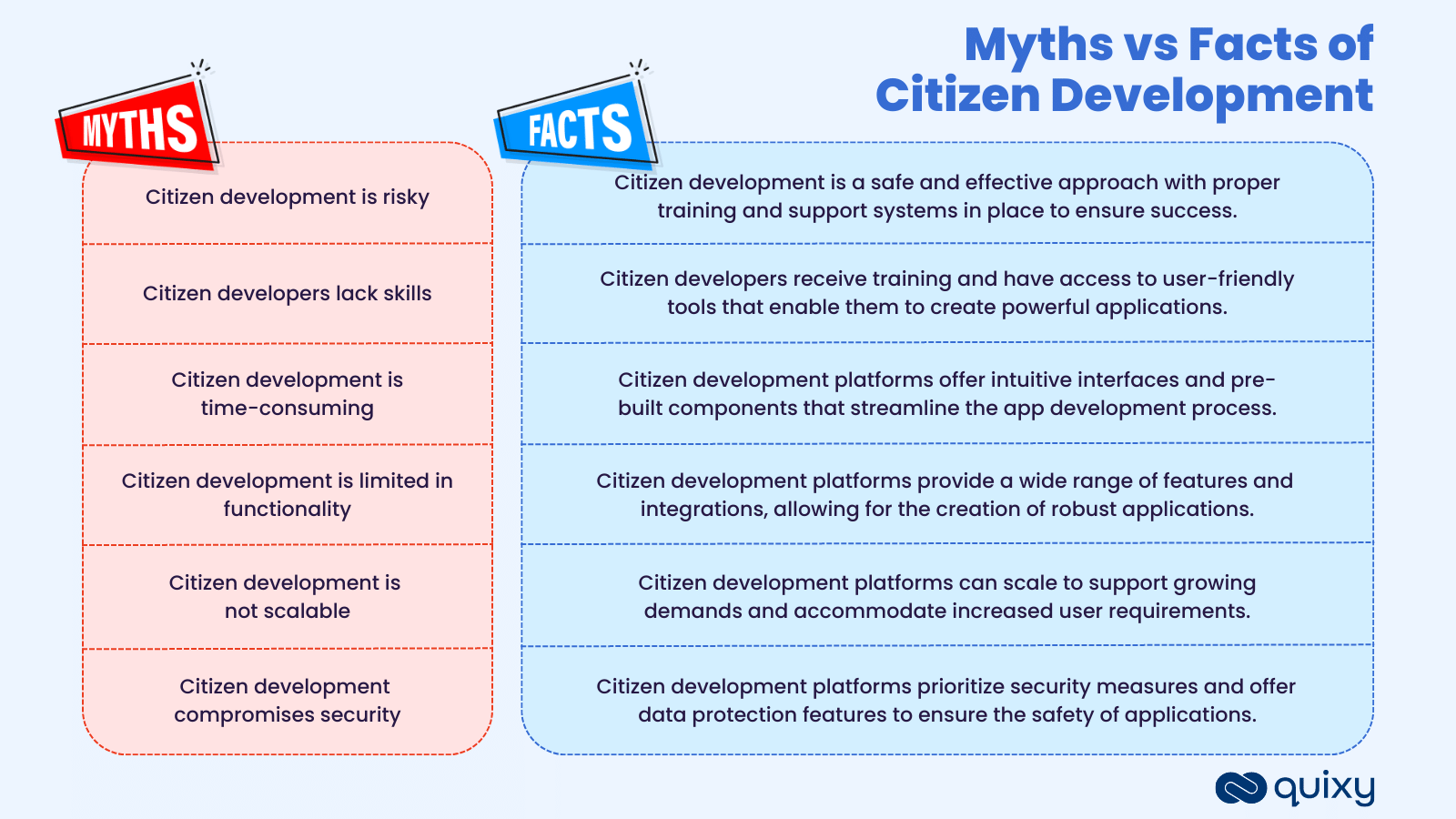
- Myth: Citizen development is risky.
Fact: Citizen development is a safe and effective approach with proper training and support systems in place to ensure success.
- Myth: Citizen developers lack skills.
Fact: Citizen developers receive training and have access to user-friendly tools that enable them to create powerful applications.
- Myth: Citizen development is time-consuming.
Fact: The platforms offer intuitive interfaces and pre-built components that streamline the app development process.
- Myth: Citizen development is limited in functionality.
Fact: CD platforms provide a wide range of features and integrations, allowing for the creation of robust applications.
- Myth: Citizen development is not scalable.
Fact: CD platforms can scale to support growing demands and accommodate increased user requirements.
- Myth: Citizen development compromises security.
Fact: CD platforms prioritize security measures and offer data protection features to ensure the safety of applications.
Benefits of Citizen Development
Citizen development accelerates application development cycles, promotes increased productivity, fosters agility, and brings cost savings by eliminating the need for expensive external development resources. Here are the core benefits organisations see in practice:
- Faster time-to-market. Apps that take months in traditional development are deployed in days. Business teams iterate in real time without developer bottlenecks.
- Reduced IT backlog. Departmental requests that would queue in IT for 6 to 12 months are handled by the teams that need them. IT focuses on strategic, high-value work.
- Lower development costs. Forrester research shows no-code and low-code solutions reduce development costs by up to 80% compared to custom-coded applications.
- Greater agility. Businesses respond to market changes, new regulations, and customer demands in days rather than months.
- Better alignment. The people who understand the problem are the people building the solution. Fewer handoff gaps, less rework, more fit-for-purpose tools.
- Employee empowerment. Giving employees the tools to solve their own problems increases engagement, job satisfaction, and a sense of ownership over outcomes.
- Scalable digital transformation. Unlike one-off IT projects, citizen development fosters continuous improvement — teams iterate and improve as needs evolve.
Also Read: Strategy for Problem-Solving Culture with Citizen Development
How Citizen Development Accelerates Digital Transformation
1. Democratising Innovation: Turning Employees into Problem-Solvers
Marketing teams automate campaign performance dashboards. Operations teams replace paper-based field reports with mobile data collection apps built on Quixy. HR departments create self-service onboarding portals that reduce manual work by 50%. The impact is faster experimentation, reduced IT dependency, and a culture where employees drive innovation.
2. Cutting Costs: 60 to 80% Cheaper Than Traditional Development
Forrester research shows that low-code and no-code solutions reduce development costs by up to 80% compared to custom-coded apps. No need to hire expensive developers — existing employees build solutions with intuitive drag-and-drop tools.
3. Improving Agility: Responding to Market Changes in Days, Not Months
Retailers deploy customer feedback apps overnight to adapt to shifting preferences. Manufacturing teams digitise shop-floor workflows to reduce downtime. Healthcare providers rapidly build patient scheduling tools during peak demand periods — all without IT involvement.
4. Enhancing Customer and Employee Experience
Sales teams build custom CRM add-ons to personalise client interactions. Support teams automate ticket routing, cutting resolution times by 40%. Employees get self-service tools for leave requests and expense approvals, boosting productivity across the board.
5. Scaling Digital Transformation Sustainably
Unlike one-off IT projects, citizen development fosters continuous improvement. Business teams iterate on apps as needs evolve. IT shifts focus from firefighting to strategic innovation. Governance frameworks ensure security and scalability throughout.
Best Practices for Successful Citizen Development
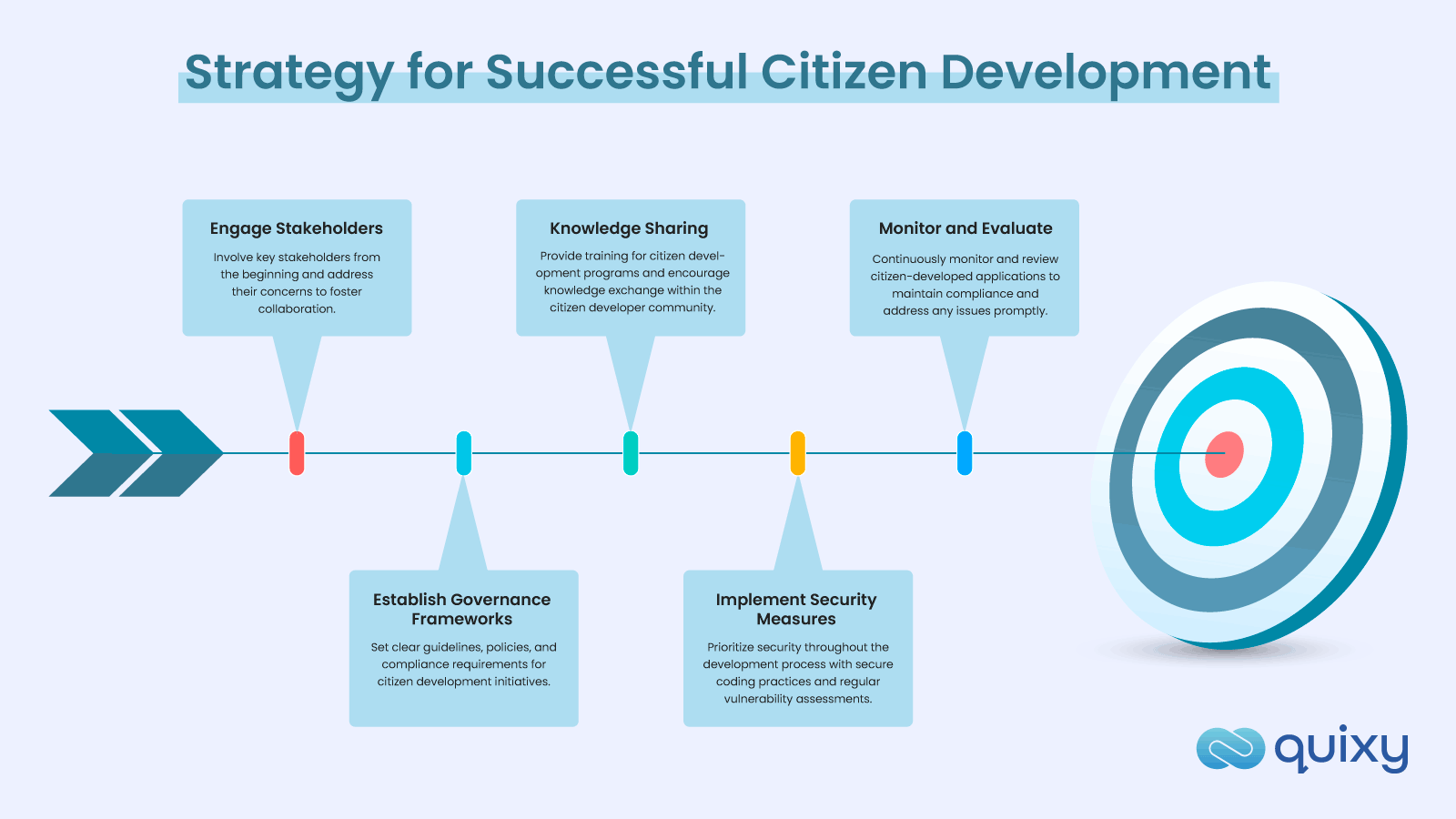
Before citizen development can scale, organisations need strategies in place to minimise risks and ensure compliance. Here are the key principles:
- Engage stakeholders early. Involve key stakeholders from the beginning and address their concerns to foster collaboration and organisational buy-in.
- Establish governance frameworks. Set clear guidelines, policies, and compliance requirements before any citizen developer builds their first application.
- Promote training and knowledge sharing. Provide structured training and encourage knowledge exchange within the citizen developer community.
- Implement security measures. Prioritise security throughout the development process with secure coding practices, role-based access, and regular vulnerability assessments.
- Monitor and evaluate continuously. Review citizen-developed applications regularly to maintain compliance and address issues before they compound.
Deep dive: How to Implement and Govern Citizen Development: 12 Expert Tips
Citizen Development Framework
A citizen development framework is a structured set of guidelines that enables and governs citizen development initiatives. It provides the structure for empowering non-technical users while maintaining the control and oversight that enterprise environments require.
- Define clear goals. Clearly articulate the problem you want to solve and establish specific, measurable goals before starting.
- Start small. Begin with manageable projects to gain confidence and demonstrate the value of citizen development to leadership.
- Select the right tools. Choose user-friendly development platforms that align with your goals, technical capabilities, and existing system integrations.
- Embrace collaboration. Collaborate with IT professionals and subject matter experts to improve application quality and ensure compliance.
- Iterate and improve. Use an iterative development approach, gather feedback, and continuously refine your applications.
Related: Citizen Development Value Tree: A Comprehensive Guide
Challenges, Ethics, and Governance
Risks of Unregulated Citizen Development
Without clear governance, employees can inadvertently create applications that expose sensitive data, violate data privacy laws, or introduce vulnerabilities into core systems. In industries like healthcare or finance, these risks can have severe consequences including regulatory penalties and reputational damage.
Related: Navigating Project Risks in Citizen Development
Balancing AI Automation with Human Oversight
AI brings speed and intelligence to citizen development, but it also raises concerns about bias, accountability, and unintended consequences. Human oversight is critical — workflows should allow human review at key decision points, especially when sensitive data or critical operations are involved.
Future-Proofing with Governance Frameworks
A robust governance framework should include clear data handling and security policies, mandatory IT reviews before apps go live, structured training and certification paths for citizen developers, regular audits for compliance and security, and continuous feedback loops for improvement.
How to Become a Citizen Developer
Becoming a citizen developer does not require extensive coding experience. The essential skills are problem-solving, communication, critical thinking, and learning agility. Understanding your processes and pain points deeply is more important than technical knowledge.
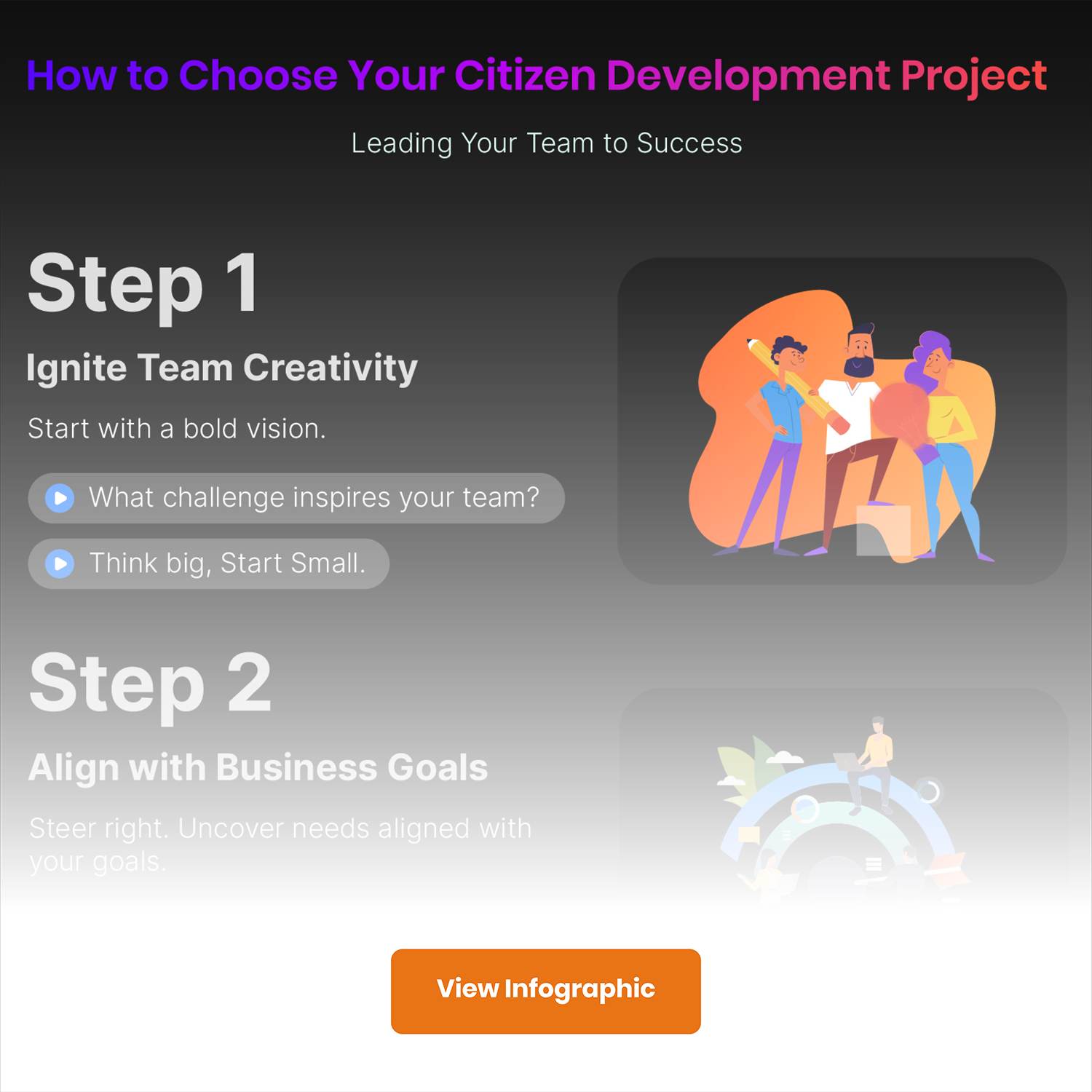
Step-by-step guide: Become a Citizen Developer in 7 Simple Steps
Best Citizen Development Platforms
Full comparison: Top Citizen Development Platforms in 2026: Best No-Code Tools for Enterprise Teams
- Quixy. Enterprise no-code platform for complex multi-step workflows, approvals, and custom app development. 40+ form fields, 6-column layout builder, mobile app, AI intelligence layer (Caddie), Gartner Peer Insights Voice of the Customer 3 years running. Best for enterprise and government.
- Bubble. No-code platform for web and mobile app development with a visual interface and wide customisation options. Best for startup MVPs and customer-facing web applications.
- Airtable. Collaborative no-code tool combining spreadsheet and database functionality. Best for content management, editorial calendars, and lightweight project tracking.
- Zapier. Integration-focused connector platform for automating workflows between existing SaaS tools. Best for simple trigger-and-action automations across applications.
- Adalo. No-code platform designed specifically for mobile app development. Best for teams needing native iOS and Android apps without development resources.
Measuring Citizen Development Impact: KPIs and ROI
Citizen development initiatives need to be measured to demonstrate value and secure continued investment. The most important KPIs fall into two categories: leading indicators (predictive signals) and lagging indicators (outcome measures).
Key KPIs to track include: time-to-value (how quickly apps move from idea to deployment), app adoption rate (whether people actually use what is built), IT backlog reduction (how many IT requests are resolved by citizen developers independently), development cost savings compared to traditional or outsourced development, and employee satisfaction scores for teams using citizen-developed tools.
Full framework: Citizen Development KPIs and ROI: A Complete Measurement Guide
The Future of Citizen Development – Emerging Trends
As organisations embrace digital transformation, citizen development is poised to play a defining role in how enterprise software gets built. Key trends shaping its future:
- AI-native platforms. The next generation of citizen development tools use AI to generate entire workflows from plain-language descriptions — reducing the building process from hours to minutes.
- Hyperautomation. Citizen development merges with RPA and AI to automate end-to-end business processes, not just individual applications.
- Expanded governance tooling. As deployments scale, IT teams need visibility dashboards and automated compliance monitoring to maintain control without becoming a bottleneck.
- Cross-functional fusion teams. The future is not IT versus business — it is collaborative fusion teams where citizen developers and IT architects work together from day one.
Full analysis: The Future of Citizen Development in 2026: Trends, Statistics and Predictions
Citizen development is not a shortcut or a workaround. It is a fundamental shift in who builds digital solutions — and how fast organisations can act on the ideas already inside them.
The pressure to innovate quickly has always existed. What has changed is that the tools are now good enough for the people who understand the problems to solve them directly. A procurement manager who has spent years managing vendor onboarding through email chains does not need a developer to automate that process. A compliance officer who manually tracks regulatory sign-offs does not need a six-month IT project to build a tracking app. The knowledge is already there. Citizen development gives it a channel.
What separates organisations that succeed with citizen development from those that struggle is not the platform they choose. It is the structure they build around it. Practitioners, Architects, and Strategists each need to understand their role. Governance needs to be defined before the first application goes live. And leadership needs to signal, clearly and repeatedly, that building is encouraged — not something that happens around the edges of someone’s actual job.
The organisations getting this right are not the largest or the most technically sophisticated. They are the ones that made a deliberate decision: to treat their business users not as consumers of software, but as builders of it.
See the citizen development KPIs and ROI framework.
The future of application development is not waiting for IT. It is giving the people closest to the problem the tools to solve it themselves — with the right platform, the right governance, and the right leadership behind them.
Frequently Asked Questions (FAQs)
Q. What is citizen development?
Citizen development is the practice of enabling non-IT employees to design, build, and deploy business applications using no-code and low-code platforms without needing programming skills. These employees, called citizen developers, use visual drag-and-drop tools to automate workflows, build custom apps, and solve business problems independently. Gartner predicts citizen developers will outnumber professional developers 4:1 at large enterprises.
Q. What are the advantages of citizen development?
The key advantages are faster application development cycles, reduced IT backlog, lower development costs (up to 80% compared to custom coding), increased business agility, improved employee productivity and satisfaction, better alignment between business needs and technical solutions, and scalable digital transformation without proportional IT investment.
Q. How does LCNC development facilitate citizen development?
Low-code and no-code platforms facilitate citizen development by providing visual drag-and-drop interfaces, pre-built templates, and logic-based workflow builders that require no programming knowledge. These platforms let non-technical employees build, test, and deploy applications without writing code — reducing development time by up to 90% compared to traditional coding approaches.
Q. What are some examples of successful citizen development projects?
Successful CD projects include creating custom workflow automation tools, building internal productivity apps, designing customer-facing portals, and developing data visualization dashboards. These projects showcase the versatility of citizen development across various industries and use cases.
Q. How does citizen development contribute to business agility?
Citizen development contributes to business agility by letting business teams build and iterate on their own tools without waiting for IT. Processes that previously took 3 to 6 months through traditional development can be deployed in days. Teams respond to market changes, customer needs, and operational challenges immediately without developer bottlenecks.
Q. What are citizen development models?
Citizen development models include centralised (a dedicated team governs all citizen development), decentralised (individual departments build independently), hybrid (combining central governance with department-level execution), community-driven (collaborative knowledge sharing among citizen developers), and platform-centric (standardised on a single approved no-code platform with centralised training and resources).
Related Post



Please login to comment
0 Comments
Oldest
Recent Posts






- Download the App