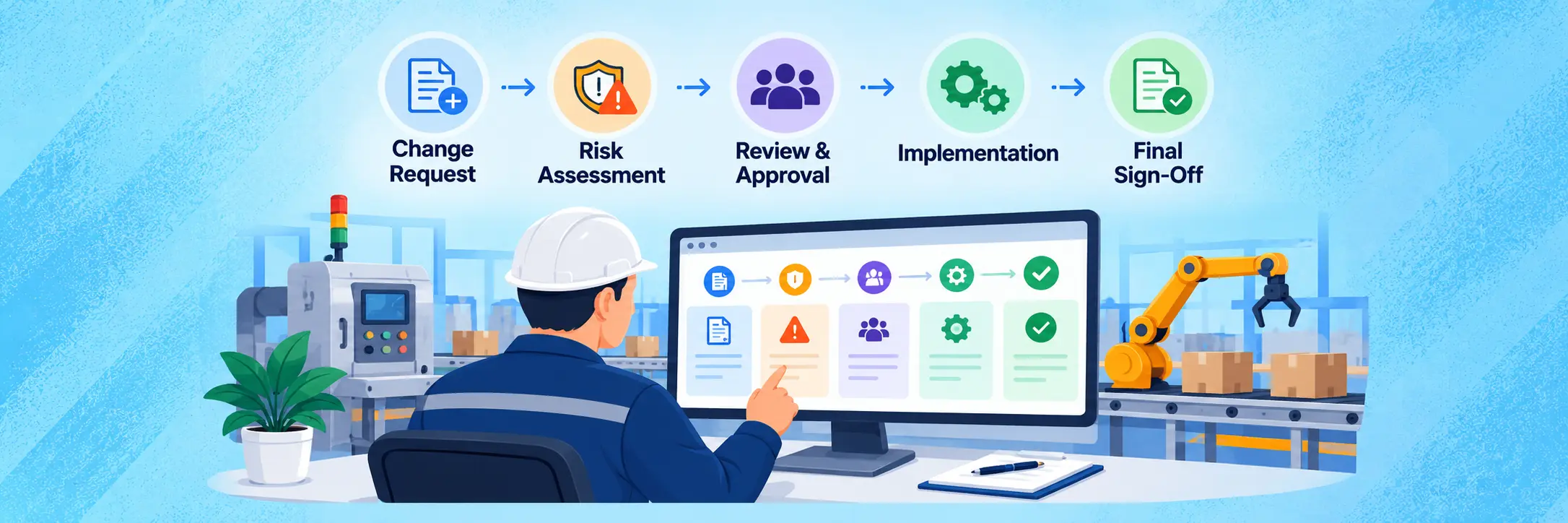

Manufacturing changes rarely affect just one machine, procedure, or department. Replacing equipment, introducing a new raw material, modifying a production parameter, or updating a standard operating procedure can affect product quality, worker safety, maintenance schedules, and production continuity. Management of Change software helps manufacturers control these changes through documented requests, risk assessments, technical reviews, approvals, implementation checks, and final sign-off.
The challenge is ensuring that every proposed change is evaluated before implementation and that the right people review its consequences. When change requests move through spreadsheets, emails, and disconnected documents, teams can struggle to identify outstanding approvals, track mitigation actions, and confirm that operating procedures have been updated.
A structured digital process provides a clearer path from the initial request to verified completion. This guide explains how manufacturers can evaluate change management software, build a practical risk assessment workflow, establish approval controls, and maintain reliable records throughout the change lifecycle.
Read More: AI Agents in Workflows: Replacing Manual Approvals With Configured Decisions

What Is Management of Change Software in Manufacturing?
Management of Change software is a digital system that helps manufacturing organizations document, assess, review, authorize, implement, and verify proposed changes to equipment, materials, processes, facilities, or operating procedures.
Often referred to as MOC software, it provides a controlled process for determining what is changing, why the change is necessary, which risks it introduces, who must approve it, and what must happen before operations can resume or the modified process can be used.
Unlike a basic request-tracking tool, a well-designed MOC system connects each stage of the change lifecycle. A request cannot simply move to completion because someone marked a task as finished. Required reviews, mitigation actions, documentation updates, and readiness checks must be addressed according to the organization’s procedures.
For example, suppose a plant wants to replace a pump with a model that has a different operating capacity. The change may affect flow rates, pressure limits, maintenance requirements, control settings, and operating instructions. A documented review helps the engineering, operations, maintenance, and safety teams evaluate these dependencies before the replacement is authorized.
The objective is not to eliminate necessary changes. It is to ensure that changes are introduced deliberately, with appropriate authorization and evidence.
Why Manufacturing Needs a Structured Change Control Process
Manufacturing environments involve interconnected assets, people, procedures, and quality requirements. Even a seemingly minor modification can create consequences outside the department initiating it.
A change to a production line, for instance, may require new operator training, revised inspection criteria, updated maintenance instructions, and additional quality checks. If one of these activities is overlooked, the organization may face rework, unplanned downtime, inconsistent production, or avoidable safety exposure.
A structured process helps manufacturers address several recurring challenges:
- Untracked requests: Proposed changes remain buried in email conversations or spreadsheets, making their status difficult to establish.
- Incomplete risk reviews: Teams assess the immediate modification without examining its effects on related equipment, procedures, or production activities.
- Unclear accountability: Engineering, quality, operations, and safety teams may assume another department is responsible for approval.
- Delayed decisions: Reviewers receive incomplete information, and requests remain pending without clear escalation.
- Missing implementation evidence: Teams cannot easily confirm whether approved modifications were completed as specified.
- Incomplete records: Updated procedures, training records, technical documents, and approvals are stored in separate locations.
The importance of controlled change extends beyond administrative efficiency. Under OSHA’s Process Safety Management standard, 29 CFR 1910.119(l), covered processes involving highly hazardous chemicals require written procedures for applicable changes other than replacements in kind. These procedures address the technical basis, safety and health impacts, operating procedure modifications, timing, and authorization requirements. Affected employees must also be informed and trained before startup, where required.
The regulation applies to specified covered processes, not automatically to every manufacturing operation. Organizations must determine which requirements apply to their facilities and processes.
How the Manufacturing Change Management Process Works
An effective MOC process follows defined stages, with responsibilities and completion criteria established at each step.
1. Initiate and document the change request
Every change begins with a clearly documented reason for the proposed modification. The requester should identify the affected asset, production line, material, procedure, or facility and explain the expected outcome.
A digital request form can capture:
- Change description and business justification
- Affected equipment, processes, and departments
- Proposed implementation date and duration
- Supporting drawings, specifications, or technical documents
- Request owner and responsible department
- Whether the change is temporary or permanent
The request should also identify whether the proposal is a replacement in kind or a modification requiring formal review under the organization’s procedures. This distinction should be determined using approved criteria rather than informal assumptions.
2. Conduct a preliminary impact assessment
Before assigning detailed reviews, the responsible team determines the potential scope of the change.
Could it affect worker safety, environmental controls, product specifications, equipment compatibility, process parameters, maintenance requirements, regulatory obligations, or production schedules?
This initial assessment establishes which specialists need to participate. A routine administrative update may require a different review path from a modification involving pressure systems, hazardous chemicals, or critical process controls.
The purpose is to route each request appropriately without allowing a potentially significant change to bypass necessary scrutiny. Integrating manufacturing process automation with structured change management workflows can help organizations coordinate operational activities, reduce manual intervention, and maintain process consistency.
3. Complete the risk assessment workflow
Risk assessment is a central decision point in the change lifecycle. It helps reviewers identify what could go wrong, evaluate the consequences, and define controls before implementation.
A documented risk assessment workflow should consider:
- Hazard identification: Identify possible failure modes, unsafe operating conditions, quality defects, and environmental impacts.
- Likelihood and severity: Evaluate how probable each identified event is and how serious its consequences could be.
- Existing controls: Review safeguards already in place and determine whether they remain effective after the change.
- Mitigation actions: Assign additional engineering controls, procedural changes, inspections, or training as necessary.
- Residual risk: Reassess risk after proposed controls and determine whether it falls within approved acceptance criteria.
- Risk authorization: Obtain the required review and approval from designated, competent personnel.
Manufacturers may use established methods such as Failure Mode and Effects Analysis (FMEA), hazard and operability studies (HAZOP), or a risk matrix, depending on the change and applicable requirements.
The software should capture the assessment method, findings, action owners, due dates, supporting evidence, and review decisions. A well-defined risk assessment workflow helps manufacturers standardize hazard evaluations, document mitigation measures, and ensure that residual risks receive the required authorization. It should not automatically treat a numerical score as sufficient authorization for a high-risk modification.
4. Review technical and operational impacts
Risk assessment alone does not establish that a change is technically suitable. Relevant specialists must evaluate whether the proposed modification can be implemented without creating unacceptable effects elsewhere in the operation.
Engineering may review equipment specifications and design constraints. Quality teams may assess inspection requirements and product conformity. Maintenance may evaluate spare parts, service intervals, and equipment access. Operations may determine whether production instructions or process settings must change.
The review should also identify dependent documents and activities, including:
- Standard operating procedures and work instructions
- Maintenance plans and inspection checklists
- Process drawings and technical specifications
- Quality control plans and acceptance criteria
- Employee training materials
- Environmental and regulatory documentation, where applicable
A documented review makes dependencies visible before the change reaches the implementation stage.
5. Compare MOC Software with Spreadsheets and General Workflow Tools
Manufacturers evaluating change management software should distinguish between tools that track requests and systems that support the full change lifecycle. The right choice depends on the complexity of the operation, risk exposure, documentation requirements, and existing plant systems.
| Evaluation criterion | Spreadsheets and email | General workflow platform | Dedicated MOC software |
| Change request tracking | Manual status updates | Configurable forms and tracking | Change-specific request management |
| Risk assessment | Separate files or templates | Configurable assessment stages | Often includes MOC-specific assessment capabilities |
| Cross-functional reviews | Email-based coordination | Configurable routing and approvals | May include predefined technical and safety reviews |
| Approval controls | Dependent on manual follow-up | Rule-based routing, depending on the platform | Often includes MOC-specific authorization controls |
| Implementation verification | Manual checklists | Configurable tasks and evidence capture | May include change-specific readiness and verification steps |
| Audit documentation | Records distributed across files | Centralized workflow records, depending on configuration | Typically designed around MOC documentation requirements |
| Temporary changes | Manual tracking and reminders | Can be configured with deadlines and alerts | May offer specific expiry and restoration controls |
| Compliance support | Requires manual procedure management | Requires careful configuration and validation | May provide industry-specific compliance functionality |
Capabilities vary by vendor and product edition. A dedicated MOC product is not automatically compliant, and a general workflow platform does not automatically provide every process-safety control. Evaluate each product against documented requirements.
For manufacturers with complex process-safety obligations, specialized software may offer relevant capabilities out of the box. A configurable workflow platform may be suitable when the organization needs adaptable forms, cross-department approvals, document tracking, and integration with existing systems. In either case, the organization remains responsible for establishing appropriate procedures, assigning competent reviewers, and verifying that required controls are effective.
6. How Workflow Automation Supports MOC Approvals
A well-configured approval workflow automation system routes requests to the correct reviewers based on defined rules. By implementing workflow automation software, manufacturers can reduce manual follow-ups, automate repetitive approval tasks, and maintain consistent review processes across departments. Instead of relying on requesters to remember every handoff, the process can assign tasks, notify responsible people, enforce required fields, and escalate overdue reviews.
Effective approval workflow automation also ensures that requests reach the appropriate decision-makers based on risk levels, departmental responsibilities, and predefined authorization rules.
For example, a proposed change affecting equipment specifications might require engineering approval before quality and operations review. A change involving hazardous process conditions may also require a qualified process-safety review.
A practical approval sequence can include:
- Initial completeness check by the MOC coordinator.
- Technical review by engineering and maintenance.
- Risk assessment and mitigation review by qualified personnel.
- Quality, environmental, or safety approvals as applicable.
- Final authorization by the designated authority.
- Verification that implementation prerequisites have been met.
The sequence should reflect the organization’s risk classification and operating procedures. Some reviews may occur in parallel, while others must be completed sequentially. With approval process automation, manufacturers can establish conditional approval paths, assign responsibilities automatically, and ensure that critical decisions are reviewed before implementation.
Useful controls include mandatory approval fields, role-based permissions, electronic timestamps, rejection reasons, version history, and escalation rules. An enterprise approval workflow can further standardize authorization across multiple facilities, departments, and management levels while maintaining clear approval records. Changes to an already approved proposal should trigger reassessment when they materially alter the reviewed scope.
Automation can make responsibilities and delays more visible, but it should not replace technical judgment. A workflow must never treat an overdue approval as an implied approval or permit implementation simply because a deadline has passed.
7. Implementation, Verification, and Final Sign-Off
Final authorization is not the same as completed implementation. A change may be approved but still require installation, testing, document updates, training, or a readiness review before it can be used.
An effective system separates authorization to proceed from confirmation that the change has been completed safely and correctly.
Verify implementation against the approved scope
The responsible team should compare the completed modification with the approved specifications. Depending on the change, verification may involve inspection records, test results, commissioning documents, photographs, or engineering confirmation.
Any deviation from the approved design should be documented and evaluated through the appropriate change process rather than informally accepted. When deviations require corrective or preventive follow-up, integrating with CAPA management software can help teams assign actions, monitor resolution progress, and maintain supporting records.
Confirm readiness before startup
Where applicable, confirm that operating procedures are updated, affected employees have received required training, safety measures are available, and outstanding actions are resolved or handled under an approved process.
For covered processes, OSHA’s pre-startup safety review requirements under 29 CFR 1910.119(i) include checking that equipment conforms to design specifications, procedures are adequate, applicable hazard-analysis recommendations have been addressed, and required training is complete before the introduction of highly hazardous chemicals.
Record final sign-off and close the change
The final record should capture the completion date, responsible implementer, verification evidence, required document updates, training confirmation, outstanding actions, and closure authorization.
A complete record provides traceability from the original request through the decision, implementation, and closure stages. It also helps teams investigate incidents, review previous modifications, and prepare for internal or external audits.
8. What to Look for in Manufacturing MOC Software
When assessing workflow management software for change control, evaluate how well the product supports the organization’s actual operating procedures.
Configurable forms and risk assessments: Can the system capture technical justifications, affected assets, risk ratings, mitigation measures, and supporting documents?
Conditional approvals: Can requests be routed according to change type, risk level, facility, department, or other approved criteria?
Action tracking: Can the system assign corrective actions, deadlines, reminders, and escalation paths while preserving accountability?
Document control: Can reviewers identify affected procedures, technical records, and training materials and confirm that required updates are completed?
Audit trail: Does the system preserve decision history, timestamps, supporting evidence, and changes to the request?
Temporary-change management: Can temporary modifications be assigned expiry dates, reviewed before extension, and tracked through restoration to the approved state?
Integration and accessibility: Can the workflow connect to relevant maintenance, quality, document management, or enterprise systems? Can authorized users access it from the locations where they work?
When evaluating manufacturing management software, organizations should also consider how easily it connects change management activities with existing production, maintenance, quality, and operational workflows.
Reporting and governance: Can managers identify pending reviews, overdue mitigation actions, changes awaiting verification, and recurring process bottlenecks?
A configurable change management system should support these controls without making the process unnecessarily complicated. A structured approach to manufacturing process management also helps organizations coordinate operational changes, maintain documentation, and ensure that production activities follow approved procedures. Before selecting a product, map the current MOC procedure, define mandatory controls, and test representative scenarios, including rejected requests, high-risk changes, temporary modifications, and changes requiring additional review. A well-configured workflow management softwaresolution can help manufacturers standardize these processes, improve accountability, and maintain visibility across every stage of change management.
9. Two Manufacturing Statistics That Strengthen the Case for Better Change Control
The need for structured change processes is reinforced by the broader shift toward digitally connected manufacturing operations.
According to Deloitte’s 2025 Smart Manufacturing and Operations Survey, 92% of surveyed manufacturers believe smart manufacturing will be a main driver of competitiveness over the following three years. This highlights the importance of managing operational and technology changes deliberately as manufacturers modernize their facilities.
Deloitte also reported that 65% of respondents ranked operational risk among their first or second priorities for mitigation when pursuing smart manufacturing initiatives. The finding reinforces why change programs need defined ownership, risk reviews, implementation controls, and verification rather than relying on informal coordination. These figures describe survey respondents, not all manufacturers, and do not measure the direct impact of MOC software.
Conclusion
Effective manufacturing change control requires more than a request form and an approval button. It requires a connected process that documents the reason for a change, evaluates its risks, gathers the right technical reviews, authorizes implementation, verifies completion, and records final sign-off.
Management of Change software can help manufacturers make that process more consistent by connecting responsibilities, approvals, mitigation actions, supporting documents, and implementation evidence in one traceable workflow. However, the software must reflect the organization’s actual risk profile, operating procedures, and applicable regulatory obligations.
Before choosing a solution, manufacturers should map their current change lifecycle, identify where reviews and records are breaking down, and define the controls that every change must satisfy. The most effective approach combines appropriate technology with clear accountability, qualified technical judgment, and disciplined verification.
Frequently Asked Questions
1. What is the best Management of Change software for manufacturing?
The best solution depends on the facility’s risk profile, regulatory requirements, integration needs, and change complexity. Evaluate risk assessment capabilities, conditional approvals, document control, audit trails, temporary-change tracking, and implementation verification before selecting a platform.
2. What is the difference between MOC software and change control software?
MOC software focuses on evaluating and controlling operational changes, including their potential safety and process impacts. Change control software is a broader term that may cover engineering revisions, documents, products, or other organizational changes. The capabilities offered depend on the specific product.
3. What should a manufacturing change risk assessment include?
It should identify potential hazards and operational impacts, assess likelihood and severity, review existing safeguards, define mitigation actions, evaluate residual risk, and obtain the required authorization. The assessment method should match the complexity and potential consequences of the proposed change.
4. How does MOC software improve audit readiness?
It can centralize change requests, risk assessments, approvals, action records, document updates, training confirmations, and implementation evidence. This makes it easier to demonstrate what was reviewed, who authorized the change, and whether required actions were completed.
5. Can workflow automation manage temporary manufacturing changes?
Yes, if the selected platform supports the necessary controls. Workflows can record the reason and duration of a temporary change, route it for authorization, trigger expiry reminders, manage extensions, and track restoration to the approved state. Safety-critical changes still require the appropriate technical reviews and authorization.

Recent Posts




- Download the App