
The biggest HR challenges today are attracting and retaining talent, keeping employees engaged, closing skills gaps, staying compliant with changing laws, managing hybrid work, adopting HR technology, and aligning HR with business strategy. Most of them share a root cause — too much manual work and too little data — and are solved by combining a clear people strategy with the right technology.
Human resources has never been more strategic — or more stretched. HR teams are expected to hire faster, keep people engaged, stay ahead of shifting regulations, and lead on technology and culture, often with the same headcount they had years ago. This guide breaks down the twelve biggest HR challenges organisations face and, just as importantly, how to solve each one.
What are HR challenges?
HR challenges are the recurring problems human resource teams face in attracting, managing, developing, and retaining people while keeping the organisation compliant and aligned with its goals. These human resources challenges range from day-to-day HR issues like scheduling and paperwork to strategic HR problems like building the right skills for the future. The most common HR challenges shift with the economy, technology, and workforce expectations — but the underlying job stays the same: get the right people doing the right work, well supported, within the rules. Below, we pair each of the biggest ones with a practical fix — HR challenges and solutions in one place.
Why HR challenges are intensifying
Several forces are converging to make HR harder than ever. AI and automation are reshaping roles faster than people can be hired or trained for them. Hybrid and distributed work has made consistency and culture harder to hold together. Employees expect more — flexibility, growth, wellbeing — and leave when they don’t get it. Regulations keep multiplying across regions. And through all of it, HR is expected to do more with the same headcount and prove its business impact with data it often can’t fully trust. None of these challenges is new on its own; what’s changed is that they now arrive all at once, and at speed.
The 12 biggest HR challenges (and how to solve them)
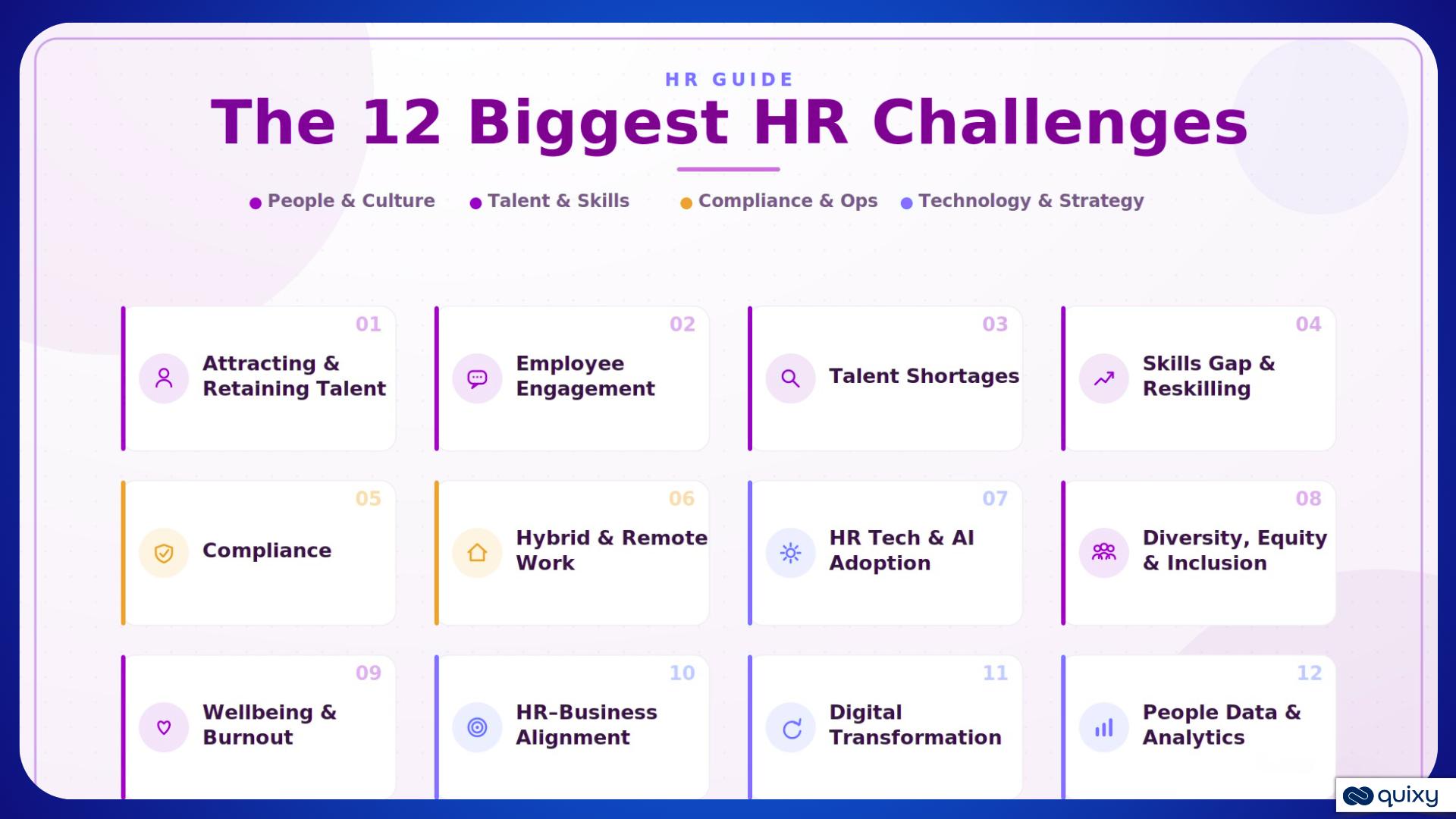
1. Attracting and retaining talent
High turnover and a competitive hiring market make attracting and keeping good people the number-one HR challenge for most organisations. Losing talent is expensive — in hiring cost, lost productivity, and morale. How to solve it: build a strong employer brand, offer clear career paths, and connect retention to a deliberate people strategy rather than reacting after resignations land. This is where a well-built human resource management strategy pays off most.

2. Employee engagement and motivation
Disengaged employees cost productivity and quietly drive turnover. Keeping people motivated — especially across hybrid and frontline teams — is a persistent challenge. How to solve it: measure engagement continuously (not once a year), act visibly on the feedback, and recognise good work in real time rather than at review season.
3. Talent shortages and workforce planning
Skills shortages and unpredictable demand make it hard to have the right people in place when you need them. Too often, gaps only become visible when a project stalls or a key person leaves. How to solve it: forecast needs ahead of time with proper human resource planning — matching the workforce you have to the one the business will need.
Skills gaps are the number-one barrier to business transformation, cited by 63% of employers — and the World Economic Forum estimates 59% of the workforce will need reskilling by 2030.
4. Closing the skills gap and reskilling
Roles are changing faster than people can be hired for them, and buying every skill on the open market is neither affordable nor scalable. How to solve it: shift from hiring to building — identify the capabilities the business will need and put structured reskilling and upskilling plans in place to develop them internally.
5. Compliance with changing regulations
Labour laws, data-privacy rules, and workplace regulations change constantly, and even small lapses carry real penalties and reputational risk — especially across multiple locations. How to solve it: replace manual tracking with automated compliance checks, audit trails, and a single source of truth for employee data, so nothing slips through.
6. Managing hybrid and remote work
Distributed teams make it harder to keep processes consistent, culture strong, and people connected. How to solve it: standardise core HR processes so they work the same wherever people are, and lean on digital self-service so location never blocks a request or an approval.
7. Adopting HR technology and AI
Many HR teams are still stuck on spreadsheets and disconnected tools, while others struggle to adopt new technology and AI effectively. Low HR-tech maturity keeps HR reactive. How to solve it: unify people data on a modern human resource management system (HRMS), then layer on automation and AI. If you’re comparing options, our guide to the best HR software and platforms is a good place to start.
8. Diversity, equity, and inclusion
Building a genuinely diverse and inclusive workforce — and measuring progress honestly — remains a challenge that’s easy to state and hard to sustain. How to solve it: set clear goals, remove bias from hiring and promotion processes, and track representation with real data rather than good intentions.
9. Employee wellbeing and burnout
Burnout is a growing driver of both attrition and lost productivity, and HR is increasingly expected to own wellbeing. How to solve it: manage workloads realistically, spot burnout risk early through engagement and workload data, and make support easy to access without stigma.
10. Aligning HR with business strategy
HR is expected to be a strategic partner, but too many teams are still buried in admin, unable to connect people decisions to business outcomes. How to solve it: automate the operational load to free up time, and tie every HR initiative back to a business goal — the essence of strategic human resource management.
11. Leading digital transformation and change
HR is often asked to lead organisational change and its own digital transformation at the same time — while keeping the day job running. Change resistance and legacy processes make it hard. How to solve it: treat it as a planned journey rather than a tool purchase, as covered in our guide to digital transformation in HR.
12. Turning people data into decisions
HR sits on huge amounts of people data but often can’t turn it into insight — because it’s scattered across systems and hard to trust. How to solve it: centralise the data first, then use analytics (increasingly AI-assisted) to guide decisions on hiring, retention, and capacity instead of relying on gut feel.
These challenges also intensify in specific sectors — retail, for example, faces all of the above at unusually high volume. See our deep dive on HR challenges in the retail industry for an industry-specific view.
How to overcome HR challenges
Look across the twelve, and a pattern emerges: almost every HR challenge is made worse by manual work and fragmented data, and eased by a combination of clear strategy and better technology. You can’t fix engagement, compliance, or planning if HR is drowning in admin and can’t trust its own numbers.
That’s why the most effective response is usually two-sided. First, a deliberate people strategy that ties HR to business goals. Second, technology that removes the manual load — a unified system of record, automated workflows, and increasingly no-code tools that let HR build and adapt their own processes. This is where no-code for HR and HR workflow automation change the equation — giving HR the capacity to be strategic instead of reactive.
Solve your HR challenges with Quixy — no code required
Most HR challenges come down to manual work and disconnected data. Quixy is a no-code platform that lets HR teams build the exact tools they need — recruitment, onboarding, approvals, compliance tracking, engagement surveys, and analytics dashboards — and change them as needs shift, without writing a line of code or waiting on IT. Its built-in AI analyst, Caddie, turns your people data into answers in plain language.
Conclusion
HR challenges will keep evolving with the economy, technology, and what people expect from work — but the way through them is consistent. Pair a clear people strategy with technology that removes the manual load and unifies your data, and the hardest problems — retention, engagement, compliance, planning — become far more manageable. The organisations that treat HR as a strategic, well-equipped function, rather than an admin one, are the ones that turn these challenges into an advantage.
Frequently asked questions about HR challenges
What are the biggest HR challenges?
The biggest HR challenges are attracting and retaining talent, employee engagement, skills shortages and reskilling, compliance with changing regulations, managing hybrid work, adopting HR technology and AI, and aligning HR with business strategy.
What are the main challenges in human resource management?
The main challenges in human resource management span people (recruitment, retention, engagement, development), compliance and risk, and technology adoption — all while HR is expected to move from an administrative role to a strategic one.
What causes most HR problems?
Most HR problems share a root cause: manual, disconnected processes and fragmented data that keep HR reactive. When data is unified and routine work is automated, many HR issues become far easier to manage.
How can HR overcome these challenges?
By pairing a clear people strategy with the right technology — a unified HR system, automated workflows, and no-code tools that let HR build and adapt processes themselves — so the team has the capacity and data to act strategically.
How is AI changing HR challenges?
AI is helping HR automate repetitive work, surface predictive insights like attrition risk, and turn people data into decisions faster — easing several challenges at once, provided the underlying data is unified and trustworthy.


Recent Posts







- Download the App