

Enterprise approval processes often slow down because of manual reviews, email-based coordination, and inconsistent decision-making. AI Approval Workflows using AI helps organizations streamline approvals by automatically routing requests, analyzing data, prioritizing tasks, and triggering actions in real time. As enterprises scale operations, AI-driven approval workflows improve speed, accuracy, compliance, and operational efficiency across departments.
Modern enterprises are increasingly adopting AI approval workflow automation, business process automation, and enterprise workflow management solutions to reduce bottlenecks and accelerate decision-making. Even platforms like Quixy are part of the broader shift toward intelligent no-code workflow automation that simplifies enterprise approvals without increasing operational complexity.
For a complete grounding in how approval processes work, see our complete guide to approval process and workflow.
Why Are Traditional Approval Workflows Slowing Down Enterprises?
Most enterprise approval workflows still rely on manual coordination between teams, managers, and stakeholders. While these processes may work initially, they become inefficient as organizations grow. Delayed approvals impact productivity, customer experience, procurement cycles, hiring, finance operations, and compliance management.
Common challenges in traditional approval workflows include:
- Email-based approvals with no centralized visibility
- Delayed responses from approvers
- Manual data verification and document handling
- Lack of audit trails for compliance
- Approval inconsistencies across departments
- High dependency on spreadsheets and disconnected systems
Businesses that modernize approval systems often experience faster turnaround times and reduced operational costs.
| Traditional Approval Workflow | AI-Powered Approval Workflow |
| Manual routing | Automated routing based on rules and AI |
| Delayed notifications | Real-time alerts and escalation |
| Human-only decision-making | AI-assisted recommendations |
| Limited tracking | End-to-end workflow visibility |
| High processing time | Faster approval cycles |
As AI moves from experiment to core operations — 78% of organizations now report using AI in at least one business function, up from 72% a year earlier — enterprises are turning that momentum toward their most repetitive, approval-heavy processes.
What Is AI Approval Workflow Automation?
It refers to the use of artificial intelligence technologies to automate, optimize, and manage approval-based business processes. These systems combine workflow automation with AI capabilities like predictive analytics, intelligent routing, document recognition, and decision recommendations.
Unlike traditional workflow automation, AI-enabled systems can:
- Analyze historical approval patterns
- Identify approval bottlenecks
- Prioritize urgent requests automatically
- Detect anomalies or compliance risks
- Recommend approval decisions
- Trigger workflows dynamically based on data
This makes enterprise approval management significantly faster and more scalable.
How AI Approval Workflows Work
A typical AI-powered approval workflow follows these steps:
- Request submission through forms or applications
- AI validates submitted data and documents
- Workflow engine identifies the right approvers
- Approval requests are prioritized automatically
- AI sends reminders or escalations if delays occur
- Decisions are recorded with complete audit trails
- Approved actions trigger downstream business processes
This reduces dependency on manual intervention while improving consistency and compliance.
Which Enterprise Processes Benefit Most From AI Approval Automation?
AI-driven approval workflows are now widely used across enterprise functions because approval-heavy processes exist in nearly every department.
Finance and Expense Approvals
Finance teams use AI-powered workflow automation to streamline:
- Expense reimbursements
- Invoice approvals
- Budget requests
- Purchase order approvals
- Vendor payment processing
AI can automatically detect duplicate invoices, unusual spending patterns, and missing documentation before approvals move forward.
Human Resources and Employee Requests
HR teams automate approvals for:
- Leave requests
- Employee onboarding
- Policy acknowledgments
- Recruitment approvals
- Travel requests
This reduces administrative workload and improves employee experience.
Procurement and Vendor Management
Procurement workflows often involve multiple stakeholders. AI helps enterprises:
- Route approvals based on spend thresholds
- Verify vendor documents automatically
- Flag procurement compliance risks
- Accelerate contract approval cycles
IT Service Management
IT departments use workflow automation software for:
- Access management approvals
- Software provisioning requests
- Security policy approvals
- Change management workflows
AI can assess risk levels before routing approvals to security or compliance teams.
Legal and Compliance Workflows
Legal teams automate:
- Contract approvals
- Compliance reviews
- Regulatory documentation workflows
- Risk assessments
AI-based document analysis can identify missing clauses, policy deviations, or approval inconsistencies.
How Does AI Improve Approval Decision-Making?
One of the biggest advantages of AI workflow management systems is intelligent decision support. Instead of only automating task movement, AI improves the quality and speed of approvals.
Intelligent Approval Recommendations
AI analyzes historical decisions and patterns to recommend likely outcomes. For example:
- Low-risk expense claims may be auto-approved
- High-value procurement requests may require additional verification
- Urgent approvals can be prioritized automatically
This reduces unnecessary approval layers.
Predictive Workflow Optimization
AI identifies workflow inefficiencies such as:
- Frequently delayed approvers
- Departments causing bottlenecks
- Repeated rejection reasons
- Approval cycle trends
Enterprises can then redesign workflows based on operational insights.
Real-Time Risk Detection
AI systems can detect anomalies like:
- Unusual spending requests
- Duplicate invoices
- Non-compliant procurement activities
- Suspicious access requests
This improves governance and reduces operational risks.
What Are the Key Benefits of AI Approval Workflow Automation?
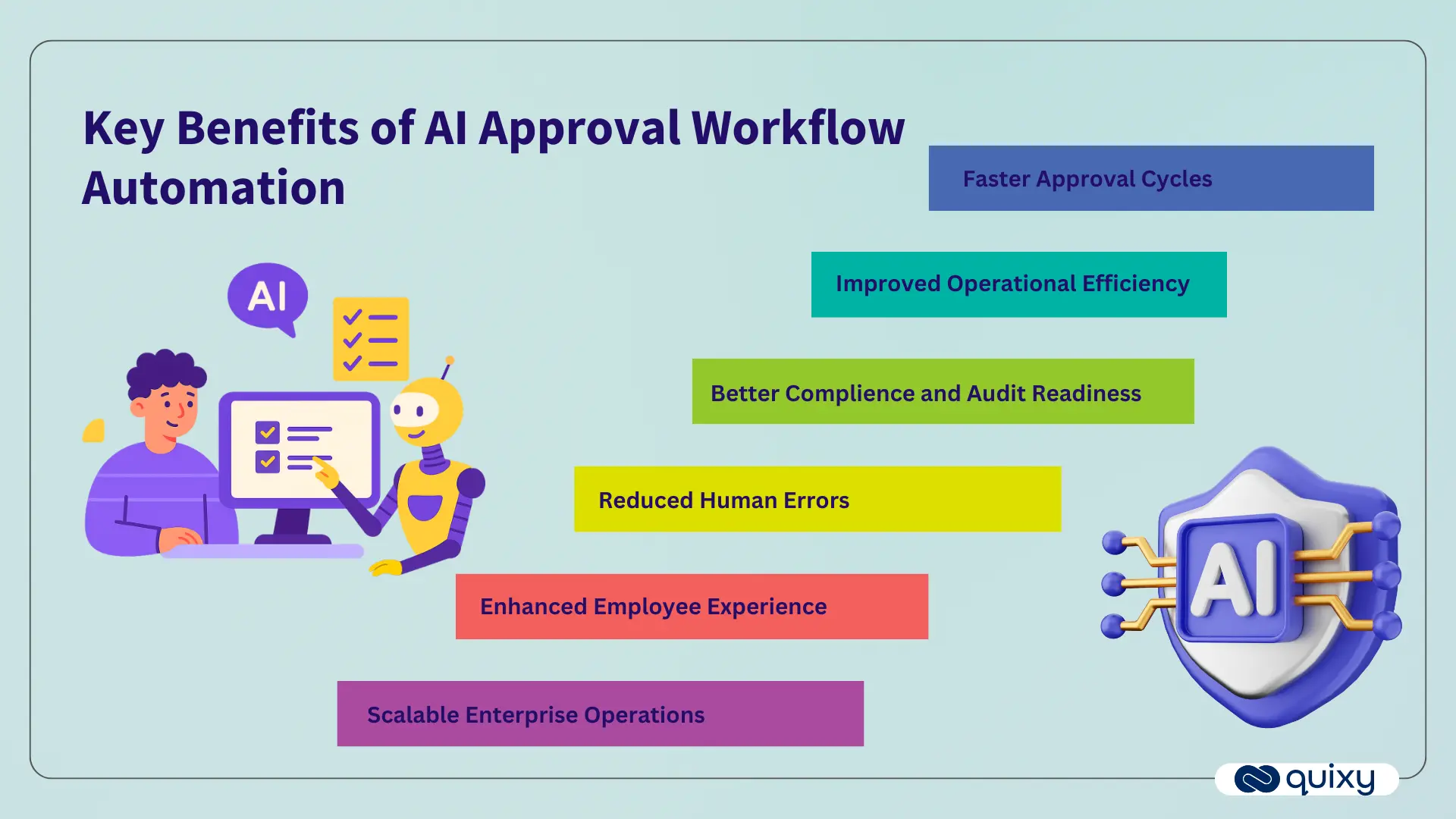
Organizations investing in enterprise workflow automation often see measurable improvements across productivity, compliance, and operational efficiency.
Faster Approval Cycles
AI eliminates delays caused by manual routing, follow-ups, and repetitive reviews. Approval turnaround times can reduce from days to hours.
Improved Operational Efficiency
Automation minimizes repetitive administrative work, allowing teams to focus on strategic tasks instead of manual approvals.
Better Compliance and Audit Readiness
AI-driven workflows create centralized approval records with timestamps, approval history, and audit trails.
This is especially important for industries with strict compliance requirements such as finance, healthcare, manufacturing, and government operations.
Reduced Human Errors
Automated workflows reduce:
- Incorrect routing
- Missing approvals
- Data entry errors
- Duplicate processing
Enhanced Employee Experience
Employees benefit from:
- Faster responses
- Transparent approval tracking
- Self-service request submissions
- Automated notifications
This improves overall workplace productivity.
Scalable Enterprise Operations
As organizations grow, AI workflows can handle increasing approval volumes without adding administrative overhead.
How Are Enterprises Using AI for Multi-Level Approval Workflows?
Large enterprises often have complex approval hierarchies involving multiple departments, conditions, and compliance checks. AI simplifies these multi-step workflows using intelligent routing logic.
For example, an enterprise procurement workflow may include:
| Approval Stage | AI Automation Capability |
| Request Submission | Validate data automatically |
| Budget Check | Match against financial policies |
| Manager Approval | Route based on hierarchy |
| Compliance Review | Detect policy risks |
| Procurement Approval | Prioritize based on urgency |
| Final Authorization | Trigger downstream workflows |
AI ensures approvals move efficiently without requiring employees to manually coordinate every stage.
What Features Should Enterprises Look for in AI Workflow Automation Software?
Choosing the right AI workflow automation platform depends on enterprise requirements, scalability, compliance needs, and integration capabilities.
Intelligent Workflow Routing
The system should automatically assign approvals based on:
- Roles
- Rules
- Business conditions
- Historical patterns
AI-Based Analytics and Insights
Enterprises should look for platforms that provide:
- Workflow performance metrics
- Bottleneck analysis
- Approval trend insights
- Predictive recommendations
Integration Capabilities
Workflow systems should integrate with:
- ERP platforms
- CRM systems
- HRMS software
- Accounting tools
- Collaboration platforms
No-Code or Low-Code Workflow Design
Many enterprises prefer no-code workflow automation to allow business teams to build and modify workflows without heavy IT dependency.
Security and Compliance Controls
Strong approval systems must include:
- Role-based access controls
- Audit logs
- Compliance reporting
- Data encryption
What Are the Common Challenges in AI Approval Workflow Implementation?
Although AI workflow automation delivers major operational benefits, enterprises still face implementation challenges.
Resistance to Process Change
Employees and managers may hesitate to trust automated approval systems initially.
Organizations often address this through:
- Training programs
- Change management strategies
- Gradual workflow adoption
Poor Workflow Standardization
AI systems work best when processes are clearly defined. Enterprises with inconsistent workflows may struggle during implementation.
Data Quality Issues
AI-based workflows depend heavily on accurate data. Incomplete or inconsistent data can reduce automation accuracy.
Integration Complexity
Connecting workflow systems with legacy enterprise applications can require additional planning and customization.
How Can Enterprises Successfully Automate Approval Workflows With AI?
Successful implementation depends on aligning automation with operational goals rather than automating every process immediately.
Start With High-Volume Approval Processes
Enterprises should begin with repetitive workflows such as:
- Expense approvals
- Procurement requests
- Employee onboarding
- IT access approvals
These areas usually deliver quick efficiency gains.
Standardize Workflow Rules
Clearly define:
- Approval hierarchies
- Escalation paths
- Business rules
- Compliance requirements
This improves automation consistency.
Use AI for Assistance Before Full Automation
Many organizations initially use AI for:
- Recommendations
- Prioritization
- Risk detection
before enabling full autonomous approvals.
Monitor Workflow Performance Continuously
Track metrics such as:
- Approval turnaround time
- Workflow completion rate
- Rejection frequency
- Operational cost savings
Continuous optimization improves long-term automation success.
Can AI Approval Workflows Replace Human Decision-Making?
AI approval workflows are designed to augment human decision-making rather than eliminate it entirely.
For low-risk and repetitive tasks, AI can automate approvals completely. However, complex decisions involving strategy, legal interpretation, or sensitive financial matters still require human oversight.
The most effective enterprise workflows combine:
- AI-driven automation
- Human approvals for exceptions
- Real-time analytics
- Compliance monitoring
This creates a balanced and scalable operational model.
What Is the Future of AI-Powered Approval Workflow Automation?
The future of enterprise AI automation is moving toward more adaptive and autonomous workflows.
Emerging trends include:
- AI copilots for workflow assistance
- Conversational approval interfaces
- Predictive process orchestration
- Hyperautomation across departments
- AI-generated workflow recommendations
- Intelligent compliance monitoring
As AI capabilities mature, approval workflows will become more context-aware, proactive, and personalized to business operations.
Conclusion
Enterprises are increasingly adopting AI workflow automation to modernize approval processes, reduce operational bottlenecks, and improve decision-making efficiency. From finance and procurement to HR and IT operations, AI-powered approval workflows help organizations streamline repetitive tasks while maintaining compliance and governance.
As approval volumes continue to grow across enterprise operations, intelligent workflow automation provides the scalability businesses need to operate faster and more efficiently. Organizations that combine AI-driven process automation with clear workflow governance, standardized approvals, and continuous optimization are better positioned to improve productivity, reduce delays, and support long-term digital transformation initiatives.
Frequently Asked Questions
What is AI approval workflow automation?
AI approval workflow automation uses artificial intelligence to automate business approval processes such as expense approvals, procurement requests, HR workflows, and compliance reviews. AI improves routing, decision-making, prioritization, and workflow efficiency while reducing manual intervention.
How does AI improve enterprise approval workflows?
AI improves approval workflows by automating repetitive tasks, reducing delays, detecting risks, prioritizing requests, and providing real-time workflow insights. This helps enterprises accelerate approvals while improving operational accuracy and compliance.
Which departments benefit most from AI workflow automation?
Departments that handle repetitive approval processes benefit the most, including finance, HR, procurement, legal, compliance, and IT operations.
Can AI automate multi-level approval workflows?
Yes. AI can automate complex multi-level approval workflows by routing requests dynamically based on business rules, hierarchy structures, compliance conditions, and workflow priorities.
What are the benefits of workflow automation for enterprises?
Key benefits include faster approvals, improved productivity, reduced operational costs, better compliance tracking, fewer manual errors, and enhanced employee experience.


Recent Posts





- Download the App