
Artificial intelligence has already reshaped the way businesses operate. Over the past decade, organizations have embraced AI-powered analytics, machine learning models, and generative AI tools to automate tasks, extract insights from data, and support decision-making. But a new wave of innovation is now pushing AI far beyond assistance and into autonomy.
Enter Agentic AI.
Unlike traditional AI systems that simply respond to commands or generate outputs when prompted, agentic AI systems can independently plan, execute, and adapt actions to achieve defined goals. Instead of functioning like tools waiting for instructions, they behave more like digital agents capable of reasoning, taking initiative, and learning from outcomes.
This shift represents a major transformation in enterprise technology. Businesses are no longer limited to using AI as a productivity assistant. They can now deploy intelligent agents capable of managing workflows, coordinating tasks across systems, and continuously optimizing operations.
Consider how organizations currently operate. Many processes still require employees to move information between systems, analyze data, approve workflows, and respond to operational issues. Even with automation tools, these workflows often remain fragmented and reactive.
Agentic AI changes this dynamic.
By combining advances in large language models, automation frameworks, and enterprise integrations, organizations can create AI systems that actively pursue business goals rather than simply executing individual tasks. These agents can monitor environments, make decisions based on real-time information, and coordinate multiple actions across digital systems.
For enterprises navigating increasing operational complexity, this capability is becoming invaluable.
From IT operations and supply chain management to healthcare coordination and customer service, agentic AI is emerging as a powerful driver of efficiency and innovation. Organizations that successfully integrate these autonomous AI systems into their workflows are likely to gain significant advantages in speed, adaptability, and productivity.
As businesses continue their digital transformation journeys, agentic AI is quickly moving from an experimental concept to a practical tool for managing modern enterprise operations.
In fact, Gartner predicts that by 2026, 40% of enterprise applications will be integrated with task-specific AI agents, up from less than 5% today.
What is Agentic AI?
At its core, it refers to artificial intelligence systems that can autonomously pursue goals by planning actions, making decisions, and learning from results.
Instead of simply generating responses or predictions, these systems function as independent agents capable of executing multi-step tasks across different tools and platforms.
A useful way to understand agentic AI is to compare it to a digital project manager. When given a goal, the system can determine what steps are required, identify relevant information, coordinate actions, and adjust its strategy based on outcomes.
Most of the systems operate through four key capabilities:
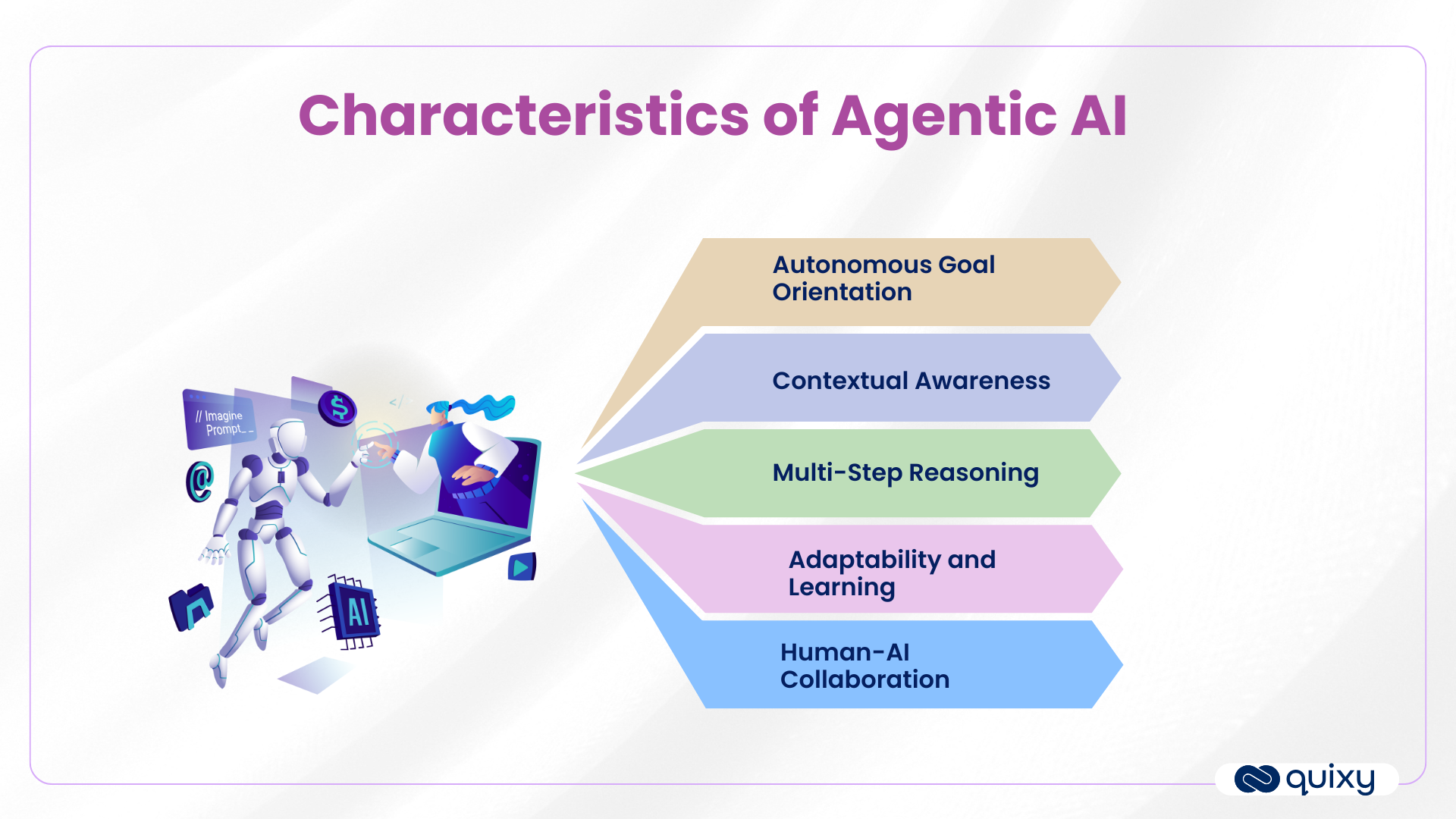
Understanding Goals
The system begins by interpreting the objective it has been assigned. This goal might involve completing a workflow, analyzing a dataset, responding to customer inquiries, or managing operational tasks.
Instead of performing a single predefined function, the AI understands the broader outcome it needs to achieve.
Planning Tasks
Once the goal is understood, the agent creates a plan. It identifies the steps required to reach the objective and determines the order in which those tasks should be executed.
This planning ability allows agentic AI to break complex processes into manageable actions.
Taking Actions
After planning, the AI agent begins executing tasks. This may involve interacting with enterprise applications, retrieving information, sending notifications, triggering workflows, or generating reports.
Unlike traditional automation systems, agentic AI can dynamically adjust its actions based on changing conditions.
Learning From Outcomes
Finally, agentic AI systems continuously learn from the results of their actions. By analyzing what worked and what didn’t, they refine their future decisions and improve their performance over time.
This feedback loop enables these agents to become increasingly effective at achieving their goals.
Together, these capabilities transform AI from a reactive assistant into a proactive digital agent that can operate within complex enterprise environments.

Also Explore: Empowering Workflows and Business Rules with Agentic AI
Difference between Agentic AI vs Generative AI
GeOne of the most common sources of confusion in the AI landscape is the difference between agentic AI and generative AI.
While both rely on advanced machine learning models, their purpose and capabilities are fundamentally different.
Generative AI focuses on creating content, such as text, images, or code. Agentic AI focuses on achieving goals by executing actions.
The following table highlights the key differences.
| Feature | Generative AI | Agentic AI |
|---|---|---|
| Primary Purpose | Generate content based on prompts | Achieve goals by planning and executing tasks |
| Autonomy | Low – requires user prompts | High – operates independently once goals are defined |
| Decision-Making | Minimal reasoning | Continuous decision-making based on context |
| Task Execution | Produces outputs like text, images, or code | Executes workflows and interacts with systems |
| Adaptability | Limited to prompt-response interactions | Learns from outcomes and adjusts strategies |
Generative AI tools have become extremely popular because they help individuals write emails, draft reports, create images, and generate code quickly.
However, these tools typically remain reactive. They wait for a user prompt and produce an output.
Agentic AI takes things a step further.
Instead of simply generating information, an AI agent can use that information to perform actions, coordinate tasks, and continuously pursue a goal without constant human intervention.
In many enterprise environments, the two technologies actually complement each other. Generative AI can produce insights, while agentic AI uses those insights to drive real-world operations and workflows.
Also read: Why AI Agents as Digital Teammates Are the Ultimate Upgrade to No-Code
How Does Agentic AI Work?
To truly grasp the power of Agentic AI, you need to understand its process. Unlike traditional AI, which reacts to inputs, Agentic AI follows a structured flow—similar to how you or I would plan and complete a task.
Here’s the step-by-step process:
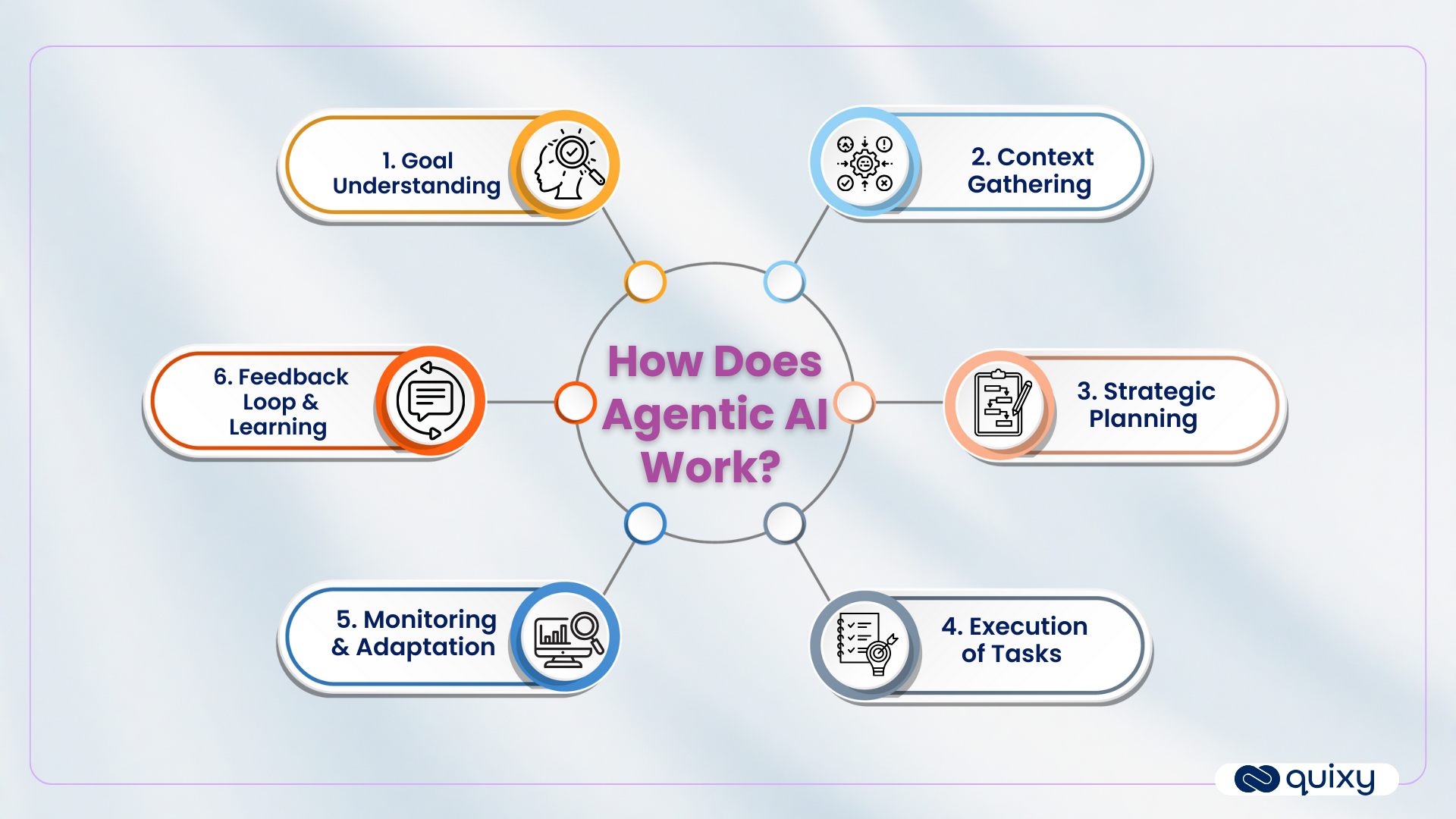
1. Goal Understanding
The journey starts when you set a goal or objective. Agentic AI interprets this input—whether it’s “optimize customer support,” “automate report generation,” or “plan a marketing campaign.” It doesn’t just take the command literally; it understands the intent behind it.
2. Context Gathering
Next, Agentic AI scans the available data, tools, and systems it has access to. This could include your CRM, ERP, or external APIs. By doing this, it builds context awareness, ensuring the decisions it makes are relevant to your environment.
3. Strategic Planning
Once the goal and context are clear, Agentic AI breaks the objective into smaller steps. Think of it as creating a mini project plan—deciding what actions to take, in what order, and with what resources.
4. Execution of Tasks
This is where the real difference shines. Agentic AI doesn’t just tell you what should be done—it actually does it. From sending emails to updating databases or even booking resources, the system executes tasks autonomously.
5. Monitoring and Adaptation
No plan is perfect. That’s why Agentic AI constantly monitors the outcomes of its actions. If something changes—like a customer’s request, a system error, or a new constraint—it adapts in real time, adjusting its path to stay aligned with the goal.
6. Feedback Loop and Learning
Finally, Agentic AI learns from every action. Just like a human gains experience, it uses feedback from results to refine its future decisions, becoming smarter and more efficient over time
Also Read: 8 Real-World Examples of Agentic AI: From Hype to Measurable Results
Why Agentic AI Is Rising Now
Although the concept of autonomous AI agents has existed for years, several technological and business factors have recently accelerated the adoption of agentic AI.
Breakthroughs in Large Language Models
Advances in large language models have dramatically improved AI’s ability to understand natural language, interpret complex instructions, and generate logical reasoning steps.
These capabilities make it possible for AI systems to analyze goals, interpret context, and plan actions more effectively than ever before.
Also Read: AI Agents in Workflows: Replacing Manual Approvals With Configured Decisions
Growing Demand for Enterprise Automation
Organizations are under constant pressure to increase efficiency and reduce operational costs.
Traditional automation tools can handle simple, rule-based tasks, but they struggle with workflows that require judgment, contextual understanding, or dynamic decision-making.
Agentic AI fills this gap by enabling automation of complex, multi-step processes.
Increasing Operational Complexity
Modern enterprises rely on dozens—or even hundreds—of digital systems. Managing workflows across these platforms can create significant friction and delays.
Agentic AI can act as a coordination layer, connecting systems and orchestrating tasks across applications.
Real-Time Decision Requirements
In industries such as logistics, healthcare, finance, and IT operations, decisions often need to be made in real time.
Agentic AI systems can continuously monitor data streams and respond to emerging situations without waiting for manual intervention.
Supporting Market Data
Industry analysts expect autonomous AI agents to play a growing role in enterprise operations. According to recent technology forecasts, AI-driven automation is projected to significantly increase productivity across knowledge work and operational processes in the coming decade.
This combination of technological readiness and business demand is accelerating the rise of agentic AI.
Also Read: Real ROI of AI Agents: Quantifying Time Saved, Approvals Accelerated, and Errors Eliminated
Agentic AI in Action
While agentic AI may sound futuristic, many organizations are already exploring its applications across different industries.
Healthcare
In healthcare environments, AI agents can coordinate patient scheduling, monitor treatment workflows, and ensure that medical records and diagnostic results are properly routed to relevant providers.
By managing these administrative tasks, agentic AI can help healthcare professionals focus more on patient care.
Logistics and Supply Chains
Logistics companies are experimenting with AI agents that monitor inventory levels, track shipments, and automatically adjust supply chain plans when disruptions occur.
These systems can analyze real-time data to identify potential delays and recommend alternative routes or suppliers.
IT Operations
In IT environments, agentic AI can monitor system performance, detect anomalies, and automatically initiate troubleshooting workflows.
Instead of waiting for engineers to manually investigate issues, the AI agent can analyze logs, identify root causes, and trigger corrective actions.
As adoption continues to grow, these examples are likely to expand across many other industries.
Want to see it in action? Watch this quick demo we presented at CDP AI Spotlight 2025 to experience how Quixy’s Agentic AI-powered workflows transform project management in real time.
Also Read: Real-World Agentic AI Use Cases to Inspire Your Automation Strategy
Conclusion: The Future Is Agentic—Are You Ready?
Agentic AI is no longer a concept—it’s the upgrade your business needs to move from reactive to proactive. The question is simple: will you just read about it, or experience it?
Schedule a demo with our experts today and see how you can build your own Agentic AI—tailored to your workflows, driving real outcomes.
Frequently Asked Questions(FAQs)
Q. Is Agentic AI meant to replace humans at work?
No. Agentic AI is designed to collaborate with humans, not replace them. It takes over repetitive, time-consuming tasks so that people can focus on strategic, creative, and relationship-driven work.
Q. How does Agentic AI actually work inside a business process?
It starts by understanding a goal, gathers context from your systems, creates a step-by-step plan, executes tasks, adapts if conditions change, and learns from outcomes. Essentially, it follows the same logical steps a human would—just faster and at scale.
Q. Why should businesses adopt Agentic AI now instead of waiting?
Because the shift is already happening. Gartner predicts that by 2026, 40% of enterprise applications will include Agentic AI. Early adopters gain a competitive edge in efficiency, speed, and adaptability.
Q. Can non-technical teams use Agentic AI, or is it just for IT?
With platforms like Quixy, non-technical users can build workflows enhanced with Agentic AI. That means business teams, not just IT, can directly create and manage intelligent automation.
Q. What’s the biggest risk of sticking with traditional AI tools?
Traditional AI is reactive—it waits for prompts and requires supervision. This slows down processes and leaves room for errors. Without Agentic AI, businesses risk falling behind competitors who automate end-to-end intelligently.
Related Post

Please login to comment
0 Comments
Oldest
Recent Posts





- Download the App