

Digital transformation promises faster operations, better customer experiences, improved data visibility, and more agile business models. But for many organizations, the journey is more complex than expected.
The biggest digital transformation challenges are rarely about technology alone. They often come from legacy systems, unclear strategy, disconnected processes, cultural resistance, security concerns, limited digital skills, and weak change management.
In 2026, transformation success depends on how well businesses can align people, processes, data, governance, and technology. Investing in digital tools is only one part of the journey. The real challenge is turning digital ambition into measurable business outcomes.
This article explores the top challenges of digital transformation, the common digital transformation risks and challenges, and practical ways organizations can overcome them with better planning, workflow automation, governance, and no-code execution.
Why Digital Transformation Fails: A Closer Look at the Real Struggles
Digital transformation failure often happens when organizations treat transformation as a technology upgrade instead of a business change initiative.
Many projects begin with strong intent but lose momentum because the execution model is unclear. Teams may adopt new tools without understanding which processes need to change, how data will flow, who owns decisions, or how success will be measured.
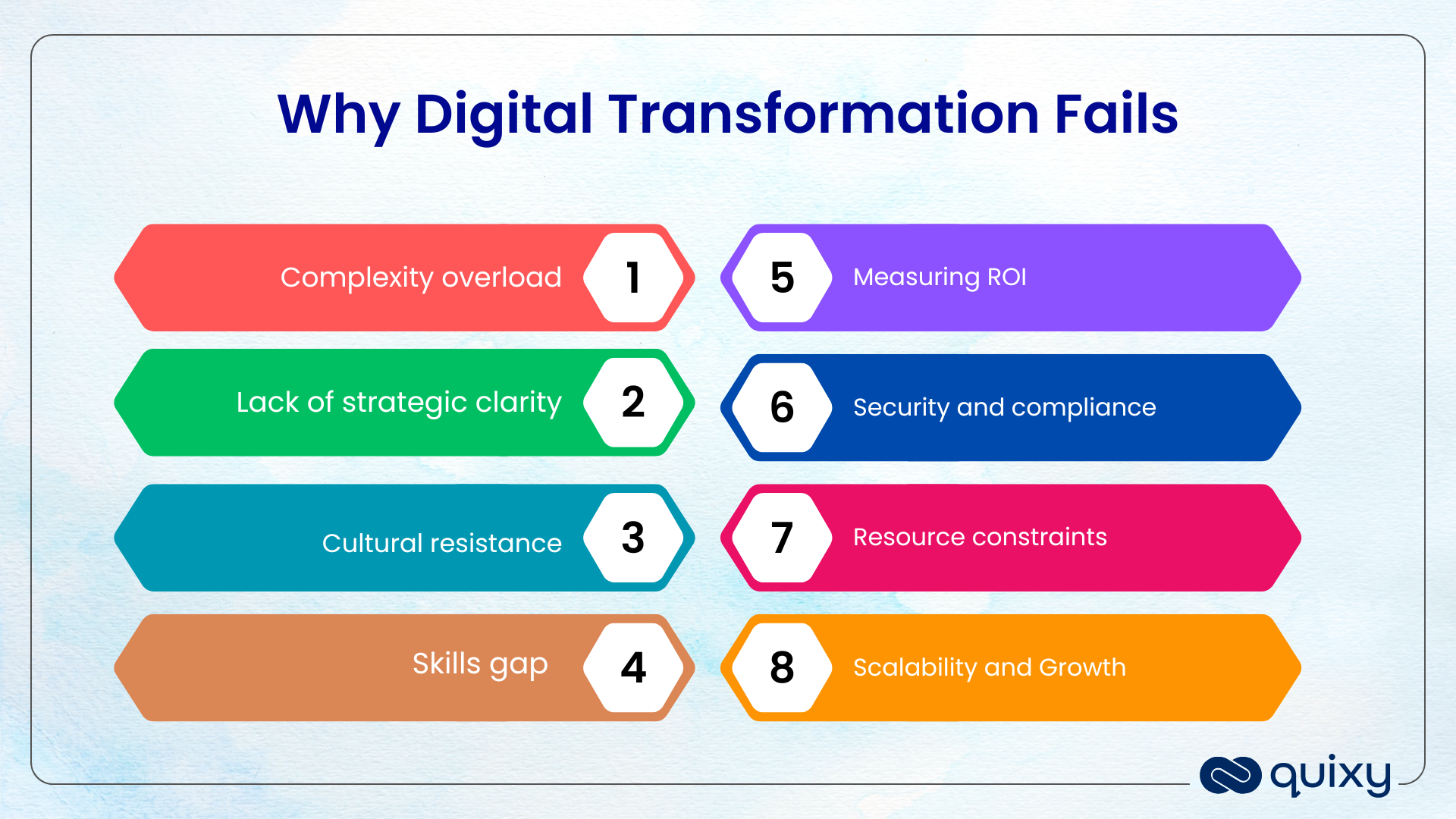
Common reasons behind digital transformation problems include:
- Legacy systems that are difficult to integrate
- Lack of alignment between business and IT teams
- Poor process visibility
- Weak leadership ownership
- Resistance from employees
- Limited digital skills
- Security and compliance concerns
- Unclear ROI measurement
Also Read: 20+ Most Mind-Blowing Examples of Digital Transformation
Digital transformation problem statement
A clear digital transformation problem statement helps organizations define what they are trying to solve before choosing tools or platforms.
For example, the problem may not be “we need new software.” The real problem may be slow approvals, scattered data, poor customer response time, manual reporting, weak process visibility, or compliance gaps.
When businesses define the problem clearly, they can separate surface-level digital problems from deeper operational issues. This makes it easier to prioritize the right initiatives, reduce risk, and measure transformation success.
Top 7 Challenges of Digital Transformation (with Real-World Relevance)
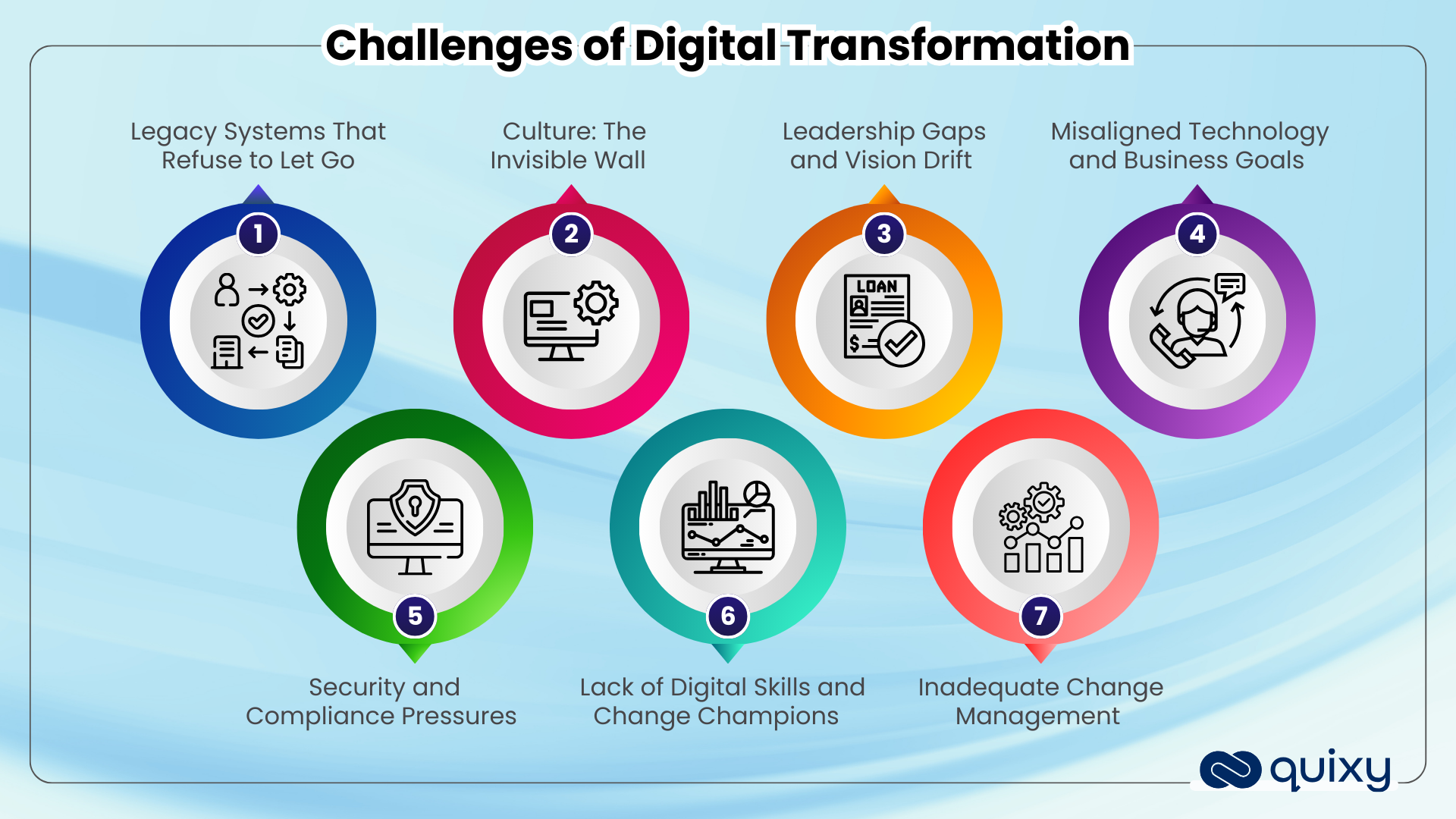
Challenges in digital transformation vary by industry, company size, and technology maturity. However, most organizations face a similar pattern of barriers: old systems, fragmented data, unclear ownership, low adoption, and difficulty proving ROI.
The following are the most common challenges to digital transformation and how businesses can address them.
1. Legacy systems that slow modernization
Legacy systems are one of the most common digital transformation challenges. Older systems may be difficult to integrate, expensive to maintain, and unable to support real-time data or modern workflows.
The challenge is not always replacing legacy systems immediately. In many cases, businesses need to bridge the gap between existing infrastructure and new digital processes.
A practical solution is to use workflow automation, APIs, and no-code platforms to connect processes, reduce manual work, and modernize gradually without disrupting core operations.
2. Cultural resistance to change
Cultural resistance is a major digital transformation challenge because transformation changes how people work.
Employees may resist new systems because they are comfortable with existing processes, unsure about new responsibilities, or worried that automation will replace their roles.
Organizations can reduce resistance by involving employees early, explaining the purpose of transformation, offering training, and showing how new workflows make daily work easier.
3. Leadership gaps and unclear vision
Leadership gaps create serious challenges with digital transformation because different departments may move in different directions.
One team may focus on customer experience, another on automation, and another on cost reduction, without a shared roadmap or governance model.
Leaders should define transformation goals, assign ownership, prioritize initiatives, and connect every digital project to measurable business outcomes.
4. Lack of digital skills and change champions
A lack of digital skills creates practical digitalization challenges because employees may not know how to use new systems effectively.
This also increases dependency on IT teams and slows down execution.
Businesses can address this by upskilling employees, creating cross-functional transformation teams, and using no-code or low-code tools that allow business users to participate in process improvement while IT maintains governance.
5. Inadequate change management
Poor change management is one of the most common reasons for digital transformation failure.
Even well-designed digital solutions can fail if employees do not adopt them.
A strong change management approach includes stakeholder communication, training, feedback loops, adoption tracking, support resources, and continuous improvement.
6. Security, compliance, and data risks
As organizations digitize more processes, they also face greater risks of digital transformation, including data exposure, access control issues, privacy gaps, and compliance failures.
These data transformation challenges become especially important when businesses move information from spreadsheets, paper forms, or legacy systems into digital workflows.
Businesses should build security into transformation initiatives from the start. This includes role-based access, audit trails, data controls, approval rules, secure integrations, and compliance reporting.
7. Misaligned technology and business goals
A common digital transformation problem is choosing tools before clearly defining the business outcome.
When technology is implemented without clear business alignment, it can create more complexity instead of solving operational issues.
Every initiative should answer three questions:
- What business problem are we solving?
- Which process or workflow will improve?
- How will success be measured?
This keeps transformation focused on outcomes rather than software adoption.

Digital transformation challenges and opportunities
While the challenges are real, they also create opportunities for businesses to modernize more intelligently.
Legacy systems can become an opportunity to improve process integration. Resistance to change can become an opportunity to build stronger employee engagement. Data silos can become an opportunity to create better visibility. Security concerns can become an opportunity to build stronger governance.
The key is to treat digital transformation challenges and opportunities together. Businesses that identify risks early can build stronger, more practical transformation programs.
Key digital transformation considerations
Before investing in new tools or platforms, businesses should review the most important digital transformation considerations:
- What business problem are we solving?
- Which workflows are most affected?
- What data needs to move between systems?
- Who will own the process?
- How will employees adopt the change?
- What security and compliance controls are needed?
- How will ROI be measured?
These questions help organizations reduce risk and avoid scattered technology adoption.
How Quixy helps businesses overcome digital transformation challenges
Overcoming digital transformation challenges requires more than ambition. Businesses need a practical way to modernize processes, automate workflows, improve visibility, and maintain governance.
Quixy helps organizations address these challenges through no-code workflow automation and custom application development.
With Quixy, teams can:
- Digitize manual processes
- Automate approvals and task routing
- Build custom workflow applications
- Reduce dependency on spreadsheets and emails
- Improve process visibility through dashboards
- Maintain role-based access and audit trails
- Support gradual modernization without disrupting existing systems
- Enable business users to participate in digital execution
This helps organizations move from scattered transformation efforts to structured, measurable, and governed digital workflows.
Also Read: Challenges Faced by IT in Digital Evolution
Also Read: How Quixy Can Help You with Digital Transformation
Final Takeaway: Every Challenge Has a Solution
The challenges of digital transformation are real, but they are not impossible to overcome.
Most transformation problems come from unclear execution, legacy systems, disconnected processes, poor adoption, weak governance, and limited visibility. Businesses that address these issues early are more likely to turn digital strategy into measurable outcomes.
Successful transformation requires a practical roadmap, strong leadership, employee adoption, secure systems, and continuous performance tracking.
The goal is not simply to adopt more technology. The goal is to build a more connected, automated, and resilient business.
👉 Schedule a free demo with Quixy and explore how we can co-create your transformation story – one innovative solution at a time.
Frequently Asked Questions(FAQs)
Q. What’s the most common challenge in digital transformation?
One of the most challenging hurdles is resistance to change – especially from teams and leaders who are comfortable with existing workflows and skeptical of adopting unfamiliar digital tools or practices.
Q. How can organizations reduce the challenges of digital transformation?
Overcoming digital transformation challenges requires a strong commitment from leadership, employee buy-in, targeted training, adaptable strategies, and choosing the right technology stack that aligns with business goals.
Q. Do legacy systems hinder digital transformation?
Yes. Legacy systems are often rigid, poorly integrated, and challenging to scale. They can create serious roadblocks when introducing modern solutions or building agile, connected operations.
Q. How do you track whether digital transformation is working?
The success of a transformation is typically measured through key performance indicators (KPIs) such as operational efficiency, customer satisfaction, process automation levels, cost savings, and adoption rates across the organization.
Q. Why does company culture matter in digital transformation?
Culture is the foundation. A culture that encourages experimentation, collaboration, and openness to change significantly increases the chances of successful digital transformation.
Related Post



Please login to comment
0 Comments
Oldest
Recent Posts







- Download the App