

Most conversations about manufacturing efficiency start with machines — faster lines, better sensors, predictive maintenance. But talk to any plant manager who has actually tried to move the needle on efficiency, and a different story comes up. The line isn’t the bottleneck. The paperwork is. The approval that sits in someone’s inbox for two days. The quality check that’s still tracked on a clipboard. The production data that lives in three different spreadsheets nobody trusts.
Manufacturing efficiency is as much a process problem as it is a machine problem, and it’s the process side that most efficiency guides skip.
What Is Manufacturing Efficiency?
Manufacturing efficiency is the measure of how effectively a plant converts inputs like labor, materials, time, and machine capacity into finished output, with minimal waste, downtime, and rework. It’s typically expressed through metrics like Overall Equipment Effectiveness (OEE), throughput, cycle time, and first-pass yield.
Unplanned downtime now costs the world’s 500 largest companies roughly $1.4 trillion a year — about 11% of their total revenue.
A plant can look efficient on a machine-utilization dashboard and still lose enormous value in the process layer sitting around those machines — the approvals, handoffs, and manual data entry that connect the shop floor to the rest of the business.

Why Manufacturing Efficiency Is Harder to Improve Than It Looks
Most manufacturing efficiency initiatives focus on the production line itself: better scheduling, predictive maintenance, tighter quality control. Those matter. But they solve for machine efficiency, not organizational efficiency.
The bigger, less-discussed drag on efficiency is what happens around the machines:
- Production data entered manually into spreadsheets after a shift ends, instead of captured in real time
- Maintenance requests routed through email, with no visibility into status or SLA
- Quality holds and non-conformance reports that take days to reach the people who need to act on them
- Multi-step approvals for material requisitions, change orders, or shift handoffs that depend on someone being at their desk
None of these show up on an OEE dashboard. All of them quietly erode efficiency, and none of them get fixed by buying a better sensor.
McKinsey’s research on factory digital twins found that real-time visibility into production data has allowed manufacturers to uncover hidden bottlenecks that traditional periodic reporting missed entirely, in one case cutting total processing time by roughly 4%.
How to Track Manufacturing Efficiency
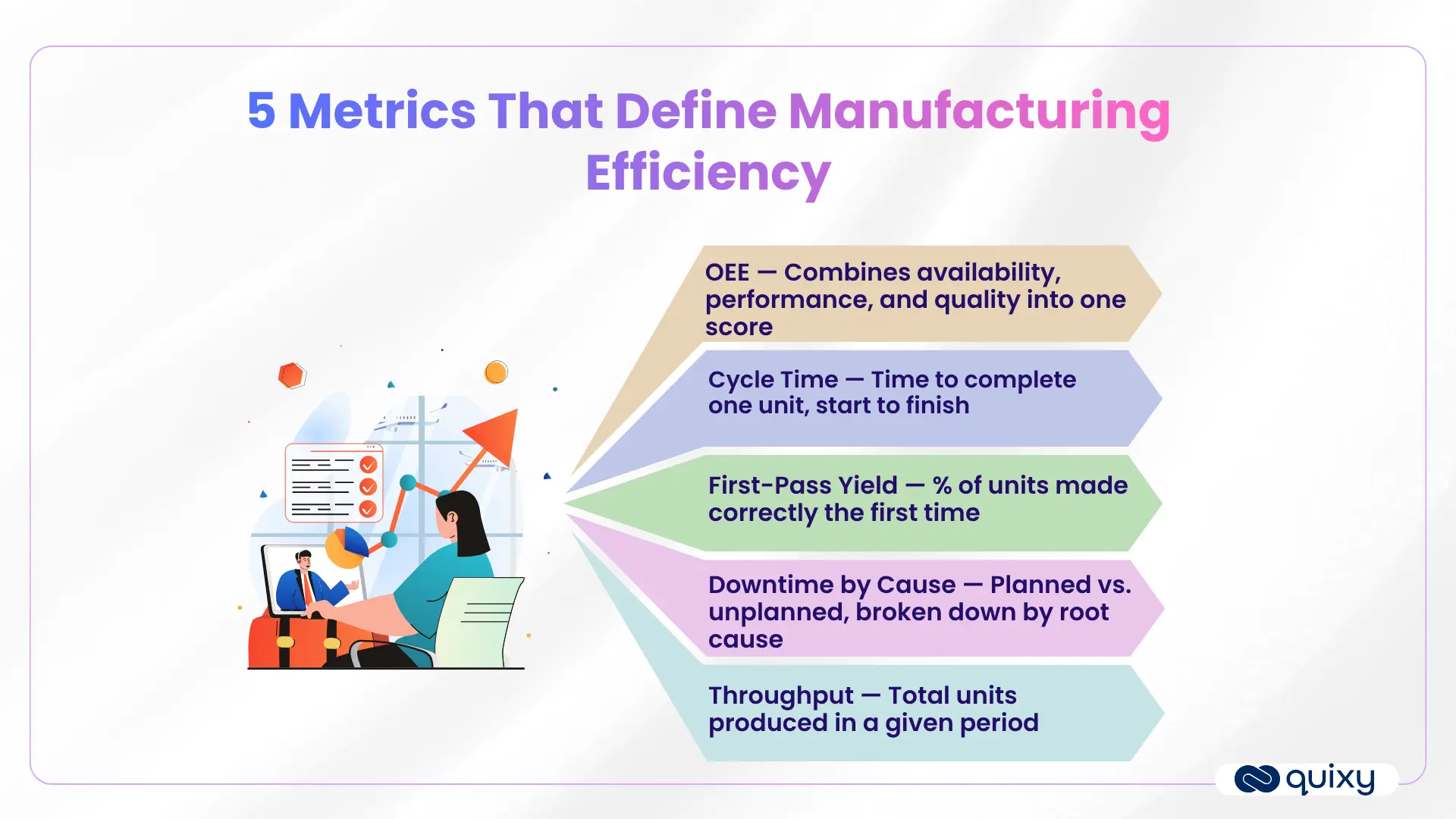
Tracking manufacturing efficiency starts with a small set of core metrics, but the metric only matters if the underlying data is accurate and current. Most plants have the right KPIs and the wrong data pipeline feeding them.
The core metrics to track
- OEE (Overall Equipment Effectiveness): combines availability, performance, and quality into a single efficiency score
- Cycle time: how long it takes to complete one unit of production, start to finish
- First-pass yield: the percentage of units produced correctly the first time, without rework
- Downtime by cause: planned vs. unplanned downtime, broken down by root cause (maintenance, changeover, material shortage, etc.)
- Throughput: total units produced in a given time period
Where tracking actually breaks down
These metrics are only as good as the data feeding them, and in most plants that data still arrives late, incomplete, or manually re-entered. A machine can report uptime in real time, but if the reason for a stoppage still gets logged on a paper form at the end of a shift, the efficiency data is already stale by the time anyone sees it. Reliable tracking depends on capturing the operational context — not just the sensor data — at the moment it happens.
This is where a workflow layer, not another dashboard, tends to be the missing piece. Digitizing downtime logging, maintenance requests, and shift handoffs into a structured, timestamped workflow gives efficiency metrics the real-time, accurate inputs they need.
How Data Visibility Helps Manufacturing Efficiency
Data visibility helps manufacturing efficiency by closing the gap between when a problem happens on the floor and when the right person can act on it. Without visibility, issues are discovered in a weekly report, days after they’ve already cost the plant time and output. With visibility, the same issue triggers an alert, an assignment, and an escalation path within minutes.
Concretely, better data visibility improves efficiency in three ways:
- Faster root-cause response. When downtime, defects, and delays are logged and routed automatically instead of written down and reviewed later, the team addressing the issue has hours of head start instead of days.
- Cross-functional accountability. When maintenance, quality, and production data live in one connected system rather than siloed spreadsheets and paper logs, it’s clear who owns the next step — no chasing people down to find out where a request went.
- Trustworthy metrics. OEE and cycle-time numbers are only useful if leadership trusts them. Automated, timestamped data capture removes the manual re-entry step where errors and delays creep in, which is usually the real reason “the numbers don’t match what’s happening on the floor.”
Visibility isn’t just a reporting upgrade — it’s what turns an efficiency metric from a lagging indicator into something a team can actually act on in the moment.
Also Read: Business Process Optimization (BPO): Definition, Benefits & Proven Techniques
How to Improve Manufacturing Efficiency: A Practical Framework
Improving manufacturing efficiency reliably comes down to four steps: mapping where time and accuracy are actually being lost, digitizing the manual steps in that path, connecting the data those steps generate, and building a feedback loop that keeps improving it. Here’s what that looks like in practice.
1. Map the process, not just the production line
Before automating anything, document the full path a unit — or a request — takes from start to finish, including every handoff, approval, and manual data entry step. Most plants have mapped their production line in detail but have never mapped the maintenance request process, the change-order approval chain, or the shift handoff. That’s usually where the time is actually going.
2. Digitize the manual steps first, not the complex ones
The instinct is to automate the most sophisticated part of the process first. In practice, the highest-ROI targets are usually the most mundane: paper checklists, email-based approvals, spreadsheet-based downtime logs. These are simple to digitize and they’re the steps most responsible for delayed, inaccurate data.
3. Connect the workflow to real-time data capture
Once a process is digitized, it can generate structured, timestamped data automatically — a maintenance request logged the moment it’s raised, a quality hold flagged the moment it’s found, a downtime reason captured the moment the line stops, not at the end of the shift. This is what feeds accurate OEE, cycle-time, and downtime-by-cause metrics without anyone re-entering anything.
Also Read: CAPA Management: 8 Steps, Process & Best Practices
4. Build a visibility layer, then a feedback loop
With clean, real-time data flowing in, the next step is making it visible to the people who can act on it — dashboards for supervisors, automated alerts for maintenance, escalation paths for quality holds. From there, efficiency improvement becomes continuous: recurring downtime causes a spike in the data, gets addressed, and the metric moves.
Also Read: A Proven Path to Digital Transformation in Manufacturing
How to Improve Operational Efficiency in Manufacturing Beyond the Plant Floor
Manufacturing efficiency doesn’t stop at the machines — it extends into procurement, quality management, compliance reporting, and supply chain coordination. A plant can run its production line at near-perfect OEE and still lose days waiting on a purchase order approval, a supplier onboarding process, or a compliance sign-off that’s stuck in an inbox.
Operational efficiency at this level improves the same way process efficiency does on the floor: by replacing manual, paper- or email-based coordination with structured, automated workflows that move information the moment it’s needed rather than the moment someone gets around to it.
Also Read: What is No-Code for Manufacturing ? 10 Exclusive Benefits
Where No-Code Workflow Automation Fits
This is the layer most manufacturing efficiency conversations skip, and it’s exactly where a no-code workflow automation platform earns its place. Quixy lets manufacturing teams digitize the process layer — downtime logging, maintenance requests, quality holds, material requisitions, shift handoffs, compliance reporting — without writing code or waiting on IT development cycles.
Because the platform is no-code, the people who understand the process best — plant supervisors, quality leads, maintenance managers — can build and adjust these workflows themselves, and the data generated feeds real-time dashboards instead of end-of-shift spreadsheets. The result isn’t just faster paperwork. It’s efficiency metrics that reflect what’s actually happening on the floor, in the moment it happens, and a plant that can act on a problem in minutes instead of discovering it in next week’s report.
Frequently Asked Questions (FAQs)
Q. What is manufacturing efficiency?
Manufacturing efficiency measures how effectively a plant converts labor, materials, time, and machine capacity into finished output, with minimal waste and downtime. It’s commonly tracked through metrics like OEE, cycle time, and first-pass yield.
Q. How do you track manufacturing efficiency?
Manufacturing efficiency is tracked using core metrics like OEE, cycle time, first-pass yield, downtime by cause, and throughput — but the metrics are only reliable if the underlying data is captured accurately and in real time, rather than re-entered manually after the fact.
Q. How do you improve manufacturing efficiency?
Improving manufacturing efficiency starts with mapping the full process — not just the production line — digitizing the manual steps that cause delays and errors, connecting that workflow to real-time data capture, and building a visibility layer that lets teams act on problems as they happen.
Q. How does data visibility help manufacturing efficiency?
Data visibility closes the gap between when a problem occurs on the floor and when the right person can respond to it, replacing delayed, manual reporting with real-time alerts, routing, and accountability across production, maintenance, and quality teams.
Q. How do you improve operational efficiency in manufacturing beyond the plant floor?
Operational efficiency beyond the plant floor improves by automating the manual, paper- or email-based coordination in procurement, quality management, and compliance reporting — the same process-digitization approach used on the production line, applied to the rest of the operation.
Related Post



Recent Posts







- Download the App